Let’s start with the surprise: her eyes are wide and blue, the color of the ocean. Mine and my wife’s are thin and dark brown, the color of coffee without cream. They say her eyes can change color up until she’s a year old, and maybe they will. Most of our close family members’ are dark like ours. But until then her eyes, big and blue, will be two unexpected pools of color in our world.
Her eyes don’t open immediately when she wakes up. In fact, it seems like sometimes they’re the last part of her body to know she’s awake. She yawns and stretches and grunts and sometimes even cries all the while her eyes stay closed. Only when she opens them fully do we know that she is ready.
Her eyes are then alerted by her stomach that she’s hungry. Often this happens immediately, seconds after they open, and food has to be made available no matter what her mother is doing. If too much time passes, she will squeeze her eyes tight, like she’s looking for something inside her face, as her mouth opens to scream.
As she eats, her eyes are focused on the task at hand, only taken occasionally by a passerby in the house (her dad) or the weight of sleep. They have no time, no patience, for distractions; eating time is for eating, and everything else will have to wait. Later, often as you are holding her, her eyes will suddenly widen and turn grave, the universal sign for I gotta take a poop. Sure enough, she will let it all out, making no effort to conceal the noise, her eyes serious the whole time.
Once she has eaten, digested, and excreted, her eyes are light, full of life. If you say something she likes—“Are you having fun with Sophie Giraffe?” “Do you love your mama?”—they will squint in delight as her chin falls to her chest and her shoulders rise and her lips curl in a smile. It is a picture of cuteness, of pure glee. If you say something she doesn’t like—“Are you ready for a nap?” “Wanna take a bath?”—they will sink and stare as her lips twist into the cleanest and clearest of frowns. It is a picture of pure disdain.
You will then have to pick her up, which is the time her eyes love the most. From your arms, they search, constantly. They look at lights and other eyes and signs hanging on the wall and ceiling fans. (Oh how they love ceiling fans.) They often look curiously at her parents’ wedding photos behind the couch, scrutinizing them as if to say, Wait, I know those people… For the first couple months of life, they love contrasts, the black-and-white books of shapes you give to her during the ever-important Tummy Time, literally seeing the world in black and white. A month or two later, they will follow you, or your finger, or whatever you’re holding, as you move from one spot to another, an important developmental milestone, you learn, called tracking.
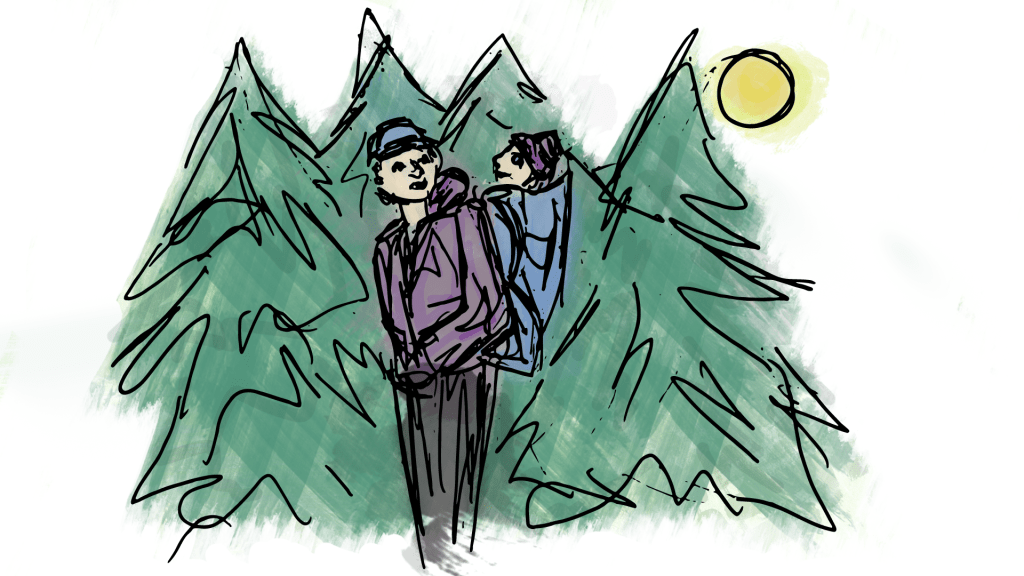
And that’s only inside. Take her outside and her eyes will have, to use the scientific terminology, an absolute field day. (Only after, of course, she theatrically squints and turns her head away from the sun, like a teenage gamer walking outside for the first time in weeks.) Once they are adjusted to the brightness, or shielded by a bucket hat, they get to work. They take in the trees and the mountains and the squirrels and the birds and the rocks and the leaves and the giant empty blue space up above and the green green green all around. Sometimes they dance across her plane of vision, darting from one thing to the next without rest; other times, they stare, endlessly, at some inanimate object, like a chair or a blade of grass. On hikes through the forest, they look straight up, through the canopy of trees, and when you are overcome by curiosity you will do the same and wonder why you don’t do it more often, for the sight is magnificent: streams of blue and light popping through small pockets between the trees. You smile as you realize that your 3-month-old has taught you to look for the beauty in hidden places.
One day her eyes will fill with tears, and it will be sudden and sad. Until then her cries were dry and therefore lacked a certain magnitude; the tears change all of that. They will hop, slowly, down her cheeks when she’s upset and you will think of the lyrics of a song called “The Girl”: When you cry a piece of my heart dies/knowing that I may have been the cause. Often, you will have been the cause: You will have had the audacity to try to get her to take a nap, or put her in the car seat. Her eyes will narrow and blink as you rock her in your arms and she releases full-throated screams, but they will refuse to close until biologically necessary. When they finally do shut, they will look so peaceful you will forget the battle you waged to get her to sleep. From the baby monitor or from the side of her crib, sometimes you will just watch her sleep, and your worries, for those precious minutes, will melt away.
With the exception of her hair, a chaos of dark brown perched wildly atop her head, her eyes, big and blue, are her most defining feature. They search and find and cry and sleep and track and close—and, you will learn, comfort.
One day you will be so worried about keeping her safe during a pandemic that you will be in the bedroom, fighting off tears. From Mom’s arms, her eyes will turn to yours and look at them curiously, as if to wonder, What’s wrong with Dad? They will stare at you for several seconds, paying attention to nothing else around them because they realize that right then you need the full extent of their love. As they continue to stare, you will think of the lyrics to another song, the one that inspired her name—And all I have to do to rise/is look into your eyes—and take her from Mom’s arms. Her eyes, big and blue, will stare up at yours. And they will, not for the last time, help you rise.
Join our mailing list!
Subscribe to the Essays of Dad newsletter, a weekly email with parenting stories, background on essays, book recommendations, and more.
 Essays of Dad
Sweetness. Thanks Robby.
LikeLike