Her Eyes

Illustration by Samantha Harrington

Let’s start with the surprise: her eyes are wide and blue, the color of the ocean. Mine and my wife’s are thin and dark brown, the color of coffee without cream. They say her eyes can change color up until she’s a year old, and maybe they will. Most of our close family members’ are dark like ours. But until then her eyes, big and blue, will be two unexpected pools of color in our world.   

Her eyes don’t open immediately when she wakes up. In fact, it seems like sometimes they’re the last part of her body to know she’s awake. She yawns and stretches and grunts and sometimes even cries all the while her eyes stay closed. Only when she opens them fully do we know that she is ready.

Her eyes are then alerted by her stomach that she’s hungry. Often this happens immediately, seconds after they open, and food has to be made available no matter what her mother is doing. If too much time passes, she will squeeze her eyes tight, like she’s looking for something inside her face, as her mouth opens to scream. 

As she eats, her eyes are focused on the task at hand, only taken occasionally by a passerby in the house (her dad) or the weight of sleep. They have no time, no patience, for distractions; eating time is for eating, and everything else will have to wait. Later, often as you are holding her, her eyes will suddenly widen and turn grave, the universal sign for I gotta take a poop. Sure enough, she will let it all out, making no effort to conceal the noise, her eyes serious the whole time. 

Once she has eaten, digested, and excreted, her eyes are light, full of life. If you say something she likes—“Are you having fun with Sophie Giraffe?” “Do you love your mama?”—they will squint in delight as her chin falls to her chest and her shoulders rise and her lips curl in a smile. It is a picture of cuteness, of pure glee. If you say something she doesn’t like—“Are you ready for a nap?” “Wanna take a bath?”—they will sink and stare as her lips twist into the cleanest and clearest of frowns. It is a picture of pure disdain.

You will then have to pick her up, which is the time her eyes love the most. From your arms, they search, constantly. They look at lights and other eyes and signs hanging on the wall and ceiling fans. (Oh how they love ceiling fans.) They often look curiously at her parents’ wedding photos behind the couch, scrutinizing them as if to say, Wait, I know those people… For the first couple months of life, they love contrasts, the black-and-white books of shapes you give to her during the ever-important Tummy Time, literally seeing the world in black and white. A month or two later, they will follow you, or your finger, or whatever you’re holding, as you move from one spot to another, an important developmental milestone, you learn, called tracking. 

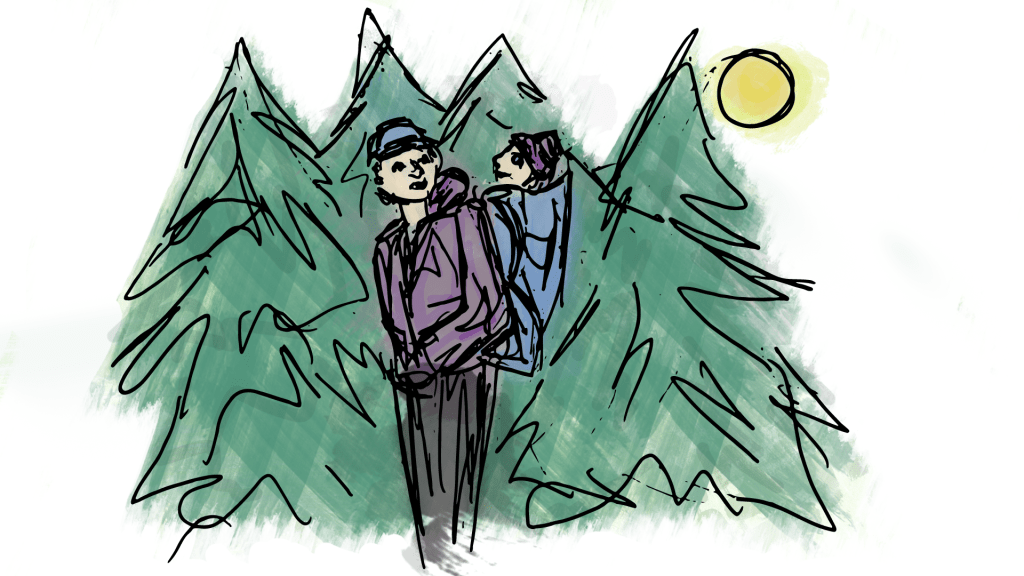
And that’s only inside. Take her outside and her eyes will have, to use the scientific terminology, an absolute field day. (Only after, of course, she theatrically squints and turns her head away from the sun, like a teenage gamer walking outside for the first time in weeks.) Once they are adjusted to the brightness, or shielded by a bucket hat, they get to work. They take in the trees and the mountains and the squirrels and the birds and the rocks and the leaves and the giant empty blue space up above and the green green green all around. Sometimes they dance across her plane of vision, darting from one thing to the next without rest; other times, they stare, endlessly, at some inanimate object, like a chair or a blade of grass. On hikes through the forest, they look straight up, through the canopy of trees, and when you are overcome by curiosity you will do the same and wonder why you don’t do it more often, for the sight is magnificent: streams of blue and light popping through small pockets between the trees. You smile as you realize that your 3-month-old has taught you to look for the beauty in hidden places.

One day her eyes will fill with tears, and it will be sudden and sad. Until then her cries were dry and therefore lacked a certain magnitude; the tears change all of that. They will hop, slowly, down her cheeks when she’s upset and you will think of the lyrics of a song called “The Girl”: When you cry a piece of my heart dies/knowing that I may have been the cause. Often, you will have been the cause: You will have had the audacity to try to get her to take a nap, or put her in the car seat. Her eyes will narrow and blink as you rock her in your arms and she releases full-throated screams, but they will refuse to close until biologically necessary. When they finally do shut, they will look so peaceful you will forget the battle you waged to get her to sleep. From the baby monitor or from the side of her crib, sometimes you will just watch her sleep, and your worries, for those precious minutes, will melt away.

With the exception of her hair, a chaos of dark brown perched wildly atop her head, her eyes, big and blue, are her most defining feature. They search and find and cry and sleep and track and close—and, you will learn, comfort.

One day you will be so worried about keeping her safe during a pandemic that you will be in the bedroom, fighting off tears. From Mom’s arms, her eyes will turn to yours and look at them curiously, as if to wonder, What’s wrong with Dad? They will stare at you for several seconds, paying attention to nothing else around them because they realize that right then you need the full extent of their love. As they continue to stare, you will think of the lyrics to another song, the one that inspired her name—And all I have to do to rise/is look into your eyes—and take her from Mom’s arms. Her eyes, big and blue, will stare up at yours. And they will, not for the last time, help you rise.


Join our mailing list!

Subscribe to the Essays of Dad newsletter, a weekly email with parenting stories, background on essays, book recommendations, and more.
Processing…
Success! You're on the list.

The First Month

Illustration by Samantha Harrington

Maybe, in a few years, we will forget all of this. Maybe, when life speeds up and obligations multiply and priorities shift, we, my wife and I, will forget the small things that made this first month of parenthood the greatest, and fastest, of our lives.

Maybe we will forget eating Jimmy John’s subs in bed at the birth center, fulfilling my wife’s nine-month vision for cold cuts after the restrictions of pregnancy eating had finally, gloriously, been lifted. Maybe we will forget the drive home a few hours later, in the dark of night, as I clutched the steering wheel harder than I ever had and Carly, the new mom, sat in the back seat with the newest member of our family, a sleeping seven-hour-old baby girl named Mayla, speaking to her softly. Maybe we will forget first carrying her blanket into the house so the dogs could familiarize themselves with her scent before she, an intruder, entered the space they’d devoted their lives to protecting. Maybe we will forget that first night, a haze of FaceTiming and unpacking and, finally, sleeping.

Maybe I will forget scooping her from her bassinet as she awoke in the middle of that first night, softly placing her on my chest as I read Lord of the Rings on Kindle. Maybe Carly will forget having to wake up every two to three hours, every night, indefinitely, to feed our growing daughter by lamplight. Maybe I will forget the fruitlessness I felt for not being able to feed her myself and occupying the far less important role of Mid-Feeding Diaper Changer to ensure she’s alert for the second half of her 3 a.m. snack. Maybe we will forget the sporadic, hopeful naps the following afternoons—sleeping, as everyone advises, when your newborn sleeps. Maybe we will forget frantically waking up at 2 a.m. to make sure that she was in the bassinet next to us, that we didn’t doze off with her in our arms in bed. Maybe we will forget, once that panic had passed, touching her sinking and rising chest to make sure she was breathing.

Maybe we will forget the countless appointments, checkups, and weigh-ins with different doctors and specialists, each of them offering a version of the most important truth: Both mom and baby are healthy and strong. Maybe we will forget putting Mayla on the porch to soak up some Vitamin D and reduce her moderately high levels of bilirubin. Maybe we will forget what the heck bilirubin is. Maybe we will forget the gratitude we felt for her first-time grandparents and aunts and uncles, who arrived from out of state to take care of the people taking care of the baby. Maybe we will forget the sheer joy they felt once they held their grandchild or niece for the first time, all of their worries melted away almost instantly.

Maybe we will forget the diapers soiled by yellow, seedy poop, a development that would have been concerning had the doctors not told you it was normal. Maybe we will forget our daughter’s propensity for peeing only when we had removed her diaper before putting on a new one, soiling the changing pad liner more times than we’d ever expected. Maybe we will forget the looks of grim determination or grave concern as she felt, or forced, a bowel movement. Maybe we will forget her first blowout, which somehow resulted in poop coming out the front of her diaper, staining, for good, the clean white shirt she’d been wearing.

Maybe we will forget staring at her, for minutes straight, watching her watch the world, her eyes a window into her days-old mind, trying to decipher what she’s thinking and learning and feeling. Maybe we will forget the furrowed brows and pursed lips and open mouths, or the sudden, instinctual punches and kicks. Maybe we will forget the grunts and moans and squeaks and yawns, the new, adorable soundtrack to our lives. Maybe we will forget her round cheeks and thick hair, her chunky legs and searching eyes. Maybe we will forget her sneezes, full-body contractions that seem to surprise her no matter how many times they come (six in a row one night). Maybe I will forget reading to her in the gray chair in the nursery, feeling her warm milky breath on my chest as she slept or stared out of the window, paying little attention to my reading of dozens of words that rhyme with llama.

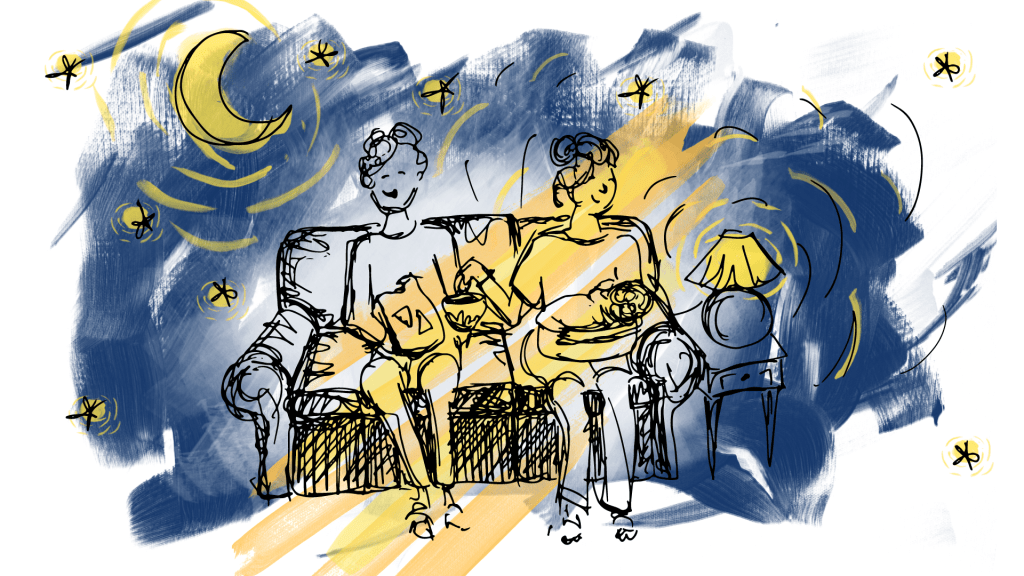
Maybe we will forget the crying, and the challenges of breastfeeding, and the stress and short fuses caused by lack of sleep. Maybe we will forget failing to adhere to any type of schedule because newborns are fickle and need to eat when they need to eat. Maybe I will forget feeding Carly appetizers on the couch as she feeds Mayla, holding a bowl of salsa steady so she can carefully dip tortilla chips into it, a hilarious food chain. Maybe we will forget our realization that they weren’t lying when they said parenting was hard.

Maybe we will forget all of this. Maybe this first month will be nothing more than a fleeting, blurry memory, a series of half-remembered moments that we will embellish with time. Maybe we will look back on them and feel completely different than we do right now.

Or maybe not. Maybe there are some moments that you will remember forever.

Maybe, one night, your daughter will have trouble feeding and your wife will be understandably frustrated, her clothes wet with excess milk. Maybe, as she is upstairs showering and you are in charge of heating up burritos for dinner, your daughter will start crying. Maybe you will pick her up and put on music; as the lyrics came through the speaker, maybe you will look into her wide blue eyes. Maybe they will stare past yours, over your right shoulder, into the middle distance. Maybe it will seem like she is watching her entire future unfold, right there in the kitchen, and she lay in your arms, a curious, half-smiling expression painting her face. And, maybe, in that moment, it will just be the two of you, and nothing else will matter, and it will feel like time slows as your eyes become warm and wet and she continues to stare past you, and then she will look at you, and right then you will feel something you’d never experienced in your life, a surge of pure love, and you will know then that she is the most important thing to ever happen to you.

No, you will not forget that.


Join our mailing list!

Subscribe to the Essays of Dad newsletter, a weekly email with parenting stories, background on essays, book recommendations, and more.

Processing…
Success! You're on the list.

On the Power of Women

Illustration by Samantha Harrington

Somehow, they sold you short. For months, years if you’re around the right people often enough, they told you this would be “the greatest day of your life” and “there’s no other feeling like it in the world” and “cherish every second because it’s over like that.” They tried, with the vocabulary available to them, to describe something that was beyond words, beyond communication, beyond, even, comprehension.

They did not tell you, in the moment your daughter, Mayla Ruth, entered the world, as you watched the midwife unwrap the umbilical cord from her gray neck and she took her first gulp of oxygen, that your own chest would fill with a light you’d never felt before as around you time slowed and surroundings blurred. They did not tell you, as she was placed, softly and immediately, on your wife’s chest, that your head would, instinctively, fall there as well, the first moments of your new family captured not in a picture but solely in your memory, where they will live forever. They did not tell you, as your wife exclaimed, “I did it!” through relieved, joyous, clipped breaths, that you would be crying more than your newborn daughter, the tears falling under your cloth mask. They did not tell you, when they described her, that words like “beautiful” and “gorgeous” and “precious” were somehow not powerful enough; angelic, maybe even divine, would come closer. They did not, could not, tell you any of this, and perhaps that was for the best, because this was, after all, something, like watching the Northern Lights or viewing the Earth from space, that could only be felt.

The intensity of those feelings, of that love, for your daughter were matched only by the same ones for your wife, and the gratitude you felt for the people who delivered your baby: the nurses and midwives at the women-run birth center who guided you through the most intense, and greatest, day of your lives. All of them reminded you, on International Women’s Day no less, of the irrepressible, imperishable power of women.


You learn a truth soon after you find out you are going to be a father: A pregnant woman is a superhero. She carries, for nine months or more, a human inside of her, one that causes her indigestion and nausea and no small amount of pain. For the first few months, she can eat only watermelon and popsicles (maybe, too, a watermelon-flavored popsicle) lest she throw up, her body rejecting foods like it never has before. If she’s lucky enough to keep down the food, it might stay in there for far longer than is normal, or healthy: The only trips she makes to the bathroom are to empty her bladder, again and again and again, like an old man in a Flomax commercial, interrupting sleep, which she wants, and needs, desperately.

The next three months, the second trimester, are supposedly the easiest, because all she has to deal with then is the small fact that a living being is growing inside of her, constantly, expanding her stomach like a slowly inflating balloon. Perhaps, too, she’ll have some “practice” contractions, and her fingers and ankles and feet will swell, rendering quotidian tasks like taking off a wedding band or putting on shoes a true challenge.

Then it gets real. Her belly, by the third trimester, is at the point where strangers ask, “When’s your due date?” Maybe she’ll describe it to you as carrying, in her stomach, a basketball, only the type that constantly kicks and moves and squirms inside of her. On walks around the neighborhood, the basketball will press down on her bladder, requiring her to find, immediately, a bathroom, or simply make her extremely uncomfortable. Preparations for the big day will be made: bags packed, nurseries decorated, floors cleaned and vacuumed over and over. She will waddle around the house, attempting to make everything perfect for her baby’s imminent arrival, a practice, your how-to-be-a-dad books tell you, called “nesting.”

If, for some reason, she is pregnant during a pandemic, she will go through all of this relatively alone, staying home for Christmas, celebrating baby showers on Zoom, talking to her doctors and watching ultrasounds by herself as you are forced to sit in the parking lot. She will not see family, or friends, for weeks, and by the end of it, months. She will ask you, on a random Wednesday, to take her on a ride to see the mountains under the sun and the cloudless sky, to breathe fresh air away from the house. She will cry, sometimes, but she will carry on with a quiet strength that you can only admire.

After all of this, she will describe it as a “pretty easy pregnancy.”

Maybe her preparation, weeks and months in advance, will be worth it soon, and she’ll have her baby on the due date, or perhaps even earlier. Or maybe she will have to wait a bit longer: a few days, or a week, or two. This time, you will learn, moves excruciatingly slow. In these cases—in the midst of countless doctor’s appointments to check the baby’s health and hers, of trips to the chiropractor to maneuver the baby into a better position, of uncomfortable exams and no-stress tests—she will experience a strange cocktail of emotions, a mix of disappointment that the baby is not yet here and disappointment with herself for feeling disappointed, and growing anxiety about labor, and anticipation, and true excitement that it could happen at any moment.

And then, one day, it will.


Or, more accurately, for biological reasons that she will have already explained to you, one night. Maybe the contractions will start around 11 p.m., just as she was ready to lay her head on her pillow to get some necessary sleep; she will attempt to sleep through them at the start, but she will soon learn that that is impossible, like trying to take a walk during a tornado. Instead she will open up her app to time contractions on her phone, and press the green button when they start and red button when they end. At the start, she’ll be able to talk through them, and as you are shuttling in and out of the garage to load up the car you will find her standing in the kitchen, wondering where to place a new sticker on her water bottle. You will smile.

The time between the contractions will get smaller, and their intensity will increase, until she calls the midwife, who will suggest taking a bath to see if they calm. They will not, and after the bath she will lay down, and suddenly she will jump up, sprint to the bathroom, flip open the toilet, and discard her dinner. The contractions, you will learn, have become so intense that in certain positions they make her throw up. “Maybe we should call her back,” she will suggest, and in less than an hour you will be on your way to the birth center as she huffs, from a small sheet of toilet paper, peppermint oil to manage the nausea.

By the time you arrive she will have been in labor for six hours, and the pain will only increase. For the next six hours, you will watch, hopelessly, as she struggles through active labor, her stomach contracting every couple minutes and rendering her speechless. She will sit on a giant exercise ball, her head bent over a pile of towels, and actually, for a few priceless minutes, doze off between contractions; she will try lying down, and again she will throw up from the pain; she will labor in a giant inflatable tub filled with water.

Throughout it all, the midwives and nurses will shuttle in and out of your room, checking on her and measuring the baby’s heartbeat. They will encourage her, suggest different positions to relieve the pain, and patiently answer your questions: “Does that mean it’s OK?” “All good?” “Are we still moving forward?” They will tell you what to do; you will gratefully listen.

You will change the music and massage her shoulders and tell her you love her, but mostly you will sit, in awe, of the strength she shows in the toughest hours of her life and the unassuming grace and professionalism of the other women helping her through them. She will not be able to speak to you, and this is perhaps the toughest part, because up to that point any major challenge you encountered together you discussed together. You will feel, more than any other time in your life, truly, utterly useless, as you watch the person you love most go through something close to an out-of-body experience as you sit next to her, painfully aware of your physical limitations and the injustice of biology.

She will not, contrary to what you remembered from your birth courses, experience any breaks, any letups from contractions. She will say, accurately, in one of her few full sentences in hours, “I feel like this is constant.” Despite this, she will not take any medicine to manage the pain, her mind set on the natural birth she’d planned for months.

And then, suddenly, miraculously, she will be 10 centimeters dilated and her water will break. You remember from your birth course that she has gone through the worst part, the dreaded “transition,” and from here it’s an hour, maybe two, of pushing the baby out. You feel, finally, that there is light at the end of the tunnel, and for the baby that is literal. Your heart starts to beat faster; you know she is close.

Three hours later, she will still be pushing. The worst part, it turned out, was far from over. At this point she will be exhausted, physically of course—over 15 hours without food, 27-plus without sleep—but also emotionally, with little left to give; she will feel nothing but pain; she will forget the reason for all of this. She will not have said a full sentence, or opened her eyes, for nearly 240 minutes. No position—sitting, laying, squatting—will ease her pain. She will, hands on her knees, barely able to hold up her head, tell you, “I’m scared.” At this point you will wonder, as you look out of a crack through the window at a plane leaving a white wake in the light-blue sky, “Is anything worth this?”

The answer will come less than 15 minutes later.


You will later reflect on the experience and conclude that it was the most impressive thing you have ever, and will ever, watched another human being do: 16 hours of unmedicated labor off of zero sleep and fueled only by fruit juice. You will know then, more than ever before, that your wife is the strongest person you know. You will force back an incredulous smile when she describes the labor as “pretty smooth”; you will know, too, that she is right: Every day, women endure labors with greater challenges and complications than hers, and you will feel even more grateful that she and your daughter are healthy and strong. You will be reminded that women are capable of what you thought was impossible.

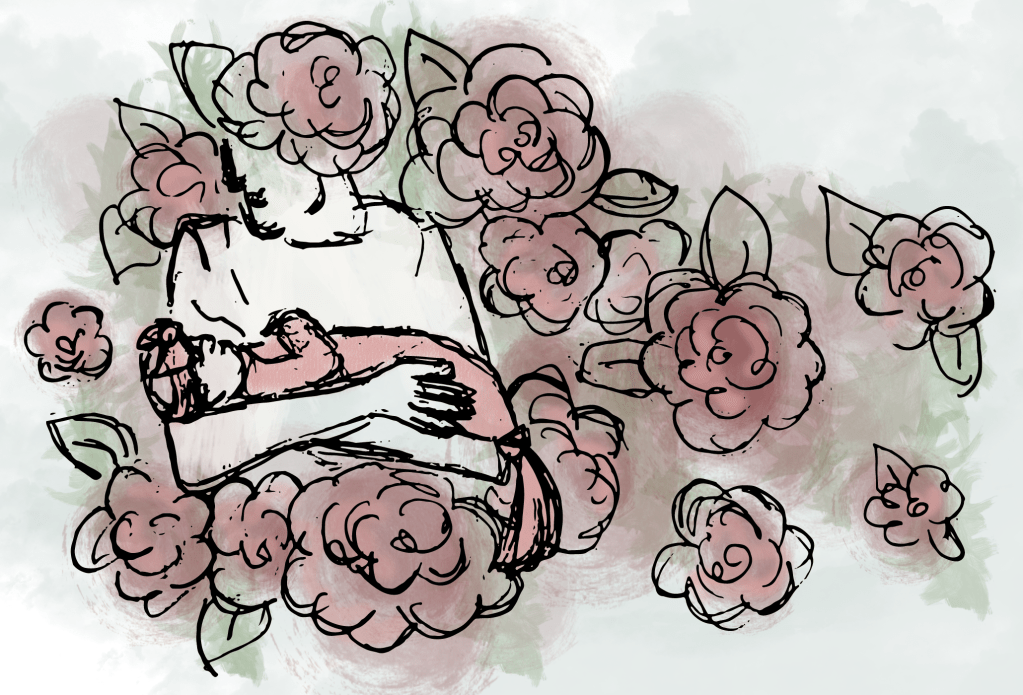
They are capable of pushing out, through primal screams, a seven-pound human from inside of them. They are capable of forgetting all of the pain—the nine months of sacrifices and hours of searing contractions—almost instantly as they hold their baby in their arms. They are capable of calmly guiding other women through the most intense experience of their lives, and of soothing the nerves, assuaging the fears, of their partners. They are capable of the extraordinary.

And that, perhaps, is the most important lesson you will ever teach your daughter.


Join our mailing list!

Subscribe to the Essays of Dad newsletter, a weekly email with parenting stories, background on essays, book recommendations, and more.

Processing…
Success! You're on the list.

An Introduction

Logo by Daniel Wilco

On June 18, 2020, our world changed forever. As I was adding chunks of frozen mango to a blender to make a smoothie, my wife, Carly, came downstairs, holding a little white-and-blue device that looked like a thermometer. She was smiling warily, walking cautiously, as if one wrong step might propel her from a dream she didn’t believe she was having but didn’t want to end. As she approached she held up the thin piece of plastic for me to read:

“Pregnant.”

The rush of emotions was contradictory and revelatory: a cocktail of relief and surprise, excitement and fear, unbridled glee and concealed disbelief. That day had started like any other of my first 27-plus years of life, with the comfort of knowing that my primary responsibility was taking care of myself; the next morning when I looked in the mirror, the same face that 24 hours earlier had looked so young stared back at me in awe, making plain a newly indisputable truth: I was going to be a father. 

To be clear, this baby was relatively planned, if a bit early. Carly and I were going to start trying later in the year, so any feelings of shock were tempered by the fact that it happened only a couple of months earlier than the best-case scenario. (When we broke the news to my parents later in the summer, my dad—whose immediate reaction was to yell, “Oh shit!”—asked if it was planned. “A happy surprise,” I told him.)

But still: I thought I had more time! I wasn’t ready to be a dad, a sentiment echoed by Chris Rock’s character in the movie What to Expect When You’re Expecting, which we watched the night we found out: “There’s no such thing as ready. You just jump on a moving train and you try not to die.” We had just outlined a pre-babymoon plan, featuring lots of time eating sushi and riding rollercoasters. We were going to prepare financially. We were going to take a beach trip. We were going to, and this is straight from the list, find Carly a dentist, get established with primary care doctors, take a road trip to Vermont with the dogs, organize the house, and, my favorite, “read books.” We were going to enjoy the last few months of our family of two. (In the back of our minds we both knew that many of the items on the list would be unattainable because of the pandemic that was ripping through the country.)   

Of course, babies don’t come immediately, but there was now a firm deadline by which we had to accomplish all of the things we wanted to accomplish by the time we became parents. We didn’t, of course, both because of the scale of our mission and because aside from the agonizingly slow last few weeks, the time flew by. 

On March 8, 2021, at 2:46 p.m., I became a father. I still don’t think I recognize the full magnitude of what it means; I don’t know if I ever will. But I’m hoping this site can help.


I used to write for a living, mostly about sports, interning at The New York Times and Boston Globe before moving out west to work at another paper after college. When I realized I wasn’t suited for the isolation of sportswriting, I did what so many other rudderless millennials do: I changed careers. In a couple of weeks I’ll enter my fifth year of teaching fifth grade in public schools, a job that is equal parts exhausting and rewarding, not unlike, I’m learning, being a parent.

I bore you with this brief biography to help myself understand my connection between writing and fatherhood. Soon after our daughter was born, I realized that every day, everything, seemed so big, so important, so significant that I needed a place to ask and answer my questions, to contextualize our challenges, to help demonstrate a love that I’d never felt before.

I hope Essays of Dad can be, or become, that place. I hope it will be a space for thoughtful writing about fatherhood, a collection of stories and essays and observations that together paint a true picture of parenting, with its contradictions and messiness and uncontainable joys. Judging from cursory Google searches, there doesn’t seem to be a site like it, which both surprised and encouraged me. I hope Essays of Dad will remain unique. 

Thank you for being here. I hope to publish an essay—accompanied by an illustration from my incredibly talented friend Sam—every week, and send out a weekly newsletter with background on essays, stories about parenting a toddler, book recommendations, and more (you can subscribe below).

Thank you, again, for reading.

Robbie Harms
August 2021


Join our mailing list!

Subscribe to the Essays of Dad newsletter, a weekly email with parenting stories, background on essays, book recommendations, and more.

Processing…
Success! You're on the list.