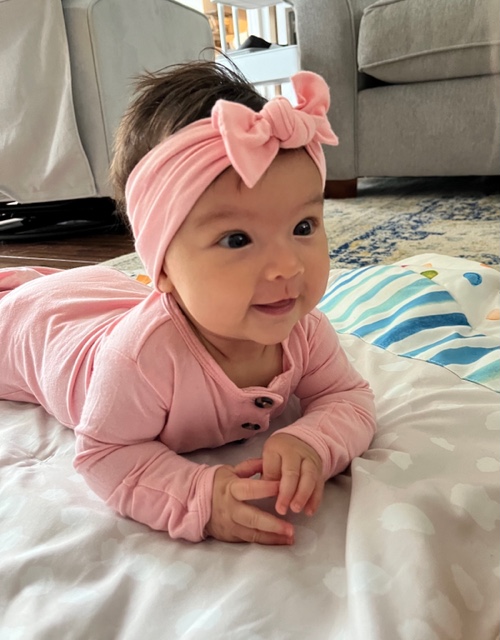
I’m sorry it took me so long to write. Since your arrival six months ago, life has been predictably busy. I started this website to record moments and memories of being a father when your big sister entered our world two-and-a-half years ago, and since then every piece has been about her. But I want you to know that is not a reflection of my love for you.
In fact, it’s the opposite: Mama and I have been working hard to make sure you and Mayla have everything you need, and writing necessarily takes a back seat to those more important obligations. Some days, like yesterday when I had to work late, that means I leave before you wake up and get home after you’re asleep, and Grandma and Mama take care of you. I want you to know that if I could be home with you, I would, that my absence does not indicate a lack of love but rather an abundance of it. Last night you woke up upset a little after midnight; rubbing your tummy as you fell back asleep was more important than anything I did that day.
I used to think, before you were here, that I had a finite capacity of love, doled out in parcels here and there to who and what I valued most—as if love were like time or energy. I worried that when you were born that I wouldn’t feel the same way about you as I do Mayla. I’ve never been happier to be wrong: You taught me that having a second child does not divide a parent’s love; it multiplies it. The past six months, watching you and Mayla grow, have been the richest of my life.
I was feeling down today, overwhelmed by responsibilities. So I watched a video of you on my phone: We were at the fair, waiting as Mama and Mayla ordered mac and cheese. I began tickling your belly and you squealed with glee, that thousand-watt smile staring up at me.
I felt better after that.
Most people, when they meet you, have that same reaction. “She’s just so happy!” they’ll tell us, and we will have no retort. Your happiness is among the purest I’ve witnessed, right up there with Ama’s as she runs around our backyard. You rarely cry, and if you do you are easily soothed. When we get you up in the morning, or from a nap later in the day, your smile is impossibly true, and your laugh, as Mama puts it, is addicting. You are thrilled that you get to experience another day in your new world. I hope you never lose that.
You never stop moving. It started when you were in Mama’s belly, and it’s continued until now. Legs, arms, feet, hands—constantly in motion, forever searching and probing your physical limits. (I joke to anyone who will listen that you are going to be a Division I athlete, and I’m only like 40 percent kidding.) When we lay you on the floor, we are no longer surprised to find you several feet away just seconds later, reaching for the dog bed or putting a ball in your mouth. I hope you never lose that curiosity either.
My favorite time of the week comes on Sunday afternoons, when I get to hold you for your afternoon nap. It’s just me, you, the sound machine, and my book. You lay on my chest, eyes closed and breathing softly, your round cheeks pressed against my shoulder, and there is nowhere I’d rather be, nothing I’d rather be doing, than sitting there with you in the quiet dark.
I love you, Rory. You are the light of my world. I’m sorry it took me so long to write to tell you.
A 30-mile journey in the mountains, to find out something important
“Have you figured out what you’re running from yet?”
The question came from a man in the dark. It was a weeknight, a few years ago, and I was stretching by my car after doing some school parking-lot loops to get in a couple extra miles after a late meeting. The question was sudden, disarming. It came from one of our school’s custodians, who had come out to his car to retrieve something during his solo night shift.
I laughed noncommittally. “Umm.” I paused, thought. “I don’t know.”
“The correct answer is heart disease and type II diabetes,” he said, smiling.
I laughed. “I guess I’ve never really thought about it,” I said. “I guess I’m just running from…” I paused. “Yesterday’s self? To get faster, I mean.”
He stopped about halfway between our cars.
“You know, I was reading Craig Ferguson’s—he’s a Scottish comedian, one of my favorites—I was reading his biography. It’s called Riding the Elephant. And in it he talks about how he’s always been a runner. You ever heard of it?”
I shook my head.
“Well, it’s about all of the challenges he’s been through—addiction, heartbreak, pain, fatherhood—and something really stuck with me. And I thought of you when I read it, because I see you running, every day.”
He paused. I looked into his eyes.
“He said that he used to run from all the hurt. Until he met his wife. That was when he finally found something to run toward.”
I let the words seep into the night. Something to run toward.
He retreated back to his car and said goodnight, leaving me alone to think in the darkness. I had been a runner for almost a decade at that point and had never considered one of its simplest questions.
What was I running toward?
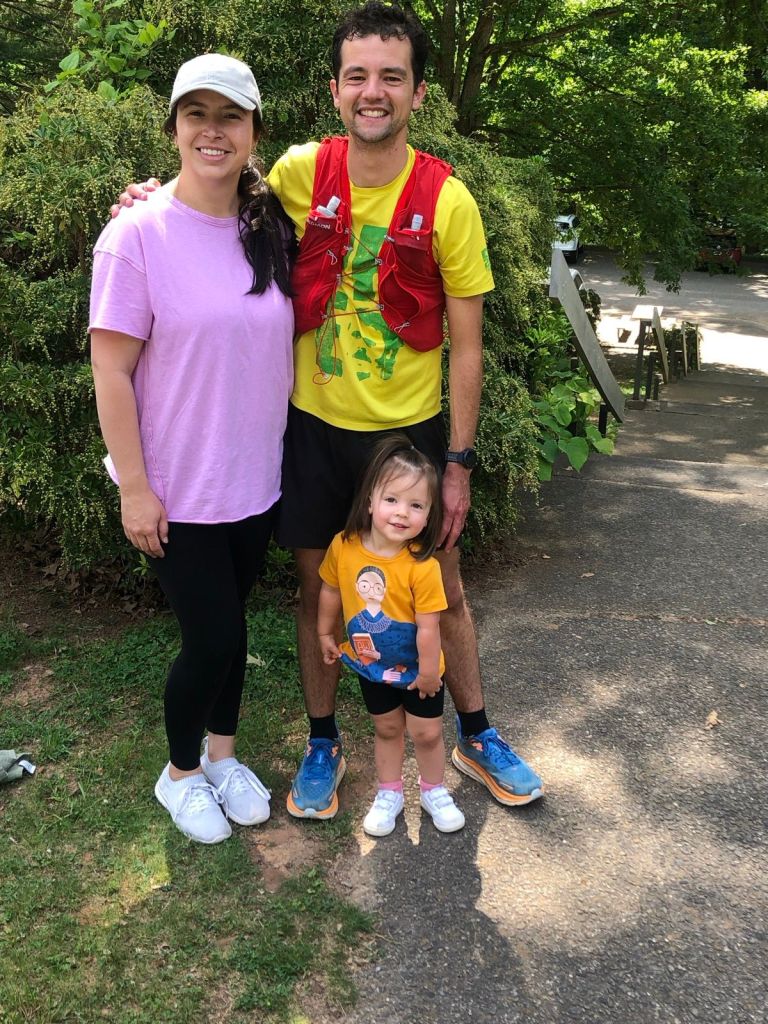
Two Saturdays ago I woke up at 3:30 a.m. to run 30 miles through the mountains. About two weeks earlier I had turned 30, and it had become something of a rite of passage among my runner friends to cover 30 miles in honor of this milestone birthday. My motivation was relatively simple: I wanted to prove to myself that even though I was getting older, I could still run something long. My plan was to run from the base of Mount Pisgah to the Folk Art Center, a section of the Mountains to Sea trail that I had covered in pieces before but never all at once. My wife, Carly, and two girls would meet me at the end. This would be, if all went well, the farthest I’d ever run, in terms of both distance and time.
And so there I was, driving up the Blue Ridge Parkway in the early morning hours with my best friend Jordan, climbing out of the car when we arrived in the parking lot of the Mount Pisgah trailhead. It was cold when we got out, the sun still hours from rising and the wind and elevation much stronger than down below. Wondering if we’d underdressed, we filled our bottles, organized our nutrition—an avalanche of sugary powders and gummies—and strapped on our running packs and headlamps. And then we entered the dark trail.
The first section, down a brutal stretch of trail officially known as 151 but more endearingly referred to as “the elevator shaft,” was choppy and technical, but we nearly immediately entered that sacred running space, where ideas and conversation bounce and flow as unpredictably as our footsteps. It was just after 5 a.m. in the mountains and we were loving it.
For the next two or so hours we talked about running and fatherhood and public education, saw one bear and two people, ran into the sunrise, and marveled at the green mountains surrounding us. Around mile 12, Jordan stopped at his car at his pre-planned departure spot, and we said goodbye. I continued down the trail on my own.
Almost immediately I popped in Carly’s Airpods and so soon Arcade Fire and Mumford & Sons accompanied me as I glided through the mountains, enjoying their curves and undulations I’d run so many times before even as my quads began to sear on the downhills.
And then a song came on that I listened to during my brief, post-college stay in San Diego, one of those times when life punches you in the mouth but you come out stronger, and then it hit me: I was running this not to simply to prove that I could, not merely to delay or defy the endless march of time, but for something deeper, more important: This 30-mile run represented my 30 years on Earth, those thousands of beautiful and difficult and ultimately purposeful days that had shaped me. I’d started the run with Jordan, my best friend since birth, covering miles together as we’d done countless times as teenagers through the heat of Florida. And now I was by myself, as I was after college, running forward, unaware of what awaited. I knew then that everything—the good, the bad, the in-between—had led me to that specific moment, sprinting down a mountain and pumping my arms to the music blaring through my headphones. It felt big.
A few miles later I ran into the parking lot where my friend Charlie was waiting with pickles and Gatorade. I ate a little, drank a ton, and ambled back to the trails, where 13 more miles beckoned.
Around mile 19, on one of the easiest sections of the trail and one I’d run dozens of times before, the physical and mental reality began to set in: double-digit miles to go on heavy legs and a tired brain. As it often does in low moments, doubt, about the rest of the run and its value, began to slowly creep in.
But Charlie, as he and so many other friends had done for me throughout runs and more broadly life, powered us through the rough patch, with humor and conversation and, most importantly, by simply being there. We continued that simple, most elemental task of putting one foot in front of the other, and the miles began to clip off a little more easily, nine to go then seven then five, and soon we were two miles out from the finish, laughing and waxing philosophical and tearing into a pack of peanut M&Ms and at one point taking a wrong turn that led us to the right place.
With a mile to go, we shoveled down some more M&Ms and opened our stride. Here it was, here it always is, the last mile, that holy place of pain and joy and heart, where you find out important things and you’re no longer running but floating, drifting by the world passing at a different speed and feeling only your chest working hard and blood coursing to your arms and legs.
I was running fast, faster than I had all day, because I finally knew the answer to my custodian’s late-night question all those years ago.
I reached the parking lot. And then I walked over to my wife and two girls.
Turns out I’ve been running toward them all along.
The note, titled “Carly and Robbie’s Pre-Babymoon,” still exists on our phones. As I read it now, I’m struck by its scope, which was hilarious and close to impossible.
Before we were to embark on the life-changing journey of becoming parents, Carly, my wife, and I decided we needed to, and this is verbatim from the list, “Find Carly a dentist,” “Take a road trip (out West, Vermont, Maine) w/ dogs,” “Eat lots of sushi,” “Backpacking w/ dogs,” “Go to theme park” (to presumably ride roller coasters), “New sink,” “Find Carly a new job,” and my favorite, “Read books.” (Which books? Doesn’t say. Just books. I hope I read the correct ones.)
We compiled this list together, sitting on our couch, in May 2020. It was our attempt to determine what we wanted to accomplish by the time the demands of parenthood, and restrictions of pregnancy, arrived. We checked off very few of our goals. We never went to a theme park. We still have our same kitchen sink. We did not take a road trip with the dogs, out West, or to Vermont or Maine.
No, this pre-babymoon lasted a mere three weeks. Because 18 days after we wrote this note, wide-eyed and filled with anticipation, we found out Carly was pregnant. That baby is now almost two years old.
The babymoon would have to wait.
Honeymoons, which possesses one of my favorite Spanish translations luna de miel (literally translating to “moon of honey”), are familiar to me: A couple travels to somewhere remote, usually tropical, to enjoy the beginning days of their marriage and escape the stress that accompanies planning a wedding. A day after we were married, Carly and I hopped on a plane to Italy for the first time in our lives; it was magical.
A babymoon, though—what the heck is a babymoon? I didn’t know until Carly brought up the “pre-babymoon” that still occupies gigabytes on our phones that it is, simply, a honeymoon for expecting parents, a time to spend time alone together before their world is turned upside down and their hearts are filled by the presence of a child, their child.
At first, as a 29-year-old going on 65, I thought it was one of those typically Millennial creations, like olive oil in a squeeze bottle or $20 avocado toast. Apparently, though, it was actually coined in the 90s by a British pregnancy author, who intended it to be the time spent with your new child after they were born; “[b]ut influenced by the ‘trip’ sense of honeymoon,” Merriam-Webster writes, “it soon gained another meaning: ‘a trip or vacation taken by a couple shortly before the birth of a child.’”
Whatever its origins, we never took one before Mayla, our now almost-two-year-old, was born: There was a pandemic tearing through the world, and the farthest we traveled in the weeks before she was born was our mile walking loop around the neighborhood. This time, though, with our days much busier and our nights centered around feeding, bathing, and putting Mayla to bed, we decided it could be good, perhaps even necessary.
So for Christmas our biggest gift to each other was nothing tangible, but a weekend away—the long-awaited babymoon.
We went to Highlands, a quaint mountain town 90 minutes from Asheville, and there is honestly not too much to report about the trip because we did basically nothing for 36 hours. And it was extraordinary.
We made a dinner reservation for 9 p.m. and didn’t leave the restaurant until close to 11. We slept, a lot. We lay in our hotel bed and watched TV and read for hours. We had a late brunch and walked around Main Street. We smelled spices inside a spice and tea shop. It snowed as we were driving there on Friday night, so we were forced to do everything slowly; North Carolina does not handle snowy roads well. And that pace, and feeling, was perfect for this weekend. It was a magical, wintry escape.
If the purpose of a babymoon is to remind expecting parents of life without children, when their responsibilities shrink and they don’t have another human to attend to, and to connect deeply with their partner and reaffirm that they are the person with whom the want to share the journey of parenting, then ours was a success. It was, in the truest sense of the word, relaxing.
But there lingered in the back of our minds, when we were waking up late and sitting with just each other at restaurants, when there was no stroller to push through the cracked sidewalks and no books about llamas to read before bed, that we were missing something, or someone. We both, I think, try to ensure that our identity is not completely intertwined with Mayla’s, that our life and interests and time extends beyond our daughter’s, that we are not just parents. And we both, admittedly, enjoyed the long-awaited babymoon, even if there we didn’t ride any roller coasters. But by the next morning, we missed her.
So we checked out an hour early and drove home to see our daughter.
Join our mailing list!
Subscribe to the Essays of Dad newsletter, a weekly email with parenting stories, background on essays, book recommendations, and more.
Processing…
Success! You're on the list.
Whoops! There was an error and we couldn't process your subscription. Please reload the page and try again.
We sat, Carly and I, in the hard plastic chairs, staring at a reflection of our family in the large rectangular mirror occupying the opposite wall. Our concern was hidden by the cloth masks covering our noses and mouths; maybe our eyes betrayed our worry. We were, more than any time I can remember as parents, genuinely scared.
Mayla, our 21-month-old daughter, had woken up the previous night, a few before Christmas, crying and coughing so hard that she threw up. But what worried us the most was her breathing: it was scratchy, clipped, labored, especially when she got upset because of the pain caused by coughing. It sounded exactly like what preceded my adolescent asthma attacks, the ones that invariably ended with me sitting in a camping chair, a clear mask over my nose and mouth delivering albuterol to my compressed airways.
It was the first time of her life that we contemplated calling 911; instead, we tried to keep calm and called, around 4 a.m., the on-call nurse, who relaxed our worry and advised us to take the normal measures to calm a cough: honey, steam, humidity. We tried, without much success, to all go back to sleep, Mayla, for one of the few times of her life, laying between us in our bed. The sun rose and we tried to get her to eat breakfast, eat and drink anything; she mostly refused, preferring to do something she almost never does: lay on the couch and watch Daniel Tiger (“Da-tah” to her). We didn’t really care what she did, as long as she didn’t get upset, because that’s when the wheezing began. We just wanted, needed, to keep her calm.
By the time we got to the doctor, she was so tired she nearly fell asleep on Carly. To pass the time and soothe our anxiety, Carly and I started flipping through old photos of her, of us, on our phone. And as I looked back and forth between the digital representation of my daughter on my phone screen and the physical one laying on Carly’s shoulder, struggling to keep her eyes open, I struggled to determine which one was real. For the first time, the pictures of her seemed more true than reality. There she was, smashing her first birthday cake and rubbing it all over her face. There she was, running through a hose in the front yard, squealing with glee. There she was, sleeping on my chest when she was just weeks old. This girl sitting next to me? No, that wasn’t our daughter: She looked so sad, tired, lifeless. They didn’t seem like the same person. I almost started crying: In those moments of high stress you start to fear the worst, and you want, more than anything, for your child to be OK, to find again that joy that you saw on the screen you held in your palm.
And that’s when I remembered coming to that pediatrician’s office almost two years ago, before Mayla was born, and walking into that room or one designed exactly like it. We were there only to meet the pediatrician and discuss Mayla’s first appointments, and thus felt relaxed, light. Our eyes then often squinted above our masks, the universal sign for a hidden smile. But I specifically remember thinking, sitting in those chairs and staring into that giant mirror, One day we’re going to be here when she’s sick and we’re going to be scared.
That day had arrived, and it was a not-insignificant comfort to remember that visit two years ago: It didn’t heal Mayla, of course, but it offered something of nearly equal value in those frenzied, anxious minutes, hours, days when you are worried about your sick child: perspective—perspective that this is part of the deal of parenthood, especially in the snotty winter months, that your marriage vows of in sickness and in health apply, too, to your children. It was helpful, as ever, to zoom out.
The rest of that doctor’s visit was not fun: Mayla did not enjoy, in fact actively fought against, the albuterol pumped into her nose and mouth and all of the probing swabs up her nose for the various virus tests (and no one could blame her on the latter). But she got some medicine to loosen her airways, she never had trouble breathing again, and she was better in a few days.
It was, as parents, our first true medical scare, and for that I feel fortunate because I know some parents experience scarier, more severe issues far earlier than we did with Mayla. And I’m sure those parents, as we did, at times felt helpless, wishing they could simply take their child’s pain away, transfer it to themselves, do anything to make their child better. Having a sick child is unlike anything I’ve ever experienced, but it’s perhaps one of the clearest, most powerful manifestations of a parent’s love.
Mayla will get sick again, as will our second child, due to arrive soon, so our worries will likely only increase. It is simply a part of life. Which, of course, exemplifies the ceaseless oscillations of life as a parent, which can bring you the most uncontainable joys and the most genuine scares. Neither can exist without the other; they are both part of the deal.
So, yes, we’ll be back in those hard plastic chairs, gazing into that immense piece of reflective glass once more. And we will remember, hopefully, those anxious December days, when our daughter helped us remember that parenting is never easy, but it is always worth it.
Join our mailing list!
Subscribe to the Essays of Dad newsletter, a weekly email with parenting stories, background on essays, book recommendations, and more.
Processing…
Success! You're on the list.
Whoops! There was an error and we couldn't process your subscription. Please reload the page and try again.
The other day, after I put our daughter, Mayla, down for her nap (something I like to consider her siesta, for she takes it after a hearty lunch), I heard noise from her room through the walls of ours. I couldn’t, at first, make out what it was, just that it was something distinct from the familiar drone of her white-noise sound machine. It was higher, sweeter, melodic.
I listened more closely for a few seconds, and then I heard it clearly: “Mama. Dada. Ama. Pay-pa. Oouu. Mama. Dada. Ama. Pay-pa. Oouu.”
Our one-and-a-half-year-old daughter, from the quiet, solitary darkness of her crib, was talking to herself.
Mama is my wife, Carly. Dada is me. Ama is our dog, Ama. Pay-pa is our other dog, Paisley. Oouu is Mayla’s word for herself, a word she learned because we consistently refer to her as “You” that she says with a knowing inflection, pointing to her chest. (It’s one of those hilariously adorable things that we should probably soon fix.)
These are the members of our immediate family. They are also five of the what Carly, a speech therapist who works with children (which means she should likely be the one writing this), estimates is the 200 words Mayla knows.
More than anything, talking has marked her transition to full-blown toddlerhood. As a baby, Mayla’s primary method of communication, like that of most babies, was crying. That soon evolved into grunts and similar noises and pointing at things. She started to do a few basic signs that we had taught her, too. But words were not a major part of her life until a few months ago.
Mayla’s first word was baa (ball). She was 10 months old. Since then, and especially in this last month, it seems like she has learned new words every day, every minute. She is a sponge: It usually takes us saying a word a few times, sometimes only once, for her to remember it and later say it, often in the proper context, to the astonishment of her parents. She knows everyday words like wa-wa to more specific ones like puz (prayers). She knows words in three languages—English, Spanish, and American Sign Language—and basically every sound any common animal makes.
I write none of this to brag; Mayla is pretty typically developing, according to Carly, who knows these things. I write it simply to document this explosion of language, when words have become her toys.
The talking begins immediately as her day begins. When Mayla is woken up in her crib by Carly or me or Ga-ma, she almost immediately calls for the other parent and dogs to come join. Within a few minutes, she brings her hand to her mouth and says, “Et.” She wants breakfast. When we confirm her desire by asking, “You want to go downstairs to eat breakfast?” she gives a little yip, accompanied by an excited hand thrust, to indicate that we have correctly interpreted her morning wishes.
As she waits for her breakfast to be prepared, she will tell you what Carly or I is doing in the kitchen—cük—and often demand to go ow-si to check in on the backyard trees (tus) and see if there are any aye-pa (airplanes) flying uppa (up high), where, at night, she loves to identify the muuhn. If it is cold outside, she will tell us by hugging herself, shaking, and saying “Couuu!” She will also invariably yell “Ama!” at the dog, raising the pitch and changing the inflection of her voice to indicate exasperation, if Ama is doing something even slightly impermissible. (This will never not be hilarious.)
When breakfast is ready, Mayla will ask to wash her hands in the ka (kitchen) sink, and then ask to be placed in her hai-cha to begin eating, but not before she demands her bua (bib) be placed around her neck. If we forget to give her a utensil to eat with, she will remind us, repeating fük (which sounds alarmingly close to a different four-letter word) until we bring her a fork from the cabinet. She then will often tell us what food she is eating—she knows the names of too many foods to list here, but my favorite one is ah-ka for avocado—and ask for muah once she eats all of her favorite food on the plate. Breakfast usually takes at least 15 minutes.
For the rest of the day, Mayla spends time playing with tuz (toys), from a ta (train) to pehs (pegs), or reading büks, telling you if she’d rather read tu-ah (“The Little Blue Truck”) or a Christmas book featuring her current favorite person and word: Suh-ta. Perhaps she will then take a wuk (walk) with her Ga-ma or want to play, again, and so walk over to her parents, grab them by the hand, and demand that they get up (this she says perfectly).
When dinner time comes, Mayla will often demand to hep, dragging a chair over to our kitchen island so she can stand on it and snap some green beans or pour the sweet potatoes onto the baking sheet. Once she is sufficiently fed, she will repeatedly tell us “Ah-da! Ah-da!” and shake her hands to indicate that she has indeed finished eating, and so it is time for the next stage of the evening, either bath or bud (bed). In either case, she will grab both of our hands and walk us to the edge of the stairs, a giant smile painting her face as she proudly exclaims “Toooo!” to indicate that she is walking two parents. This makes our hearts full.
Her final words of the day are often accompanied by an action: a huaa (hug) or kus (kiss) to say goodnight.
I used to be a journalist and currently run a saccharine dad blog; Carly’s job revolves around helping young people develop language. We both appreciate the importance of words, those “most inexhaustible sources of magic,” as Dumbledore famously called them. So watching our daughter, our first child, discover their beauty and power has delighted us beyond measure.
There will perhaps come a day when her tiny, squeaky voice doesn’t bring me complete joy, or even a time when I think that she is talking too much; that day has, thankfully, not yet arrived. For now, I’m simply going to relish every Dada and oouu and kus, going to enjoy this extraordinary stage when our daughter is finding her voice.
Join our mailing list!
Subscribe to the Essays of Dad newsletter, a weekly email with parenting stories, background on essays, book recommendations, and more.
Processing…
Success! You're on the list.
Whoops! There was an error and we couldn't process your subscription. Please reload the page and try again.
Every picture, they say, tells a story, and so here is ours.
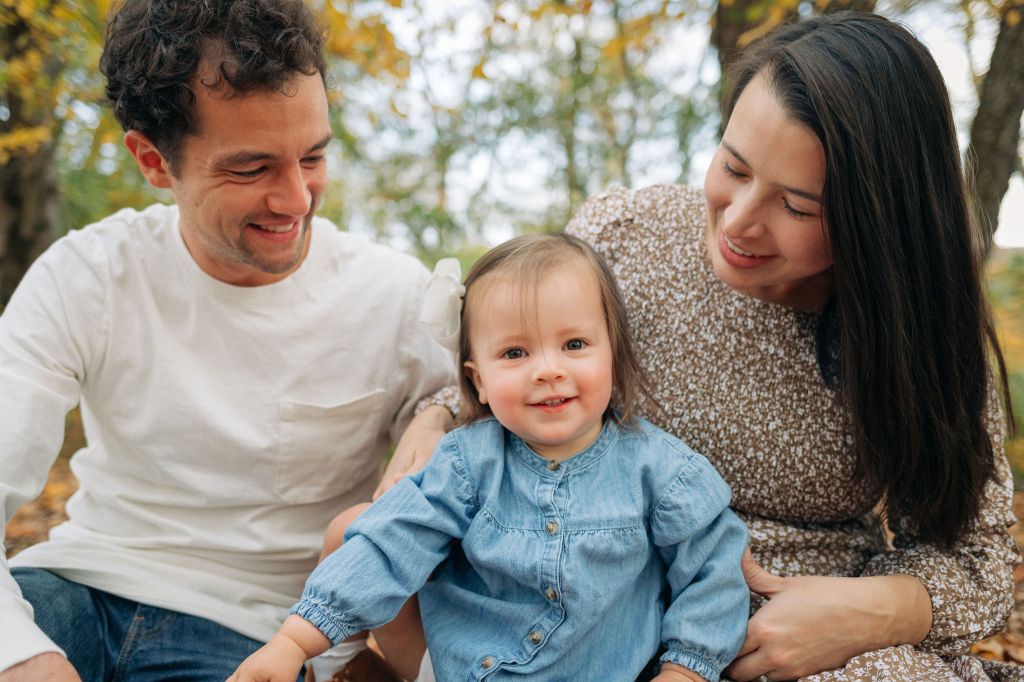
This picture tells the story of our family: three humans, two dogs (here in spirit), one more (human) on the way. This picture captures one of the dwindling moments of our current family of three, a true snapshot of our life as it currently stands, among the oranges and yellows and browns of fall in western North Carolina. This picture represents our abundant joy and immeasurable love for the young person in the center of it, an unstoppable, irrepressible girl named Mayla Ruth, whose joy and curiosity, it seems, radiate from the thin, toothy smile painting her face.
This picture captures one moment from one day of the combined thousands of our lives, one we will, no doubt, look back on in years with a remember-those-days smile. This picture will, and does, make us happy.
But this picture does not tell our full story, because no picture, even those worth a thousand words, can: It is necessarily limited by the time and place it was taken, by the disposition on the faces of the people in it, by the circumstances surrounding it.
This sometimes unrealistic portrayal is, of course, exacerbated by social media, which often and predictably depicts the best version of the person, family, or company it represents; it is natural to hide the less desirable, to mask the parts you don’t want the public to see. But those flaws, those vulnerabilities, those missteps—they are no less part of the story, no less important to its telling, than the triumphs.
Perhaps most significantly, it does not represent the impossible challenge of trying to wrangle a 19-month-old to sit in one spot long enough to take a picture, and, if and when she finally does, look at a camera and smile. She would, of course, much rather spend time outside wandering, picking up leaves and rocks and flowers, pointing at the creek. The fact that this picture exists at all is a testament to Rachel’s photography (and stuffed giraffe).
This picture does not tell the story of how, after college, I was lost and confused and living on the other side of the country before, as so many lost and confused people do, moving home. This picture does not tell the story of how my life changed, forever, when I met the woman on the right side of it.
This picture doesn’t tell our love story, of the walks on the beach under the stars, of the impromptu dancing to Leon Bridges on condo balconies, of the challenges navigating a (relatively) long-distance relationship: the anticipatory drives to each other on Friday afternoons and reluctant goodbyes on Sunday night and sad Monday mornings. This picture does not tell the story of leaving everything and almost everyone we know and moving to another state to build a life together, of our engagement and marriage in the mountains, of the cozy one-bedroom apartment by the river and the simple rhythms and major adjustments of life as a newly married couple.
This picture does not tell the story of the first days, weeks, months of caring for a newborn, of the significant adjustments to our life and marriage, of the inevitable tension caused by trying to figure out parenthood. It does not capture our long, challenging journey to feed Mayla, of the long nights Carly spent alone in the dark of Mayla’s room, rocking her in the chair and attempting to get her as much food as possible, of the worry we had when we discovered she dropped to the sixth percentile for weight when she was three months old. This picture does not capture the mental and physical strain of life with less sleep than we needed, of listening to our baby scream into the late hours of the night when we were all exhausted.
Behind our smiles in this picture are all of these experiences, the good and bad and in-between. Every picture, they say, tells a story—but perhaps one deeper than your eyes can see. Here was ours.
Join our mailing list!
Subscribe to the Essays of Dad newsletter, a weekly email with parenting stories, background on essays, book recommendations, and more.
Processing…
Success! You're on the list.
Whoops! There was an error and we couldn't process your subscription. Please reload the page and try again.
Do you miss out on your true 20s if you become a parent before they’re over?
Mayla, and younger her brother or sister.
It is, I think, your first realization that you are no longer young: One of your friends—or simply someone you graduated with—becomes a parent. It happened for me soon after college, when I was 22 or 23 and a few relative acquaintances got married and had children within a year of throwing our caps and gowns into the spring air. I remember thinking, I didn’t even know people my age were allowed to have kids. It seemed like just the other day that I was walking past them on the way to ECON 410, or pretending to study at the table next to them in the library. We were so young.
Part of the reason for this way of thinking was the fact that I was nowhere close to becoming a father. My longest relationship up to that point in my life had lasted a couple of months, I was confused about what I wanted to pursue as a career, and I was living more than 2,000 miles away from most of my friends and family. I was making frozen meals from Trader Joe’s (which, to be clear, are objectively delicious) in the garage kitchen of a subletted house most nights for dinner. I also looked like I was 17 and was probably immature. No, I was not ready to become a dad.
But perhaps an even bigger reason for my surprise was the fact that it was increasingly and strikingly rare, among my oft-discussed/criticized Millennial generation, for a 22- or 23-year-old to have a baby. We are, of course, a selfish generation that delays parenthood (or doesn’t have kids at all!), which, of course, is leading to the inexorable decline of America. I looked at these new young parents with some mixture of curiosity and pity: Why did they want to sacrifice their 20s to the whims of a child? They couldn’t be that great, could they? This thinking was a product of a pretty significant societal shift: If I were the same age without kids living decades earlier, I would have been the one viewed as the outcast. Not having a child in your early 20s, for much of the 20th century, was uncommon and maybe even frowned upon.
I’m a dad now. My wife, Carly, and I have an 18-month-old daughter named Mayla, with another on the way: Carly is 21 weeks pregnant. I will have two children before I turn 30—something, had you told me seven years ago, about which I would have laughed out loud because it seemed so farfetched. Life, as the saying goes, comes at you fast.
But, despite the joys of fatherhood and my deep love for Mayla and her soon-to-arrive little brother or sister, that same thinking that I had when I was 22 still sometimes creeps in: Are other people my age thinking about me, about us, the same way I did about them? We’re older now, yes, but not by that much. We are still not the norm.
Am I growing up too fast?
Last week, after a particularly long day at work, I went on a run on the trail closest to my school. I’d run this trail, a winding, well-groomed section of the Mountains to Sea, dozens of times since we moved to Asheville four years ago, but on this run my mind wandered back to those early days when it was just me and Carly, living in a two-bedroom apartment close to downtown as we attempted to navigate our mid-20s. Life, I thought as I snaked through the leaves on that recent run, seemed so simple then: working and running and walking the dog before dinner. Our biggest decision—and I recognize that rose-colored glasses are indeed real—was often what new restaurant we should try on Friday night.
The leaves fell around me, painting the trail in browns and yellows and reds as I thought back to those times with an undeniable nostalgia and maybe even a bit of jealousy. Everything now, with a child, especially during the week, seems so frantic, so rushed that those days without the responsibilities of parenthood seem (justifiably or not) like an oasis of freedom.
Part of it, probably, is true. There is no denying that life with a child is vastly different from life without one. Becoming a parent is simply a sudden recognition that you are now responsible to sustain and nurture more than one human. For the first however many years of your life, your primary responsibility was to make sure you ate, slept, put on pants, etc.; as a dad, as a mom, as any type of caregiver, those responsibilities multiply.
That doesn’t take into account the fact that your child, especially a baby or toddler, becomes the center of your family’s solar system. They have to eat and sleep at certain times, and when they’re not doing either of those, they need to be entertained. This is, of course, incredibly rewarding—I still have not discovered any better use of my time than reading to Mayla as she sits, enthralled in a book she’s read dozens of times and smiling because she knows that the dragons are about to burn down the house because they unknowingly ate spicy salsa—but also, it’s fair to admit, incredibly exhausting. Apart from sitting your child in front of a screen, something we try extremely hard to never do (and, honestly, something that Mayla often doesn’t have the patience for anyway), there is little to no downtime when your toddler is awake.
The other part of my nostalgia, of the frequent questions about whether I’m growing up too fast, is perhaps more selfish. Your 20s are, the thinking goes, supposed to be the time you focus on yourself: figuring out your career, finding your new home, having fun with your friends. None of that is impossible with a child, but it’s different, accelerated. Sometimes I look at friends/acquaintances around my age, single and living in major cities, working 60-plus hours a week but meeting coworkers for happy hour and going out every weekend, taking cabs and ordering Uber Eats from the office—and it seems kind of fun, a thrill. (Again, the grass is always greener…) Did I miss that—am I missing that—because I became a dad at 27?
I finished the run and drove home to take Mayla to the park.
Maybe, as ever, there is more than one way of looking at it. Maybe, and not to get too philosophical here (though as a dad you start thinking deeper about most things), every person has a general path set for them, and small and big choices here or there determine its exact curves and undulations. Maybe life—maybe your 20s—is simply a series of mistakes and twists and waves, and it’s up to you to ride, learn from, enjoy them all, and trust that it’s ultimately going to work out the way it should.
I don’t regret becoming a dad at 27, or having two children before I turn 30. I wonder, of course, how my life would have been different had the timing or circumstances of a few small things been different—had I chosen a different major in college, had stuck it out in sports journalism, had I never moved back to Florida—but that’s forever secondary to the intense joy and gravity of being a dad.
When I came home the other day, Mayla’s face lit up as she exclaimed, “Dada!” She ran to me and wrapped my legs in a hug. And right then I knew that I had grown up at exactly the right time.
Join our mailing list!
Subscribe to the Essays of Dad newsletter, a weekly email with parenting stories, background on essays, book recommendations, and more.
Processing…
Success! You're on the list.
Whoops! There was an error and we couldn't process your subscription. Please reload the page and try again.
Three minutes dancing to “Dos Oruguitas”—and navigating a world that keeps changing and changing…
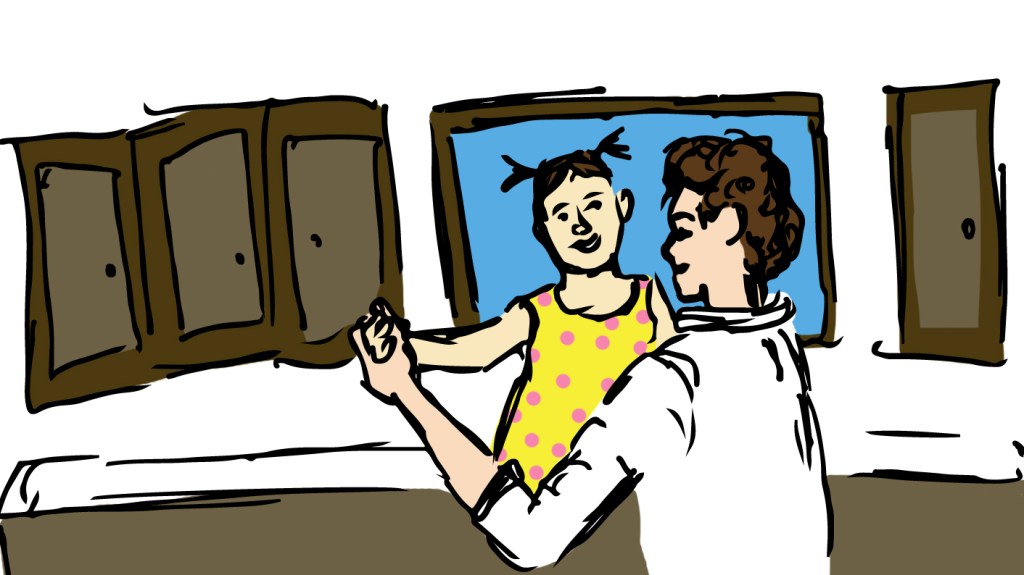
Illustration by Samantha Harrington
Picture this: It’s a Tuesday evening, 7:00. You’ve had a long day: writing and teaching and coaching and tutoring. You know it’s time to wear your most important hat—Dada—but you lack the energy you know you’ll need to entertain your daughter. She’s almost 19 months old and a bundle of curiosity and movement and big feelings.
You drop your shoes in the garage and walk through the door, into the kitchen, where your wife is simmering a delicious, fragrant combination of sweet potatoes, black beans, and spices. There’s Disney music playing from the robot with a human name sitting on the counter. Your daughter is performing one of her favorite activities: removing every piece of Tupperware from the cabinet and placing it on the floor. You greet her. She smiles and says, “Dada!”
You feel better already.
A few minutes pass and the song “Dos Oruguitas” from the movie Encanto comes on. This is one of your favorites, the type of longing song that makes you just a little bit sad. It’s about two caterpillars in love who become butterflies and have to leave each other, full of symbolism and beauty and sadness.
You scoop up your daughter to dance.
At first, like she is most times, she’s resistant, trying to wiggle free and get back down to her Tupperware. When she was little she would rest her head in the nook between your neck and shoulder, but that rarely happens now. You miss those days.
But then you sway her dramatically, high into the air. A smile immediately grows on her round face. You sway her some more. She starts giggling.
You listen to the hypnotic rhythm of the guitar and Spanish lyrics:
Dos oruguitas enamoradas (Two caterpillars in love) Pasan sus noches y madrugadas (Spend their nights and mornings) Llenas de hambre (Full of hunger) Siguen andando y navegando un mundo (They continue navigating a world) Que cambia y sigue cambiando (That keeps changing and changing) Navegando un mundo (Navigating a world) Que cambia y sigue cambiando (That keeps changing and changing)
Holding your daughter in your arms, swinging her from side to side, you think about the past 18 months. You think about the moment she entered the world and changed yours forever. You think about the sleepless nights and the crying and the utter dependence she had on you and your wife. You think about her struggles feeding and their endless complications. You think about the first year of her life featuring a rotating cast of Greek symbols-turned public-health crises and the constant buzz of worry anytime you left the house with her. You think about the good times and bad and everything in between.
You think, And we continue navigating a world that keeps changing and changing…
Dos oruguitas paran el viento (Two caterpillars stop the wind) Mientras se abrazan con sentimiento (While they embrace with feeling) Siguen creciendo, no saben cuándo (They keep growing, they don’t know when) Buscar algún rincón (To look for some shelter) El tiempo sigue cambiando (Times keep changing) Inseparables son (They are inseparable) El tiempo sigue cambiando (Times keep changing)
She’s loving the dancing now: swaying up to the left, up to the right, softer now, and less dramatic, following the cadence of the song. She’s smiling. You’re smiling. The sun is going down outside, it’s getting cold out there, and the kitchen is thick with the smells of a warm dinner. You think, We are inseparable…
Her smile widens as the chorus begins.
Ay, oruguitas, no se aguanten más (Ay, little caterpillars, don’t hold on too tight) Hay que crecer aparte y volver (You must grow apart and come back) Hacia adelante seguirás (You will carry on, forward) Vienen milagros, vienen crisálidas (Miracles are coming, chrysalises are coming) Hay que partir y construir su propio futuro (You must leave and build your own future)
You don’t listen to the song’s mandates: You hold your daughter even tighter. You don’t want to think about the simple, inevitable truth that all parents must confront: Your child grows up and there is nothing you can do to stop it. You don’t want to think about the next stages of her life, when she’ll no longer be the only child and then go to daycare and then preschool and then regular school and then…?
No, you think, let’s stay here in this kitchen, dancing forever.
You continue to bounce your daughter in your arms as the next verse of the song—about breaking down walls, about new dreams, about miracles—comes and goes. And then, as the final chorus begins, you begin to float, like a butterfly, right there in the kitchen, and all of your worries, all of your fears, all of your strivings and goals and responsibilities, all of it melts away and it’s just you and your daughter, flying together through the kitchen…
Ay, mariposas, no se aguanten más (Ay, butterflies, don’t hold on too tight) Hay que crecer aparte y volver (You must grow apart and return) Hacia adelante seguirás (You will carry on, forward) Ya son milagros, rompiendo crisálidas (There are already miracles, chrysalises breaking open) Hay que volar, hay que encontrar (You must fly, you must find) Su propio futuro (Your own future)
Picture this: It’s a Tuesday evening, 7:05, and as these words drift throughout your kitchen, your daughter rests her head in the nook between your neck and shoulder. Just like she used to.
You must fly, you must find Your own future
You hold her tight.
Join our mailing list!
Subscribe to the Essays of Dad newsletter, a weekly email with parenting stories, background on essays, book recommendations, and more.
Processing…
Success! You're on the list.
Whoops! There was an error and we couldn't process your subscription. Please reload the page and try again.
Recently Mayla, our 18-month-old daughter, has rediscovered a book she enjoys, which means that she insists that we read it to her, multiple times a day. It’s called Dream Big and it’s about powerful women throughout history: There’s Katherine Johnson writing complex math equations on a chalkboard, Jane Goodall playing with chimpanzees, Zaha Hadid designing a sleek building.
Mayla enjoys the illustrations—caricatures of each person surrounded by scenes of their professional interests—and short sentences, but she gets the most animated on the page featuring Florence Griffith Joyner, the decorated Olympian sprinter with multiple world records. As soon as she sees the illustrated Flo-Jo running on a track and hears me read “Dream fast,” she points to the page and exclaims, “Dada!”
My daughter knows her dad is a runner.
It is, of course, hilarious and adorable that Mayla compares me to one of the most famous track athletes in history. To her growing and forever connecting mind, a runner is a runner, regardless of talent or accomplishments. To her, Flo-Jo and I are kindred spirits.
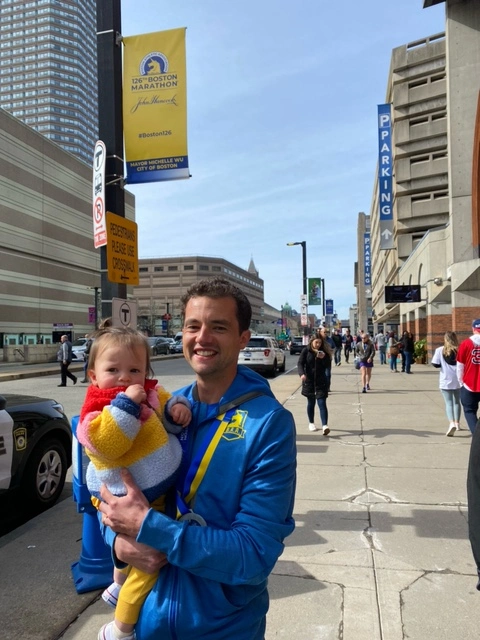
But what struck me the most was that she recognized that I am a runner, that she knew to make the connection. We run together sometimes, and she has watched me run around the neighborhood or park or famous streets of Massachusetts, so I guess it shouldn’t be surprising. But it still made me smile that she associated running with me.
Raising a child has of course altered my life in countless ways, but one of the few things that has remained constant, one of the few similarities between pre-Mayla life and post-Mayla life, is running: a five to seven to 10-mile run, six days a week, on the trails or around the park or through the greenways.
I’ve been a runner for more than 10 years, and it, like fatherhood, has changed my life for the better. Its physical benefits are clear, it’s brought me several of my closest friends, and it indeed does often make your mind clearer and attitude better. I have reached the point where I need running: I need its rhythm and clarity and consistency, its daily exploration of yourself and the world. I am not the same person when I do not run.
This necessity has only been exacerbated by the challenges and questions of fatherhood. Running has helped me navigate being a father, has helped me contextualize those challenges and answer some of those questions (you have a lot of alone time on runs), and I think it’s fair to say it’s even made me a better husband and dad.
But these last 18 months of fatherhood have also been the only time that, on certain days, I feel bad about running, something I’ve felt good about for most of my life. On those days there lingers a question that, I think, most parents who spend hours away running or biking or any other endurance sport have wrestled with: Is it OK to be doing this?
Time, of course, is the most valuable currency to a toddler. They don’t know or care whether you are away at work or on a run or at the store buying groceries; you are simply not there and that is all that matters to them. Their view on time, then, is binary: You are there with them, or you are not.
When I was training for Boston, I was not there a lot. Marathon training necessitates hours that turn into days that turn into weeks that turn into months spent performing, as the author John L. Parker Jr. puts it, “that most unprofound and sometimes heart-rending process of removing, molecule by molecule, the very tough rubber that comprised the bottoms of [your] training shoes.” Running is a sport that demands sacrifices, and as a dad I’ve realized the most significant one is your time: It does not care if you are a father or a husband or an employee; it does not care how you spend your time outside of its relatively simple, often cruel mandates. It, like a toddler, possesses a black-and-white view of time.
The dilemma, then, is plain: Your child wants—needs—you to be there with them, guiding them through their new world, but running commands that every day you spend an hour, sometimes more, devoting your time and energy to something else. So, as a parent to a baby or toddler, you begin to justify your absences, why you aren’t there as often as you or they want you to be: Running is a metaphor for life: What you put in is directly proportional to what you get out. It teaches perseverance and instills physical and mental strength. Chasing something big and exploring the edges of your being are important.
But to a toddler, these justifications ring hollow. They don’t care about or even recognize any of these grand lessons about life; they just want you to read a book or build a tower with them. You just spent most of their waking hours away from them at work, and after that you spend more running. There are, you remember walking through the door on those late afternoons, only 24 hours in a day.
Your spouse, too, notices and perhaps sometimes resents the time you aren’t there to help them raise your child. They deserve a present, supportive husband, and often you’re off chasing some dream they might not fully understand but ultimately support because they know it’s part of you. You are reminded, time and again, that one of their truest expressions of their love is recognizing and allowing that.
So what do you do? You could, theoretically, just stop running, choose another, less time-intensive sport, leave it behind for good. You could find something else to replace it. You could attempt to quiet the voices, assuage the guilt, telling you that you aren’t around enough. Or you could attempt to find some type of balance that makes it all work.
Perhaps the biggest irony is that to think about these questions and their solutions all you want to do is go for a run.
There are, of course, countless other parents navigating the challenge of raising a child and pursuing an endurance sport, and countless who do it well, with clarity and grace. There are also professional runners and cyclists and swimmers who devote their entire lives to the sport and still make time for their kids. Being a runner and being a good parent aren’t and shouldn’t be mutually exclusive.
I’ve only been a dad for 18 months, and I probably haven’t mastered the balance yet. But perhaps the biggest lesson I’ve pulled from this relatively short time as a father is the power of our time: it is forever limited, and how we spend it defines who we are and what we value.
So when I get home after work and running, I leave my phone upstairs so I’m not distracted. I refuse to work on the weekends and run only once, early on Sunday morning before Mayla wakes up or during her nap in the afternoon. I’ve become as efficient as possible at work and on runs so I don’t waste any precious time that could be spent with Mayla. All of this has led me to have a different, clearer view on running: I realize now it’s a privilege, something I get to do, that it’s not and never has been guaranteed. I appreciate the sport more now than I ever have.
Perhaps the clearest manifestation of that realization is running before work to maximize my time with Mayla in the afternoons. On those days I’ll wake up early, drive to work under the stars, and begin clipping off miles in the morning dark, thinking of my daughter as she dreams.
Join our mailing list!
Subscribe to the Essays of Dad newsletter, a weekly email with parenting stories, background on essays, book recommendations, and more.
Processing…
Success! You're on the list.
Whoops! There was an error and we couldn't process your subscription. Please reload the page and try again.
On bedtime, stuffed elephants, and watching your child grow up
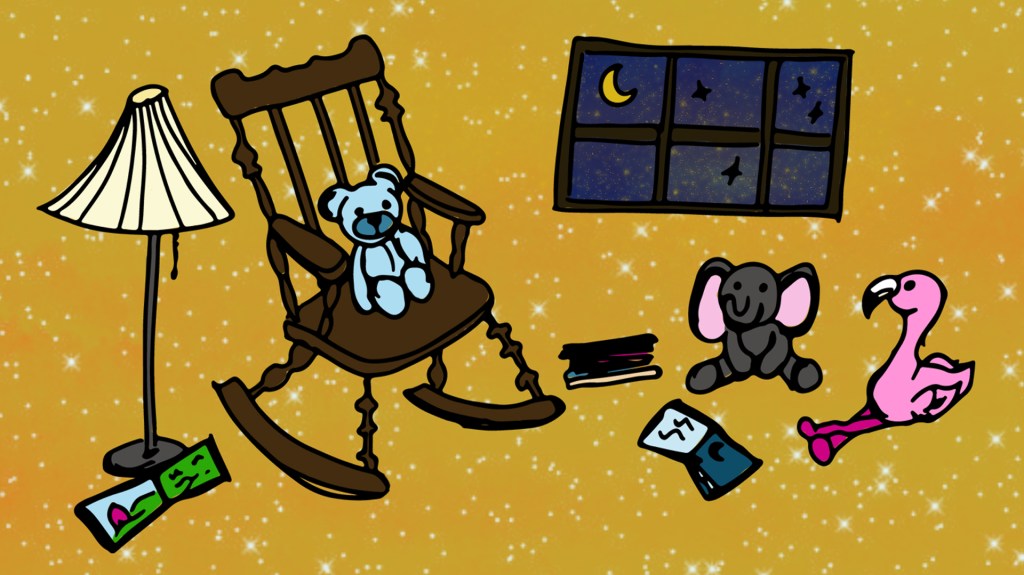
Illustration by Samantha Harrington
One Friday night over a year ago, my wife, Carly, and I picked up dinner from our favorite barbecue restaurant. She ordered pulled pork; I got chicken wings.
We were, as first-time parents to a 4-month-old named Mayla during scary stages of a pandemic, exhausted and probably too excited about our once-a-week takeout meal: a chance to sit on the floor of our living room, eating food we didn’t have to prepare from our coffee table and watching a familiar, comfortable TV show—just the two of us, like old times in old places. These meals were refreshing and necessary, some of my favorite times of the week.
All we had to do was get Mayla to bed.
Perhaps more than anything else, bedtime—that nightly journey to help your child find sleep—has demonstrated how much Mayla has grown up, and how much she has changed.
Before I became a father, bedtime was simply a couple-of-steps routine that I did almost automatically: brush the teeth, read or mindlessly scroll through the phone, turn off the lights. Once we had Mayla, though, I learned that it was something far greater: Bedtime is a significant part of the day, like mealtime and naptime and playtime. It is scheduled and, because I’m married to an extremely organized woman, scripted, written out in steps on the white board that hangs in our hallway. Bedtime is an event.
And for the first five months of Mayla’s life, it was an event that she hated with a burning passion. We would, our little family, be having a pleasant evening and Carly and I would be thinking that, hey, maybe parenthood isn’t that hard, maybe we’re doing OK—and then 7:30 or 8:00—bedtime—would come around and everything would fall apart. Mayla would scream as we carried her up the stairs to the nursery, scream as we put her pajamas on, scream (louder now) when we dimmed the lights and turned on the sound machine, scream as we sang a soft lullaby (the contrast was striking and borderline comical), and scream, especially, as we lay her down in her crib (or bassinet during the earlier months) to sleep. And this wasn’t one of those halfhearted, I’m-going-to-see-if-I-can-get-what-I-want screams; this was a full-throated, visceral shriek of intense displeasure. She’d do this for upwards of an hour some nights. Bedtime was awful.
Hypotheses about why she so despised it abounded: We thought, for a while, that maybe because she had cried the first few times we implemented a structured bedtime routine she had, like Pavlov’s dogs, become conditioned to dislike it thereafter. We thought that maybe she was experiencing a very early and strong feeling of FOMO, that she didn’t want to go to bed because she wanted to hang out with her parents and keep exploring this grand new world. We thought that maybe she just didn’t like the dark.
(The likely truth was actually much sadder than any of these guesses: We had an extremely challenging time feeding Mayla, centered mostly on her inability to take a bottle, and we realized later, once she could finally drink from one, that she was probably just hungry. Carly had fed her as much as Mayla would take given her tongue and lip tie—would feed her for hours every day and exhaust herself physically and mentally—but Mayla still couldn’t get enough.)
Pretty soon we stopped thinking at all. We were drained. Bedtime soon became a trigger not only for Mayla but for Carly and me as well. As soon as the evening started winding down, as soon as the summer sky would turn a soft blue-gray, I’d get that sinking feeling in my chest: Bedtime was coming, and it wasn’t going to be pleasant.
There were very few times I was incorrect with that assessment: We’d go through the routine—PJs, lights, sound machine, lullaby—that had become a drudgery and Mayla would cry the entire time. Carly would rock her in her arms for sometimes a half-hour (or approximately 20 renditions of “Twinkle, Twinkle Little Star”) before being physically incapable to continue and passing her off to me. I’d sing and rock and sway and do everything I could think of to try to calm her down, and Mayla would simply scream into the dark.
It was, of course, intensely frustrating and I think we’d both admit, not proudly but honestly, that some small, ugly part of us began to resent our baby daughter. To us, it seemed so simple: Just go to bed! We both, at that point, would have given away a vital organ for precious sleep, and here she was refusing what we craved more than anything. We knew that thinking was wrong and bad, that she was simply a baby and was trying to communicate in the only way she knew how, but we were, like most first-time parents, confused and tired.
When someone, usually Carly, was finally able to get her to calm down, to stop crying and close her eyes in her mom’s warm arms, the real challenge began: to lay her down without waking her up. Carly would lean over the edge of the crib and slowly, so slowly, lower her arms. If Mayla made even the slightest movement Carly would pick her back up and start the process anew. When she got her down on the mattress, perhaps after two or three tries of this first step, she then had to extract her hands from underneath Mayla. Removing her hand from behind Mayla’s back was typically straightforward, but moving it from under her head was entirely more complex: Carly had to use her other hand to delicately lift Mayla’s head to give her head-holding hand the space to move out, and then lay her head back on the mattress without letting it roll to the side or land too hard, because either would wake her and render the entire process worthless. Watching her do this—as I usually did, sitting in the dark corner of the nursery—was like watching a doctor perform open-heart surgery, so precise was her every move. Mayla woke up during this process more often than not, and it was those nights that we felt truly defeated.
That Friday night when we ordered takeout was one of those times. Mayla screamed for what seemed like hours, before finally calming down but then waking up screaming when Carly tried to lay her in the crib. This happened at least three times. We were in the room for close to two hours before our daughter, miraculously, went to bed.
The barbecue was cold when we ate it later.
Mayla loves bedtime now. When, after dinner and post-dinner reading or swinging or block playing, we say, “OK, it’s time to go get ready for bed!” our daughter’s face will light up as she points toward the ceiling to indicate that she is ready to go upstairs. Often she will climb up by herself and other times she asks to be carried, and thus begin bedtime.
First, we brush her teeth—with a squeeze of toothpaste the size of grain of rice—ourselves before allowing her to try by herself (which she does with a smile but very little teeth cleaning). She then loves to exclaim “Wawa!” to identify the clear liquid falling from the sink, and giggles as it gets her feet wet in the sink. Next we try to wrangle her into some pajamas as she laughs and squirms and talks and holds both of her stuffed babies in either arm. The only passing sign of displeasure is when we have to apply cream or moisturizer for rashes or dry skin.
Then she waddles over to her basket of stuffed animals to get them in place for reading time, taking each one out and handing them to whichever one of us is sitting in the rocking chair, where we are now surrounded by at least three stuffed bears, two elephants, a llama, and a flamingo. Only when everyone is in place does she choose two or three books for us to read, specifying which one is for Mama and which is for Dada, before (sometimes) sitting and (less often) listening attentively as we read about mice and bears and little girls named Madeline getting appendectomies. When the books are finished, she invariably tries to ask us to read more, which she would do until midnight if we let her.
When reading time is over, we tell her to put her animals away—most go back in the basket, but she sleeps with one of the elephants, so he goes over the crib railing—and we once asked if she was going to put her babies in bed, too, but she shook her head no, and now she does that every night whether we ask or not. So she holds on to them tight.
Finally, we lay out her sleep sack on the floor and say, “OK, it’s time for sleep sack!” And our daughter, who used to cry as soon as we carried her up the stairs to her room for bedtime, lays down on the floor on her own accord because she wants to go to bed.
Bedtime is genuinely enjoyable now, a pleasant conclusion to Mayla’s day and the beginning of our precious hours of relaxation before we go to bed ourselves.
Once Mayla is in her sleep sack, Carly rocks her in the chair as we say our prayers and she rubs her eyes, yawns, and leans over to both of us for kisses (and often holds up her babies so we kiss them, too). Once we say “Amen,” I tell her she is beautiful and I love her to the moon and back, and before I close the door on the way out, I look back into her deep blue-green eyes, sleepy and serious. I relish the fact that the last thing my daughter sees before the lights dim is me blowing her kisses.
Carly comes out of the room a few minutes later, and together sometimes we watch, from the baby monitor, Mayla hug her elephants and dolls and shift her body dramatically to get comfortable, and we marvel at how far she has come, how far we have come, how our daughter is growing up, and that fills us with a strange mixture of pride and nostalgia, nostalgia for those long loud nights and cold barbecue, when she needed us to hold her, and pride that she made it, we made it, our little family is making it, and we both just stand there with silent smiles.
Join our mailing list!
Subscribe to the Essays of Dad newsletter, a weekly email with parenting stories, background on essays, book recommendations, and more.
Processing…
Success! You're on the list.
Whoops! There was an error and we couldn't process your subscription. Please reload the page and try again.



 Essays of Dad