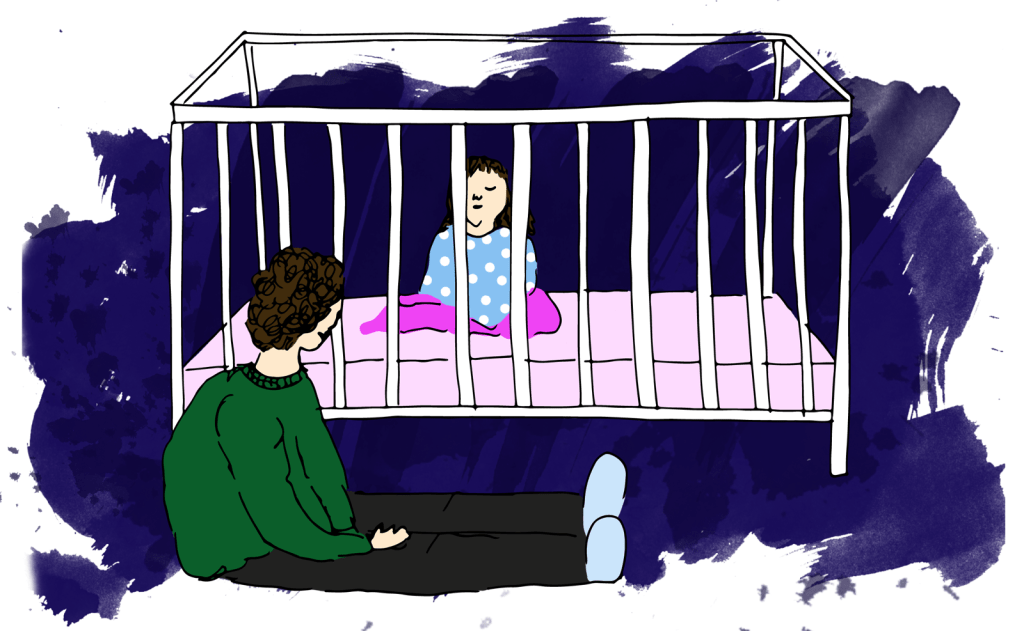
“Mama?” your 2-year-old daughter repeats. She’s sitting up in her crib.
“Mama can come up if she needs to, but why don’t we try to fall asleep,” you propose, “and if you can’t, I’ll go get Mama.”
Silence. You take that as confirmation that it wasn’t a horrible suggestion and an invitation to start a conversation. She’s been having trouble going to bed recently, been having trouble with a lot of things since her little sister arrived three weeks ago. So there you are, kneeling at the edge of her crib, reasoning about sleep with your toddler. Your eyes are failing to adjust to the darkness. All you see is black.
“Hey, Mayla,” you ask, head leaning on the hard wooden crib posts, “are you feeling sad?”
“Deh.” Yeah.
“Why are you feeling sad?”
“Dow-stahs. Mama.”
“You’re feeling sad because you want to go downstairs to see Mama?”
“Deh.”
“I gotcha. I’m sorry you’re feeling sad. But right now we can’t go downstairs to see Mama because it’s time to sleep.”
“No, no, no!” She starts to get upset.
“What type of ice cream did you get Mama earlier?”
“Sta-ba.”
“Strawberry?”
“Deh.”
“Did you get Dada some ice cream, too?”
“Deh.”
“That was so nice. What do you want to do tomorrow?”
“Red büks.” She inflects on the word books, making it clear that they are what she wants to read, not something else.
“Read books? That sounds like fun. What else do you want to do?”
“Go ow-si.”
“Yes! It’s finally supposed to be warm tomorrow. Do you want to draw with chalk outside?”
“Deh.”
“And go on the swing?”
“Deh.”
She then says a long sentence that you don’t fully understand. That happens a lot these days, as her language has continued to develop and she says things that to her make perfect sense but to us have very little meaning. And your wife isn’t here to translate.
“Hey,” you say, “did we follow Daniel Tiger’s bedtime routine tonight?”
“Baf tam bhush teeth ps on stor n song ff to bed!” she recites. Bath time, brush teeth, PJs on, story and song, and off to bed!
“Yeah! We took a bath, brushed our teeth, put on our PJs, read a story, sang a song. And now it’s time to…go to bed!”
She repeats the song.
“Hey, Mayla,” you say, sensing it’s now the right moment, “remember at dinner when we talked about how sleep is so important to help us grow and feel happy?”
“Deh.”
“And remember last night when you were feeling sad when you went to bed, and when you woke up this morning you were feeling happy?”
“Deh. Oou hap-pa.” I happy.
“Well, I think the same thing might happen right now if you try to go to sleep. And if you want to do all of those fun things tomorrow, you want to feel rested and happy.”
Silence.
“Why don’t you try to lay down and see if you can fall asleep?”
Shifting. Slight creaking. Your eyes have still not adjusted, so you reach your hand into the crib. She is laying down.
“Do you want Dada to rub your back and sing a song while you try to fall asleep?”
“Deh.”
“What song do you want Dada to sing?”
“Tinkl tinkl li stah.”
“Twinkle, Twinkle, Little Star?”
“Deh.”
You begin singing and gently rubbing her back. She lay still and silent. You repeat the song several more times. Still silent.
You still can’t see anything, so you text your wife to check the baby monitor to see if her eyes are closed. They are not. You keep singing.
You move your hand from her back and find her hand. You hold it and run your fingers on her palm. Twinkle, twinkle, little star…
For the past few weeks she’s seemed giant, both physically and developmentally, compared to her 3-week-old little sister. She can run and talk and eat and play and help with chores around the house. But in that moment, holding her tiny hand, you remember that she is still small, still your little girl. And that will never change.
Your wife texts back. “Eyes are closed.”
You gingerly get up, still humming the song, and quietly exit the room. You need to go to bed, too. You have to be ready to go outside with your daughter tomorrow.
We sat, Carly and I, in the hard plastic chairs, staring at a reflection of our family in the large rectangular mirror occupying the opposite wall. Our concern was hidden by the cloth masks covering our noses and mouths; maybe our eyes betrayed our worry. We were, more than any time I can remember as parents, genuinely scared.
Mayla, our 21-month-old daughter, had woken up the previous night, a few before Christmas, crying and coughing so hard that she threw up. But what worried us the most was her breathing: it was scratchy, clipped, labored, especially when she got upset because of the pain caused by coughing. It sounded exactly like what preceded my adolescent asthma attacks, the ones that invariably ended with me sitting in a camping chair, a clear mask over my nose and mouth delivering albuterol to my compressed airways.
It was the first time of her life that we contemplated calling 911; instead, we tried to keep calm and called, around 4 a.m., the on-call nurse, who relaxed our worry and advised us to take the normal measures to calm a cough: honey, steam, humidity. We tried, without much success, to all go back to sleep, Mayla, for one of the few times of her life, laying between us in our bed. The sun rose and we tried to get her to eat breakfast, eat and drink anything; she mostly refused, preferring to do something she almost never does: lay on the couch and watch Daniel Tiger (“Da-tah” to her). We didn’t really care what she did, as long as she didn’t get upset, because that’s when the wheezing began. We just wanted, needed, to keep her calm.
By the time we got to the doctor, she was so tired she nearly fell asleep on Carly. To pass the time and soothe our anxiety, Carly and I started flipping through old photos of her, of us, on our phone. And as I looked back and forth between the digital representation of my daughter on my phone screen and the physical one laying on Carly’s shoulder, struggling to keep her eyes open, I struggled to determine which one was real. For the first time, the pictures of her seemed more true than reality. There she was, smashing her first birthday cake and rubbing it all over her face. There she was, running through a hose in the front yard, squealing with glee. There she was, sleeping on my chest when she was just weeks old. This girl sitting next to me? No, that wasn’t our daughter: She looked so sad, tired, lifeless. They didn’t seem like the same person. I almost started crying: In those moments of high stress you start to fear the worst, and you want, more than anything, for your child to be OK, to find again that joy that you saw on the screen you held in your palm.
And that’s when I remembered coming to that pediatrician’s office almost two years ago, before Mayla was born, and walking into that room or one designed exactly like it. We were there only to meet the pediatrician and discuss Mayla’s first appointments, and thus felt relaxed, light. Our eyes then often squinted above our masks, the universal sign for a hidden smile. But I specifically remember thinking, sitting in those chairs and staring into that giant mirror, One day we’re going to be here when she’s sick and we’re going to be scared.
That day had arrived, and it was a not-insignificant comfort to remember that visit two years ago: It didn’t heal Mayla, of course, but it offered something of nearly equal value in those frenzied, anxious minutes, hours, days when you are worried about your sick child: perspective—perspective that this is part of the deal of parenthood, especially in the snotty winter months, that your marriage vows of in sickness and in health apply, too, to your children. It was helpful, as ever, to zoom out.
The rest of that doctor’s visit was not fun: Mayla did not enjoy, in fact actively fought against, the albuterol pumped into her nose and mouth and all of the probing swabs up her nose for the various virus tests (and no one could blame her on the latter). But she got some medicine to loosen her airways, she never had trouble breathing again, and she was better in a few days.
It was, as parents, our first true medical scare, and for that I feel fortunate because I know some parents experience scarier, more severe issues far earlier than we did with Mayla. And I’m sure those parents, as we did, at times felt helpless, wishing they could simply take their child’s pain away, transfer it to themselves, do anything to make their child better. Having a sick child is unlike anything I’ve ever experienced, but it’s perhaps one of the clearest, most powerful manifestations of a parent’s love.
Mayla will get sick again, as will our second child, due to arrive soon, so our worries will likely only increase. It is simply a part of life. Which, of course, exemplifies the ceaseless oscillations of life as a parent, which can bring you the most uncontainable joys and the most genuine scares. Neither can exist without the other; they are both part of the deal.
So, yes, we’ll be back in those hard plastic chairs, gazing into that immense piece of reflective glass once more. And we will remember, hopefully, those anxious December days, when our daughter helped us remember that parenting is never easy, but it is always worth it.
Join our mailing list!
Subscribe to the Essays of Dad newsletter, a weekly email with parenting stories, background on essays, book recommendations, and more.
Processing…
Success! You're on the list.
Whoops! There was an error and we couldn't process your subscription. Please reload the page and try again.
The other day, after I put our daughter, Mayla, down for her nap (something I like to consider her siesta, for she takes it after a hearty lunch), I heard noise from her room through the walls of ours. I couldn’t, at first, make out what it was, just that it was something distinct from the familiar drone of her white-noise sound machine. It was higher, sweeter, melodic.
I listened more closely for a few seconds, and then I heard it clearly: “Mama. Dada. Ama. Pay-pa. Oouu. Mama. Dada. Ama. Pay-pa. Oouu.”
Our one-and-a-half-year-old daughter, from the quiet, solitary darkness of her crib, was talking to herself.
Mama is my wife, Carly. Dada is me. Ama is our dog, Ama. Pay-pa is our other dog, Paisley. Oouu is Mayla’s word for herself, a word she learned because we consistently refer to her as “You” that she says with a knowing inflection, pointing to her chest. (It’s one of those hilariously adorable things that we should probably soon fix.)
These are the members of our immediate family. They are also five of the what Carly, a speech therapist who works with children (which means she should likely be the one writing this), estimates is the 200 words Mayla knows.
More than anything, talking has marked her transition to full-blown toddlerhood. As a baby, Mayla’s primary method of communication, like that of most babies, was crying. That soon evolved into grunts and similar noises and pointing at things. She started to do a few basic signs that we had taught her, too. But words were not a major part of her life until a few months ago.
Mayla’s first word was baa (ball). She was 10 months old. Since then, and especially in this last month, it seems like she has learned new words every day, every minute. She is a sponge: It usually takes us saying a word a few times, sometimes only once, for her to remember it and later say it, often in the proper context, to the astonishment of her parents. She knows everyday words like wa-wa to more specific ones like puz (prayers). She knows words in three languages—English, Spanish, and American Sign Language—and basically every sound any common animal makes.
I write none of this to brag; Mayla is pretty typically developing, according to Carly, who knows these things. I write it simply to document this explosion of language, when words have become her toys.
The talking begins immediately as her day begins. When Mayla is woken up in her crib by Carly or me or Ga-ma, she almost immediately calls for the other parent and dogs to come join. Within a few minutes, she brings her hand to her mouth and says, “Et.” She wants breakfast. When we confirm her desire by asking, “You want to go downstairs to eat breakfast?” she gives a little yip, accompanied by an excited hand thrust, to indicate that we have correctly interpreted her morning wishes.
As she waits for her breakfast to be prepared, she will tell you what Carly or I is doing in the kitchen—cük—and often demand to go ow-si to check in on the backyard trees (tus) and see if there are any aye-pa (airplanes) flying uppa (up high), where, at night, she loves to identify the muuhn. If it is cold outside, she will tell us by hugging herself, shaking, and saying “Couuu!” She will also invariably yell “Ama!” at the dog, raising the pitch and changing the inflection of her voice to indicate exasperation, if Ama is doing something even slightly impermissible. (This will never not be hilarious.)
When breakfast is ready, Mayla will ask to wash her hands in the ka (kitchen) sink, and then ask to be placed in her hai-cha to begin eating, but not before she demands her bua (bib) be placed around her neck. If we forget to give her a utensil to eat with, she will remind us, repeating fük (which sounds alarmingly close to a different four-letter word) until we bring her a fork from the cabinet. She then will often tell us what food she is eating—she knows the names of too many foods to list here, but my favorite one is ah-ka for avocado—and ask for muah once she eats all of her favorite food on the plate. Breakfast usually takes at least 15 minutes.
For the rest of the day, Mayla spends time playing with tuz (toys), from a ta (train) to pehs (pegs), or reading büks, telling you if she’d rather read tu-ah (“The Little Blue Truck”) or a Christmas book featuring her current favorite person and word: Suh-ta. Perhaps she will then take a wuk (walk) with her Ga-ma or want to play, again, and so walk over to her parents, grab them by the hand, and demand that they get up (this she says perfectly).
When dinner time comes, Mayla will often demand to hep, dragging a chair over to our kitchen island so she can stand on it and snap some green beans or pour the sweet potatoes onto the baking sheet. Once she is sufficiently fed, she will repeatedly tell us “Ah-da! Ah-da!” and shake her hands to indicate that she has indeed finished eating, and so it is time for the next stage of the evening, either bath or bud (bed). In either case, she will grab both of our hands and walk us to the edge of the stairs, a giant smile painting her face as she proudly exclaims “Toooo!” to indicate that she is walking two parents. This makes our hearts full.
Her final words of the day are often accompanied by an action: a huaa (hug) or kus (kiss) to say goodnight.
I used to be a journalist and currently run a saccharine dad blog; Carly’s job revolves around helping young people develop language. We both appreciate the importance of words, those “most inexhaustible sources of magic,” as Dumbledore famously called them. So watching our daughter, our first child, discover their beauty and power has delighted us beyond measure.
There will perhaps come a day when her tiny, squeaky voice doesn’t bring me complete joy, or even a time when I think that she is talking too much; that day has, thankfully, not yet arrived. For now, I’m simply going to relish every Dada and oouu and kus, going to enjoy this extraordinary stage when our daughter is finding her voice.
Join our mailing list!
Subscribe to the Essays of Dad newsletter, a weekly email with parenting stories, background on essays, book recommendations, and more.
Processing…
Success! You're on the list.
Whoops! There was an error and we couldn't process your subscription. Please reload the page and try again.
Three minutes dancing to “Dos Oruguitas”—and navigating a world that keeps changing and changing…
Illustration by Samantha Harrington
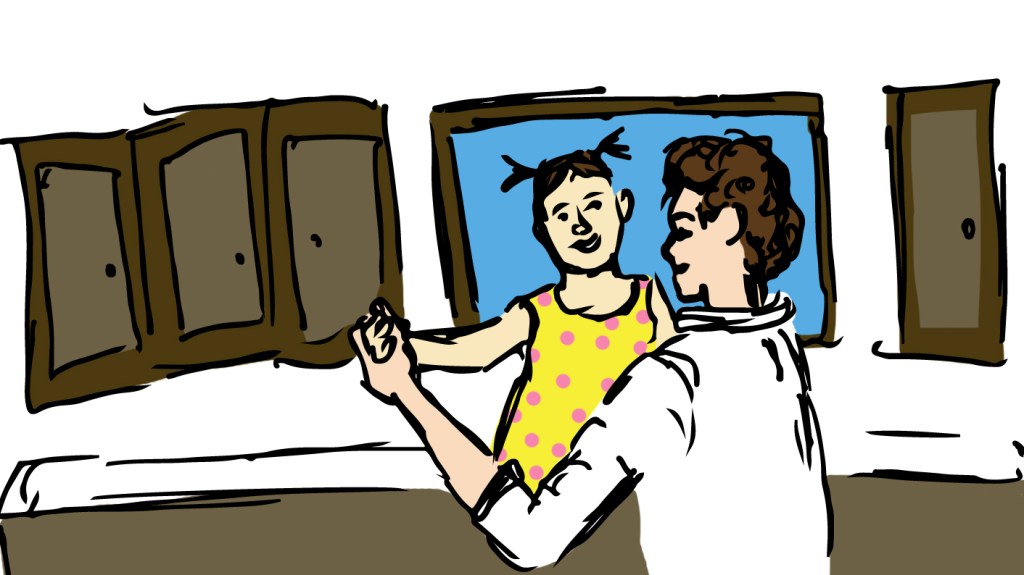
Picture this: It’s a Tuesday evening, 7:00. You’ve had a long day: writing and teaching and coaching and tutoring. You know it’s time to wear your most important hat—Dada—but you lack the energy you know you’ll need to entertain your daughter. She’s almost 19 months old and a bundle of curiosity and movement and big feelings.
You drop your shoes in the garage and walk through the door, into the kitchen, where your wife is simmering a delicious, fragrant combination of sweet potatoes, black beans, and spices. There’s Disney music playing from the robot with a human name sitting on the counter. Your daughter is performing one of her favorite activities: removing every piece of Tupperware from the cabinet and placing it on the floor. You greet her. She smiles and says, “Dada!”
You feel better already.
A few minutes pass and the song “Dos Oruguitas” from the movie Encanto comes on. This is one of your favorites, the type of longing song that makes you just a little bit sad. It’s about two caterpillars in love who become butterflies and have to leave each other, full of symbolism and beauty and sadness.
You scoop up your daughter to dance.
At first, like she is most times, she’s resistant, trying to wiggle free and get back down to her Tupperware. When she was little she would rest her head in the nook between your neck and shoulder, but that rarely happens now. You miss those days.
But then you sway her dramatically, high into the air. A smile immediately grows on her round face. You sway her some more. She starts giggling.
You listen to the hypnotic rhythm of the guitar and Spanish lyrics:
Dos oruguitas enamoradas (Two caterpillars in love) Pasan sus noches y madrugadas (Spend their nights and mornings) Llenas de hambre (Full of hunger) Siguen andando y navegando un mundo (They continue navigating a world) Que cambia y sigue cambiando (That keeps changing and changing) Navegando un mundo (Navigating a world) Que cambia y sigue cambiando (That keeps changing and changing)
Holding your daughter in your arms, swinging her from side to side, you think about the past 18 months. You think about the moment she entered the world and changed yours forever. You think about the sleepless nights and the crying and the utter dependence she had on you and your wife. You think about her struggles feeding and their endless complications. You think about the first year of her life featuring a rotating cast of Greek symbols-turned public-health crises and the constant buzz of worry anytime you left the house with her. You think about the good times and bad and everything in between.
You think, And we continue navigating a world that keeps changing and changing…
Dos oruguitas paran el viento (Two caterpillars stop the wind) Mientras se abrazan con sentimiento (While they embrace with feeling) Siguen creciendo, no saben cuándo (They keep growing, they don’t know when) Buscar algún rincón (To look for some shelter) El tiempo sigue cambiando (Times keep changing) Inseparables son (They are inseparable) El tiempo sigue cambiando (Times keep changing)
She’s loving the dancing now: swaying up to the left, up to the right, softer now, and less dramatic, following the cadence of the song. She’s smiling. You’re smiling. The sun is going down outside, it’s getting cold out there, and the kitchen is thick with the smells of a warm dinner. You think, We are inseparable…
Her smile widens as the chorus begins.
Ay, oruguitas, no se aguanten más (Ay, little caterpillars, don’t hold on too tight) Hay que crecer aparte y volver (You must grow apart and come back) Hacia adelante seguirás (You will carry on, forward) Vienen milagros, vienen crisálidas (Miracles are coming, chrysalises are coming) Hay que partir y construir su propio futuro (You must leave and build your own future)
You don’t listen to the song’s mandates: You hold your daughter even tighter. You don’t want to think about the simple, inevitable truth that all parents must confront: Your child grows up and there is nothing you can do to stop it. You don’t want to think about the next stages of her life, when she’ll no longer be the only child and then go to daycare and then preschool and then regular school and then…?
No, you think, let’s stay here in this kitchen, dancing forever.
You continue to bounce your daughter in your arms as the next verse of the song—about breaking down walls, about new dreams, about miracles—comes and goes. And then, as the final chorus begins, you begin to float, like a butterfly, right there in the kitchen, and all of your worries, all of your fears, all of your strivings and goals and responsibilities, all of it melts away and it’s just you and your daughter, flying together through the kitchen…
Ay, mariposas, no se aguanten más (Ay, butterflies, don’t hold on too tight) Hay que crecer aparte y volver (You must grow apart and return) Hacia adelante seguirás (You will carry on, forward) Ya son milagros, rompiendo crisálidas (There are already miracles, chrysalises breaking open) Hay que volar, hay que encontrar (You must fly, you must find) Su propio futuro (Your own future)
Picture this: It’s a Tuesday evening, 7:05, and as these words drift throughout your kitchen, your daughter rests her head in the nook between your neck and shoulder. Just like she used to.
You must fly, you must find Your own future
You hold her tight.
Join our mailing list!
Subscribe to the Essays of Dad newsletter, a weekly email with parenting stories, background on essays, book recommendations, and more.
Processing…
Success! You're on the list.
Whoops! There was an error and we couldn't process your subscription. Please reload the page and try again.
Recently Mayla, our 18-month-old daughter, has rediscovered a book she enjoys, which means that she insists that we read it to her, multiple times a day. It’s called Dream Big and it’s about powerful women throughout history: There’s Katherine Johnson writing complex math equations on a chalkboard, Jane Goodall playing with chimpanzees, Zaha Hadid designing a sleek building.
Mayla enjoys the illustrations—caricatures of each person surrounded by scenes of their professional interests—and short sentences, but she gets the most animated on the page featuring Florence Griffith Joyner, the decorated Olympian sprinter with multiple world records. As soon as she sees the illustrated Flo-Jo running on a track and hears me read “Dream fast,” she points to the page and exclaims, “Dada!”
My daughter knows her dad is a runner.
It is, of course, hilarious and adorable that Mayla compares me to one of the most famous track athletes in history. To her growing and forever connecting mind, a runner is a runner, regardless of talent or accomplishments. To her, Flo-Jo and I are kindred spirits.
But what struck me the most was that she recognized that I am a runner, that she knew to make the connection. We run together sometimes, and she has watched me run around the neighborhood or park or famous streets of Massachusetts, so I guess it shouldn’t be surprising. But it still made me smile that she associated running with me.
Raising a child has of course altered my life in countless ways, but one of the few things that has remained constant, one of the few similarities between pre-Mayla life and post-Mayla life, is running: a five to seven to 10-mile run, six days a week, on the trails or around the park or through the greenways.
I’ve been a runner for more than 10 years, and it, like fatherhood, has changed my life for the better. Its physical benefits are clear, it’s brought me several of my closest friends, and it indeed does often make your mind clearer and attitude better. I have reached the point where I need running: I need its rhythm and clarity and consistency, its daily exploration of yourself and the world. I am not the same person when I do not run.
This necessity has only been exacerbated by the challenges and questions of fatherhood. Running has helped me navigate being a father, has helped me contextualize those challenges and answer some of those questions (you have a lot of alone time on runs), and I think it’s fair to say it’s even made me a better husband and dad.
But these last 18 months of fatherhood have also been the only time that, on certain days, I feel bad about running, something I’ve felt good about for most of my life. On those days there lingers a question that, I think, most parents who spend hours away running or biking or any other endurance sport have wrestled with: Is it OK to be doing this?
Time, of course, is the most valuable currency to a toddler. They don’t know or care whether you are away at work or on a run or at the store buying groceries; you are simply not there and that is all that matters to them. Their view on time, then, is binary: You are there with them, or you are not.
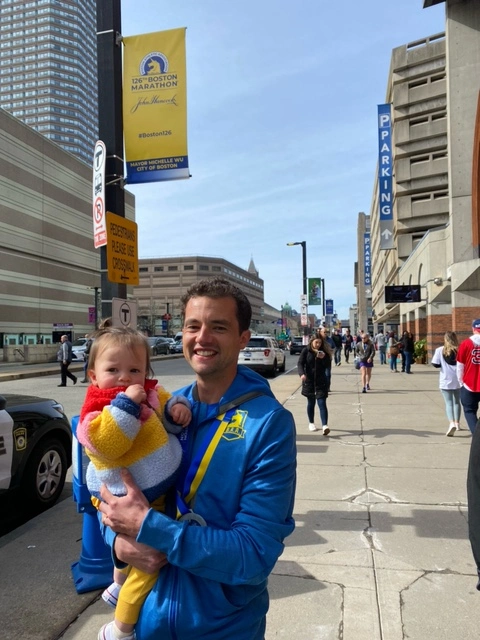
When I was training for Boston, I was not there a lot. Marathon training necessitates hours that turn into days that turn into weeks that turn into months spent performing, as the author John L. Parker Jr. puts it, “that most unprofound and sometimes heart-rending process of removing, molecule by molecule, the very tough rubber that comprised the bottoms of [your] training shoes.” Running is a sport that demands sacrifices, and as a dad I’ve realized the most significant one is your time: It does not care if you are a father or a husband or an employee; it does not care how you spend your time outside of its relatively simple, often cruel mandates. It, like a toddler, possesses a black-and-white view of time.
The dilemma, then, is plain: Your child wants—needs—you to be there with them, guiding them through their new world, but running commands that every day you spend an hour, sometimes more, devoting your time and energy to something else. So, as a parent to a baby or toddler, you begin to justify your absences, why you aren’t there as often as you or they want you to be: Running is a metaphor for life: What you put in is directly proportional to what you get out. It teaches perseverance and instills physical and mental strength. Chasing something big and exploring the edges of your being are important.
But to a toddler, these justifications ring hollow. They don’t care about or even recognize any of these grand lessons about life; they just want you to read a book or build a tower with them. You just spent most of their waking hours away from them at work, and after that you spend more running. There are, you remember walking through the door on those late afternoons, only 24 hours in a day.
Your spouse, too, notices and perhaps sometimes resents the time you aren’t there to help them raise your child. They deserve a present, supportive husband, and often you’re off chasing some dream they might not fully understand but ultimately support because they know it’s part of you. You are reminded, time and again, that one of their truest expressions of their love is recognizing and allowing that.
So what do you do? You could, theoretically, just stop running, choose another, less time-intensive sport, leave it behind for good. You could find something else to replace it. You could attempt to quiet the voices, assuage the guilt, telling you that you aren’t around enough. Or you could attempt to find some type of balance that makes it all work.
Perhaps the biggest irony is that to think about these questions and their solutions all you want to do is go for a run.
There are, of course, countless other parents navigating the challenge of raising a child and pursuing an endurance sport, and countless who do it well, with clarity and grace. There are also professional runners and cyclists and swimmers who devote their entire lives to the sport and still make time for their kids. Being a runner and being a good parent aren’t and shouldn’t be mutually exclusive.
I’ve only been a dad for 18 months, and I probably haven’t mastered the balance yet. But perhaps the biggest lesson I’ve pulled from this relatively short time as a father is the power of our time: it is forever limited, and how we spend it defines who we are and what we value.
So when I get home after work and running, I leave my phone upstairs so I’m not distracted. I refuse to work on the weekends and run only once, early on Sunday morning before Mayla wakes up or during her nap in the afternoon. I’ve become as efficient as possible at work and on runs so I don’t waste any precious time that could be spent with Mayla. All of this has led me to have a different, clearer view on running: I realize now it’s a privilege, something I get to do, that it’s not and never has been guaranteed. I appreciate the sport more now than I ever have.
Perhaps the clearest manifestation of that realization is running before work to maximize my time with Mayla in the afternoons. On those days I’ll wake up early, drive to work under the stars, and begin clipping off miles in the morning dark, thinking of my daughter as she dreams.
Join our mailing list!
Subscribe to the Essays of Dad newsletter, a weekly email with parenting stories, background on essays, book recommendations, and more.
Processing…
Success! You're on the list.
Whoops! There was an error and we couldn't process your subscription. Please reload the page and try again.
Ten things I’ve learned, or relearned, from my 18-month-old daughter
Illustration by Samantha Harrington
We, as parents, are supposed to teach our kids about the world: what’s good and bad and everything in between. We’re supposed to provide them a structure and framework by which they can begin to understand its complexities and ask questions when they don’t. We’re supposed to help them shape and sharpen their perspective and challenge it when necessary. We’re supposed to be their guides.
But through 18 months of being a dad to Mayla, our strong, hilarious, stubborn little girl, I’ve learned that the opposite is true, too: Our kids can teach us. I’ve learned—or perhaps relearned—things from Mayla that are as or more valuable than anything I’ve taught her.
So here’s to those timeless lessons of toddlerhood. May we all remember them when life gets crazy.
Take your work seriously.
Recently Mayla has become a chore connoisseur. If you ask her to open the door to let the dogs in, she immediately stops what she’s doing and marches over to it, stretching her arm and standing on her tippy toes to pull the handle. If you hand her a piece of trash and ask her to throw it away, she opens her hand and takes it to the trash can in the kitchen. If you open the dishwasher, she’s suddenly at your side, taking spoons out of the silverware hatch and handing them to you to put in the drawer (which she’d do herself if she were tall enough). If you say it’s time to feed the dogs, she scoops up the dog bowl and heads over to the bin of food in the pantry, waiting expectantly for someone to scoop a cup in. Then she carries over the now-filled bowl to the dogs’ designated eating spots, invariably dropping some (or a lot) of food along the way. When this happens, she immediately sits down and silently picks up every piece of dropped food, one by one, and places it into the dog bowl. It is attention to detail at its finest.
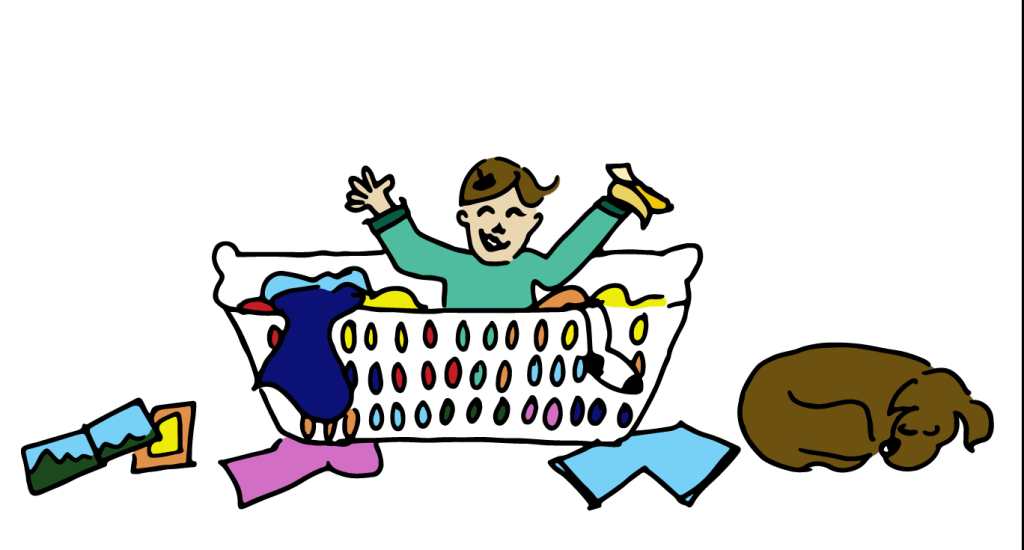
By far my favorite, though, is laundry. First, she loves to help put the dirty clothes into the machine, taking care not to miss even the smallest sock, helps scoop and pour the detergent, and presses the power button to begin the cycle. Then she goes about her day—until she hears the washer chime to signal the cycle is complete. She immediately drops whatever she’s doing, points over to the laundry room, and exclaims, “Uuahh!” as a giant smile forms on her face. This is our signal that she wants to move the clothes to the dryer, which we then do together. Finally, once all of the clothes are clean and dry (another chime that elicits a joyful scream), she helps us sort and organize all of them as we put them away in our bedroom.
My favorite part about all of this is the look on Mayla’s face when we ask her to do one of these tasks: She looks us directly in the eye, unsmiling, as if to say, Thank you for trusting me. I won’t let you down. To us, they’re relatively menial, quotidian chores; to her, they’re the most important thing she’ll ever do, and she treats them as such. I love that.
Play. Every day.
Work, as Mayla has established, is important. But so too is play.
Most of Mayla’s non-eating waking hours are spent playing: at the park, on the swing Papa built her in our backyard, in the playroom upstairs. She loves to play with blocks and cars and ramps and balls and bubbles. She loves to play hide-and-seek and chase and (an extremely basic form of) soccer. She loves to play with her Mama and Dada and grandmas and grandpas and aunts and uncles, with anyone who will pick up some blocks and help her make a tower. She loves to play.
Life, as we all know, is busy, and fulfilling your responsibilities as a parent or spouse or employee is of course paramount. But perhaps we should not forget to make time for, every day, something that brings us that simple, pure joy we found every day as kids.
Food is life. Treat it as such.
Since we had such a challenging time feeding Mayla as an infant, we were worried that we might also have trouble when she graduated to solids. We did not.
Mayla loves to eat. Breakfast, second breakfast, lunch, post-nap afternoon snack, pre-dinner stroller snack—these are, probably, her favorite times of the day. It starts in the morning, soon after she wakes up, when she’s strapped into her high chair, wrapped with her bib, and gets to work. She eats eggs or waffles or oatmeal or yogurt (or sometimes several of these at once) and always, always fruit: blueberries and bananas, mostly, but often also strawberries and blackberries and oranges. It is her biggest and best meal of the day.
The rest of her day is dictated by her eating schedule, and she will, by rapidly moving her bunched fingers toward her mouth, sign language for “eat,” let you know when it is time for her next meal. She’s the queen of snacks—Cheerios and cucumbers and cottage cheese—and loves to feed herself independently. If she likes the food you offer her, which is most of the time, she will sign for more and say, “Muuahh!” so adorably that you will have no choice but to agree to her demands. At some meals she will eat more than her mother. If she doesn’t recognize what’s on her plate, she lets us know, usually by pointing at the unidentified food and saying, “Uuahh?” Only when we have identified it all—“black beans,” “rice,” “avocado”—will she begin eating.
Mayla does not understand all of the hype about fad diets. She does not skip breakfast. She does not believe in intermittent fasting. She is not picky or demanding; if it’s in front of her, she’ll try it, and probably like it. She loves going to the farmers’ market and the local ice cream shop. When she’s there, she often treats herself to bites of her parents’ ice cream and doesn’t feel guilty about it. She does not think eating healthy is as difficult as adults sometimes make it seem. She abides by an eating philosophy radical in its simplicity: Eat good food and enjoy it.
Sometimes all you need is a nap.
Mayla does not pretend to be perfect. There are times when no amount of work, play, or food will fulfill her. During these times she simply needs what most of us crave every afternoon: a nap. A good, dark-room, fan-on, A/C-down, uninterrupted nap. When she wakes up she is refreshed and happy and ready to explore again.
Pet your dogs.
Read, often.
If Mayla is not eating, sleeping, playing, or working, she’s likely reading a book. She has her favorites—Blue Hat, Green Hat; Brown Bear, Brown Bear, What Do You See?; Will You Be My Sunshine?—but is willing to try new ones, too. She loves the rhythm of the words and simple beauty of the illustrations. She loves pointing at pictures of things she recognizes, like “buhh”s (birds), “duahh”s (dogs), and “wawa” (water). She reads probably a dozen books a day, at all times of the day. Books, Mayla has reminded me, are sometimes the only entertainment we need.
Go outside when it’s sunny.
Go outside when it’s raining.
Mayla is not brought down by the presence of rain; she is energized by it. As soon as she sees water falling from the sky, she excitedly points outside and exclaims, “Wawa!” She then relentlessly asks to go outside, and we eventually must let her, such is her desire to go play in the rain. When she gets her wish, she toddles around through the wet grass and splashes in puddles and raises her arms up to catch the miraculous wet drops falling from above. Her joy in these moments is pure.
Expressing your feelings and communicating are important.
Mayla has big feelings, and she does not shy away from sharing them. When she is happy, we know. When she is sad or angry, we know. When she is confused, we know. There is something refreshing in knowing exactly what she’s feeling at any given moment, because even if we can’t do something to immediately make her feel better, at least we understand and sometimes that’s all that matters. Carly, my wife, is especially adept at helping Mayla navigate her feelings. “I see that you’re sad,” she’ll tell our daughter. “But we are about to eat dinner, so I don’t want you to fill up on more Cheerios.” Sometimes simply the soothing sound of her mom’s voice will help her become calm; other times it won’t, but Mayla will know that her feeling was identified and understood.
At some point as we grow up we are conditioned to hide weakness, to hide those big feelings, and sometimes that makes it difficult for others to understand. Mayla has reminded me that emotions are real and it’s OK to share them. We don’t have to be perfect. We just have to be honest.
The world is a vast, beautiful place.
My 18-month-old daughter thinks it’s an absolute joy to be alive. Sometimes she can’t believe that she gets to, every day, explore the world. She thinks it’s a privilege to watch birds fly and rabbits run and water rush through the creek. She thinks every rock on the ground and every airplane flying above is a joy, a miracle. She doesn’t take for granted that she gets to splash in puddles and read books and play with toys. She appreciates the simplicity of walking the dogs around the neighborhood and pointing up to the mountains along the way. She is endlessly curious and endlessly happy.
I love her.
Join our mailing list!
Subscribe to the Essays of Dad newsletter, a weekly email with parenting stories, background on essays, book recommendations, and more.
Processing…
Success! You're on the list.
Whoops! There was an error and we couldn't process your subscription. Please reload the page and try again.


 Essays of Dad