*Editor’s note: All student names have been changed.
They cried. As the principal came on the intercom for his last announcement of the year, as they finished the final lines of their impromptu karaoke of “See You Again,” their arms linked with their classmates-turned-friends, as final minutes, then seconds, of their fifth-grade year trickled by, as the bell rang to release them for summer, a typically joyous occasion, half of my fifth-grade students were in tears. Brittany’s eyes were red and puffy. Eva’s tears were streaming down her face, under her blue surgical mask. Camila turned to her friend and said, “This is the first time I’m sad to leave school for the summer.”
The past school year, more than most, meant something to them, and to me. We created, my fifth graders and I, something special, memorable. Our class, at the risk of sounding cliché, felt like something close to a family. They bickered like siblings, knew one another’s strengths and flaws and idiosyncrasies, laughed and fought and cried together. They knew that Jeremiah liked at least two sleeves of grape jelly on his biscuit every morning. They enjoyed the fact that Erica owned over 50 birds, and listened and asked questions as she led a presentation about them every Friday during “Bird Talk with Erica.” They appreciated Ada’s love of Star Wars, and Evan’s obsession with Pokémon. They, whether or not they realized it, filled a classroom with love.
As I watched them say goodbyes to friends new and old on that final day of school, I fought back tears of my own. I thought about the journey that led me to that specific moment, one that took me from coast to coast and dropped me in the mountains of North Carolina. I thought about how much the young people in front of me had grown since August. I thought about how becoming a teacher had changed my life.
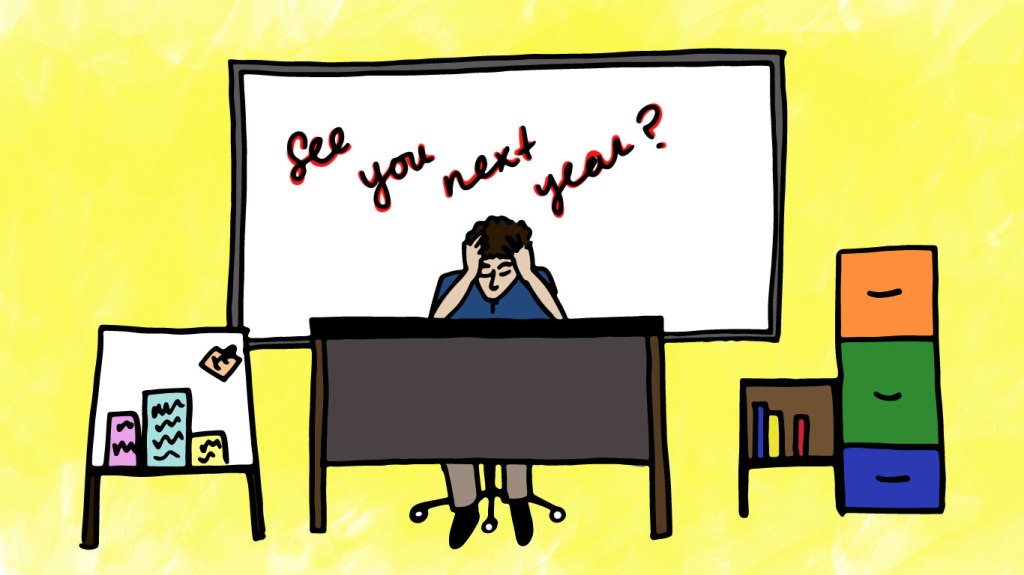
I thought about a lot during those final minutes of our school year, but hanging over every thought, like a cloud promising rain, was a brutally simple question: Was this my last day of school, too?
Last school year, of the five I’ve taught, was the most challenging. There were days I left the building defeated, or worse, disillusioned. Sometimes I’d spot a teacher friend in the hallway, and we’d simply share a knowing look and sigh. Teaching during a pandemic, devoting our not limitless energy and time to countless things unrelated to academics, worrying if we’ll make enough money to support (or start) a family—all of of the problems that have for years plagued public-school teachers, especially in North Carolina—they all began to, finally and inevitably, bear consequences. A teacher around my age found a new job and started it after winter break. Others took weeks off to recalibrate. Several teachers I know joined the almost 8,000 (!!) in the state who planned to leave the profession altogether.
For most of the year, I thought I’d be one of them. The realities of working full-time for not enough pay and being a dad became immediately and strikingly clear: When I got home from school, I’d usually tutor or complete my work as a teaching assistant for a college course to supplement our income. All I could think about during those hours was that I was missing spending time with Mayla, our now 17-month-old daughter, that I was missing her grow up.
And that was at home. At school, chaos reigned. For the first half of the year, I usually spent the first 30 minutes of every day trying to figure out who was allowed to be there: Was that scratchy throat and runny nose dripping into their mask COVID or just allergies? Wait, was she technically exposed since they were outside but weren’t wearing masks? Does that kid need to show me a negative test so he can learn about fractions today? How many days was he in quarantine? I had to send more than one kid home, pulling them out in the hallway to tell them that according to the ever-changing policies they were not supposed to be at school. They handled the news, as ever, like champions: This was their new world.
When a student in my class tested positive, an administrator would walk down to my room, carrying a pool noodle (they’re exactly six feet, apparently) to determine who else was potentially exposed and therefore had to go home and quarantine for 14 (and later, 10, and later, seven, and later, five) days. I didn’t keep track, but I’d estimate that in my class alone the total number of days missed by students was over 100. They fell behind, of course, because if virtual learning taught us anything, it’s that it doesn’t teach students anything.
(None of this is to complain about pandemic policies or downplay the severity of a new and scary and often deadly virus; it is simply to say that how to be an effective micro-scale public health coordinator was not something they taught us in grad school [not that North Carolina values grad school, because they don’t pay a master’s degree supplement].)
COVID, of course, also exacerbated other issues that had already plagued the public-school system: behavior problems, achievement gaps, transportation. Our school, like so many others across our county and country, had a severe shortage of bus drivers, which meant that the ones we did have ran two, sometimes three, loads of students to and from school, which meant that teachers and other staff members were arriving hours early and staying hours late to supervise the early arrivers and late departers (who were often the same kids). During one particularly rough stretch, a group of students who lived in the same apartment complex had to leave school 20 minutes before the bell rang, missing out on instruction and time with teachers and friends, because it was the only way we could get them home before 6 p.m. If one of the drivers, God bless them, got sick or had to miss school—COVID or otherwise—the entire system came crumbling down. They couldn’t drive (and if you think hiring a bus driver is difficult, try to find a substitute), which meant many of their students couldn’t get to or from school because their parents worked early or late and they were relying on the bus. I remember missing a couple of my students one day because their bus wasn’t running and thinking that being unable to transport a child to and from school has to be one of the biggest failures of the public-school system ever.
Teachers got sick and had to miss school too, of course, and if that happened finding a substitute to replace him for a day was often close to impossible. When a class didn’t have a sub, usually a support staff member (media specialist, intervention teacher) would step in to cover it, which of course affected their own schedule and their students’ learning. Worse still, if there were several teachers out without substitutes, there wasn’t enough support staff at the school to cover their classes, so the students would be split into other teachers’ classrooms: More than once I had students from other classes arrive at my classroom door asking where they should sit for the day. (During all of this, we were called to a meeting in which a higher up in the system told us our students’ test scores were troubling.)
Not that there were easy solutions: Teachers and administrators and staff at our school worked long days and often long nights simply to keep the school running; this wasn’t an issue of not caring or working hard enough. No, this was an issue of finding answers to often unanswerable questions. This was, as had become the trite saying, unprecedented.
We were exhausted and sometimes broken. As every restaurant and grocery store around town started posting “We’re Hiring” on their road signs, we began to do the uncomplicated math: at almost $20 an hour for some of those jobs, accounting for working summers, we could make nearly the same salary we did teaching. One day after school my friend from down the hall came to me and said, “Today was one of those days that made me want to go pack boxes at Amazon.” At that moment I couldn’t come up with an argument against it. (And that’s not to take anything away from people who work those jobs, which are not trivial, or to say that they don’t deserve the salary they earn; it’s to say that teachers are underpaid relative to their training.)
It all began to feel unsustainable. For the first time in my career, I began to feel what everyone warned me about when I became a teacher: burned out.
So I began looking for a way out.
On the second-to-last day of school, less than 24 hours before my students cried during their final moments of fifth grade, I had a third-round interview for a writing job at a science education technology company. If I progressed, I’d have a final interview before the company decided whether to offer me the position.
The application and subsequent interview process were intense—multiple essay questions, an initial interview with a manager, a writing challenge that took close to 10 hours of planning and research, an interview in which two senior team members critiqued and peppered me with questions about that writing challenge, an interview with other team members that required me to come up with several ideas for a potential science video—but I was relatively prepared, because six months earlier I had gone through the nearly the exact same thing for a similar job with a similar company.
I was prepared to leave teaching halfway through the year.
The jobs, which were fully remote, came with tantalizing benefits—401K matching! Weeks of (or unlimited) PTO! Free health and dental! Three months of paid paternity leave!—and a salary that doubled what I earned teaching. The complete package was more than six figures, easy.
The contrast with teaching was striking. When Mayla was born toward the end of the previous school year, I took three weeks—15 days—and had to use sick leave for all of them. My wife, Carly, who also works in the public-school system, took 12 weeks and was paid for exactly zero of them.
It baffled me: I could earn double my salary with benefits dwarfed those provided by teaching without gaining any extra training, education, or experience. I was still the same exact person! There was a job out there—multiple jobs—that valued my skill set (which, to be fair, is not that impressive) at least 100 percent more than the public education system did. I didn’t realize that this market existed for me. I thought a career change would involve, like it does for most other jobs, going back to school and earning another degree.
I was taken: I imagined spending mornings writing and researching in our home office before heading downstairs to eat lunch with Mayla, and then maybe taking the dogs for a walk during a mid-afternoon break. I imagined taking a day off without feeling guilty. I imagined, overall, feeling less stressed. One of my greatest sources of worry as a dad was (and is) earning enough to support Mayla and our family, and this would have all but eliminated it. All of this, naturally, only increased my resentment for the current education landscape. These jobs wouldn’t be perfect, of course, I knew that, but it was difficult to think that getting either of them wouldn’t be a positive career and family move.
But there lingered, during every hour spent applying to jobs and preparing for interviews, during runs spent pondering my future and the drives home after, a question I tried hard to ignore: Was I selling out?
Turns out I never had to answer it, because I didn’t get either job. After each final interview, I was emailed a stock rejection from the company’s HR rep. But the fact that at least some part of me questioned my willingness to leave teaching for a higher-paying, less stressful job surprised me. And the reason, as always, was what the entire crumbling, confusing, contradictory education system is built upon, and will be forever: the kids.
Because every time I thought about my new life working remotely, I also thought about Patrick, who went from never turning in assignments to becoming one of the strongest math students in the class and crushing the end-of-year test. Every time I imagined a day without the unnecessary bureaucracy of education, I also thought about Joy, who showed up in tears on the first day of school and by the end of the year was confidently running my classroom. Every time I wondered what life would be like working in the real world, I also thought about Abby, who organized the entire class writing inspirational notes before I left to run the Boston Marathon, leaving me with no words and red eyes. I knew, no matter the companies’ claims of Improving the education of every child! and Implementing innovative, thoughtful solutions to personalize learning!, that they weren’t the same as being in the classroom, never would be. They couldn’t and wouldn’t match the feeling of flipping the lights on every morning and preparing for the rush of questions and stories and life that came from teaching a group of 10-year-olds. They would never come close to the love you felt as you gazed, from the front of your classroom, at those wide-eyed young people you were responsible for. They couldn’t replicate the pride you felt when one of them told you about finishing Harry Potter or the laughter that echoed around the classroom when one of them tried to teach you ballet. There would be no more inside jokes and personalized handshakes and sticky notes on my desk with fun facts. There would be no more Patricks or Joys or Abbys. They would be out there somewhere, sure, but I wouldn’t get to know them. And that ate at me.
Because that’s all it’s ever been about, right? I realized early in my career, with startling clarity, that our students, those 20-plus (sometimes 30-plus!) vessels of humanity seeking our guidance, our wisdom, our presence—they are the reason teachers endure what they endure. They are the reason we bear the early mornings and late afternoons spent in the quiet aloneness of our classrooms, the after-school duties and meetings during planning, the ever-changing guidelines and protocols, the endless parade of important-sounding acronyms—in short, the challenges that public-school teachers deal with every time we walk in our classrooms. Our students need us. They need our knowledge, our discipline, our strength. They need us to listen to their weird stories and questions, to assuage their worries and fears, to inspire and lead and tell them it’s going to be OK. We are there, first and always, for them.
I try to remember that simple truth every day: It’s about the kids. That’s all it’s ever been about.
Therein lies the teaching dilemma: the conflict between rationality and emotion, the endless war between your brain and your heart. Or, as Gary Smith, one of my favorite writers, put it: “An old nettle digs at most every human heart: the urge to give oneself to the world rather than only to a few close people.” If teachers were all Adam Smith-created (different Smith) rational beings, governed by pure self-interest, the entire system would crumble in days. Because teaching, at its core, is irrational, at least in the economic sense: Most teachers’ skills and experiences would earn them more money, sometimes far more, and perhaps a higher standard of living in another field. There is nothing tying them to their jobs other than a deep, abiding commitment to the young people in front of them (and summers off).
It’s cruel, really: It’s difficult to leave because you know you’ll lose that strong sense of purpose but difficult to stay because of everything else. The question, then, is which part of you do you choose: the pragmatist or the dreamer? That’s the question every teacher, those that left the classroom and those that are starting another year of teaching this week or month or year, wrestled with at some point before they made their decision. There is no right or easy answer.
I made my choice: Yesterday I started my sixth year of teaching. The question for me, then, and all fathers, is how do I teach Mayla which voice to listen to, which itch to scratch? How do I teach her how to balance reason with emotion, logic with passion? Can she—can anyone—have both? For a good portion of last year I thought that I couldn’t be both a good teacher and a good father because I wasn’t around enough, but what I’ve learned is that maybe being a good teacher is part of being a good father, that maybe one of the most important lessons you can teach your child is that the world is complicated and sometimes you have to listen to the nettle that digs at your heart.
All of that’s for the future, though. For now, I’ll simply smile when, on the final pages of her favorite book Brown Bear, Brown Bear, What Do You See?, she points to the teacher and proudly says, “Dada!”
“Yes,” Carly tells her. “Dada is a teacher.”
Join our mailing list!
Subscribe to the Essays of Dad newsletter, a weekly email with parenting stories, background on essays, book recommendations, and more.
 Essays of Dad