30 for 30

A 30-mile journey in the mountains, to find out something important

“Have you figured out what you’re running from yet?”

The question came from a man in the dark. It was a weeknight, a few years ago, and I was stretching by my car after doing some school parking-lot loops to get in a couple extra miles after a late meeting. The question was sudden, disarming. It came from one of our school’s custodians, who had come out to his car to retrieve something during his solo night shift. 

I laughed noncommittally. “Umm.” I paused, thought. “I don’t know.”

“The correct answer is heart disease and type II diabetes,” he said, smiling. 

I laughed. “I guess I’ve never really thought about it,” I said. “I guess I’m just running from…” I paused. “Yesterday’s self? To get faster, I mean.”

He stopped about halfway between our cars. 

“You know, I was reading Craig Ferguson’s—he’s a Scottish comedian, one of my favorites—I was reading his biography. It’s called Riding the Elephant. And in it he talks about how he’s always been a runner. You ever heard of it?”

I shook my head.

“Well, it’s about all of the challenges he’s been through—addiction, heartbreak, pain, fatherhood—and something really stuck with me. And I thought of you when I read it, because I see you running, every day.”

He paused. I looked into his eyes.

“He said that he used to run from all the hurt. Until he met his wife. That was when he finally found something to run toward.”

I let the words seep into the night. Something to run toward

He retreated back to his car and said goodnight, leaving me alone to think in the darkness. I had been a runner for almost a decade at that point and had never considered one of its simplest questions.

What was I running toward?


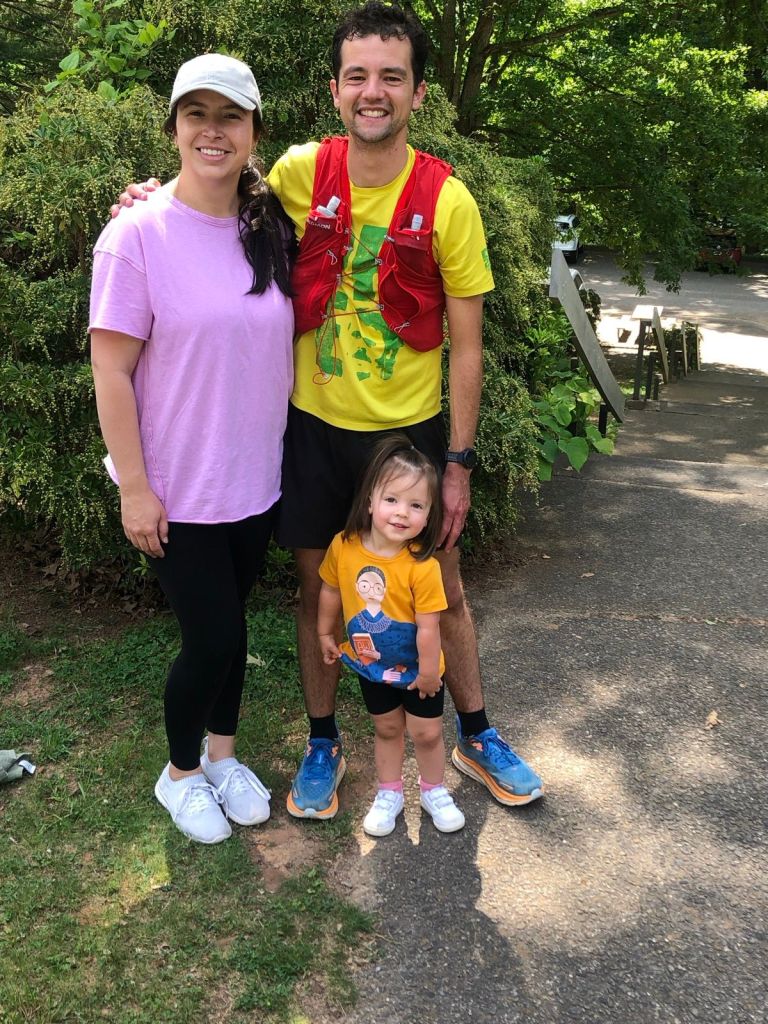
Two Saturdays ago I woke up at 3:30 a.m. to run 30 miles through the mountains. About two weeks earlier I had turned 30, and it had become something of a rite of passage among my runner friends to cover 30 miles in honor of this milestone birthday. My motivation was relatively simple: I wanted to prove to myself that even though I was getting older, I could still run something long. My plan was to run from the base of Mount Pisgah to the Folk Art Center, a section of the Mountains to Sea trail that I had covered in pieces before but never all at once. My wife, Carly, and two girls would meet me at the end. This would be, if all went well, the farthest I’d ever run, in terms of both distance and time.

And so there I was, driving up the Blue Ridge Parkway in the early morning hours with my best friend Jordan, climbing out of the car when we arrived in the parking lot of the Mount Pisgah trailhead. It was cold when we got out, the sun still hours from rising and the wind and elevation much stronger than down below. Wondering if we’d underdressed, we filled our bottles, organized our nutrition—an avalanche of sugary powders and gummies—and strapped on our running packs and headlamps. And then we entered the dark trail. 

The first section, down a brutal stretch of trail officially known as 151 but more endearingly referred to as “the elevator shaft,” was choppy and technical, but we nearly immediately entered that sacred running space, where ideas and conversation bounce and flow as unpredictably as our footsteps. It was just after 5 a.m. in the mountains and we were loving it. 

For the next two or so hours we talked about running and fatherhood and public education, saw one bear and two people, ran into the sunrise, and marveled at the green mountains surrounding us. Around mile 12, Jordan stopped at his car at his pre-planned departure spot, and we said goodbye. I continued down the trail on my own. 


Almost immediately I popped in Carly’s Airpods and so soon Arcade Fire and Mumford & Sons accompanied me as I glided through the mountains, enjoying their curves and undulations I’d run so many times before even as my quads began to sear on the downhills. 

And then a song came on that I listened to during my brief, post-college stay in San Diego, one of those times when life punches you in the mouth but you come out stronger, and then it hit me: I was running this not to simply to prove that I could, not merely to delay or defy the endless march of time, but for something deeper, more important: This 30-mile run represented my 30 years on Earth, those thousands of beautiful and difficult and ultimately purposeful days that had shaped me. I’d started the run with Jordan, my best friend since birth, covering miles together as we’d done countless times as teenagers through the heat of Florida. And now I was by myself, as I was after college, running forward, unaware of what awaited. I knew then that everything—the good, the bad, the in-between—had led me to that specific moment, sprinting down a mountain and pumping my arms to the music blaring through my headphones. It felt big.

A few miles later I ran into the parking lot where my friend Charlie was waiting with pickles and Gatorade. I ate a little, drank a ton, and ambled back to the trails, where 13 more miles beckoned.


Around mile 19, on one of the easiest sections of the trail and one I’d run dozens of times before, the physical and mental reality began to set in: double-digit miles to go on heavy legs and a tired brain. As it often does in low moments, doubt, about the rest of the run and its value, began to slowly creep in. 

But Charlie, as he and so many other friends had done for me throughout runs and more broadly life, powered us through the rough patch, with humor and conversation and, most importantly, by simply being there. We continued that simple, most elemental task of putting one foot in front of the other, and the miles began to clip off a little more easily, nine to go then seven then five, and soon we were two miles out from the finish, laughing and waxing philosophical and tearing into a pack of peanut M&Ms and at one point taking a wrong turn that led us to the right place.

With a mile to go, we shoveled down some more M&Ms and opened our stride. Here it was, here it always is, the last mile, that holy place of pain and joy and heart, where you find out important things and you’re no longer running but floating, drifting by the world passing at a different speed and feeling only your chest working hard and blood coursing to your arms and legs. 

I was running fast, faster than I had all day, because I finally knew the answer to my custodian’s late-night question all those years ago. 

I reached the parking lot. And then I walked over to my wife and two girls. 

Turns out I’ve been running toward them all along.


What I Talk About When I Talk About Running With My Daughter

Illustration by Samantha Harrington

We blazed, my daughter and I, down the mountain, the trees around us a blur and our hair jetted back like we were on a rollercoaster. I looked down at the watch on my left wrist; it indicated that we were running sub-6-minute-mile pace. Perhaps concerned about the speed, Mayla, my one-and-a-half-year-old daughter, looked back at me through the crack in the stroller awning, as if to ask, You got me, dad? We closed the 6-mile run on one of my favorite trails in 5 minutes and 57 seconds; it was our fastest mile together, and we’ve run many.

We’ve covered miles in our neighborhood, on trails, on the beach, on the dirt road I used to run from my parents’ house as a high schooler in Florida. We’ve run in the heat and cold and rain. We’ve run to blow off steam after a long day and to feel the wind rush past our faces and the oxygen snake through our veins. We’ve run because it is sometimes the best way to give thanks for another day of sun and cloudless skies. We’ve run because sometimes the best thing to do when life gets overwhelming or complicated is to throw on the trainers (HOKAs for me, white low-top Converse for her) and sweat. We’ve run to feel free, alive. We’ve run every mile together. 

I had been looking forward to running with Mayla before she was born, and was slightly disappointed when I found out that she wasn’t old enough to go for a run until she was six months old (count this as one of the many logical things I didn’t know entering fatherhood). But when Carly, my wife, bought me a used running stroller as an early Christmas gift, it was, in the most literal sense of the phrase, as if Christmas had come early.

I took her out in it for her first run later that week; she seemed to love it. Since then, our runs have become something exclusively ours: Dada and Mayla, pounding pavement or crushed gravel, with the squirrels and rabbits and birds often our only companions. They are some of my favorite times as a dad.   

I always wonder what she thinks when we’re running. Often she smiles and points at dogs or other animals passing by, identifying them by name if she knows. Other times she’ll, after minutes of silence, sit up suddenly and yell “Dada!” as if she just remembered who was making her move. “Hi, Mayla!” I’ll respond, and she’ll look back at me, wave her hand dramatically, and say, “Haaii!” with an irrepressible smile. Recently, when she’s bored I guess, she’s started rotating her fists in front of her face, which means she wants to hear “Wheels on the Bus.” And that is why, if you’re around the park near our house at the right time, you’ll hear a dad singing “The people on the bus go up and down/up and down…” through clipped breaths as his daughter throws her hands up, dancing to the song in the stroller that he’s pushing in front of him.

Most of the time, though, she sits there essentially expressionless, taking in the sights and sounds and life around her. It’s in those moments, when I look down at my daughter, the person who changed my life for the better, forever, that we experience something pure, a type of wordless communication of love, the embodiment of stillness and contentment: Just a dad and his daughter covering ground as we were designed to do. I like to think she loves these runs as much as I do. (As if to prove that point, she fell asleep on one run: As we climbed up a steep hill on our first trail run, as the stroller bumped and swung over the uneven ground and Arcade Fire blasted from my phone’s speaker, as I sweat and huffed vigorously, Mayla closed her eyes, put to sleep by the rhythms of running. She awoke shortly after to eat a snack once we reached the top of the hill.)

I don’t know if Mayla will become a runner when she’s older; I won’t attempt to sway her one way or another. I mostly want her to appreciate its simplicity and groundedness with the natural world, to understand that there’s value in making your heart work hard and letting your mind escape the everyday, to see that the world is vast and gain important perspective. Maybe she’ll find that through running, or maybe it will be something else.

Right now, though, we’re going to keep running. A few weeks ago we went out for a 2-miler, and about a mile-and-a-half in it began to rain, gradually picking up in intensity. We were still a good half-mile from our house, so I tried to cover her the best I could with the awning as we turned home. A few seconds later, we hit a significant bump, and my phone flew from the top of the stroller into her lap. I walked around to the front of the stroller to retrieve it. 

“You ready?” I asked, extending my hand. She looked me in the eye and returned my fist bump.

So the father and daughter ran home in a growing rain. 


Join our mailing list!

Subscribe to the Essays of Dad newsletter, a weekly email with parenting stories, background on essays, book recommendations, and more.

Processing…
Success! You're on the list.

Running Through My Childhood

For the first time as a father, I returned to my childhood. Everything was the same.

“You’re not gonna wear a shirt?” my dad asks me from the garage. He’s wearing a thin shirt blotched by giant circles of sweat. “Mosquitoes are bad today.”

I’m standing between my parents’ cars in their driveway, attempting to connect my GPS watch by holding my left wrist above my head, pleading with the heavens. I smile and nod. 

“Well, you didn’t listen to me when you were 16,” he tells me, walking inside. “You’re not gonna listen to me when you’re 28.”

He’s right. My shirtlessness was never in question on this run: It’s the second day of August in central Florida, the time of year when, as a friend once told me, “the air is so thick you can chew it.” I start off down the crushed stone driveway, shaking out the stiffness from my legs as I cross the cracked concrete bridge leading into the rest of the neighborhood.  

I’m home—or am I?—for a week, working at a camp that helps high school students apply to college. That’s how I described this solo trip to anyone who asked—“I’m going home to Florida”—but now I’m hesitant. Is my parents’ house, where I spent 16-plus years, where I picked blackberries in the spring with my mom and watched “Jeopardy!” on school nights with my dad and battled friends in marathon basketball games—is this home? My wife and our daughter stayed back at our house in North Carolina, where pictures of our growing family dot the walls, a 15-minute drive from friends and work and the apartment we lived in when we moved there three years ago. In the coming days, I will tell my wife, “I can’t wait to come home.” Is it possible—is it allowed—to have two homes, or is home, by its very definition, a singular place? 

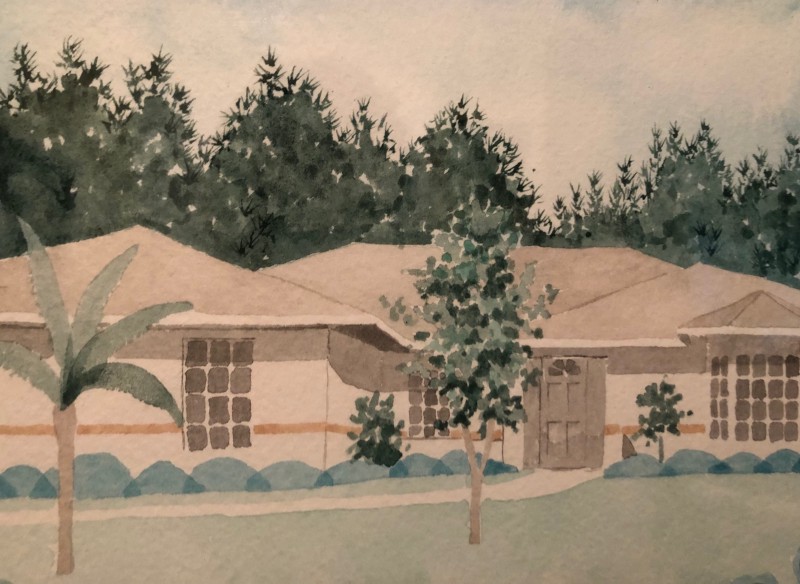
Maybe I’m just being sentimental; people tell me I’m too sentimental. Maybe I’m calling my parents’ house in rural Daytona, a one-story stucco with a weathered palm tree in the front yard and the stump of a towering sycamore in the back—maybe I’m calling it home because I know this could be the final time I’m here, and assuredly the final time I’m here alone. They’re going to sell this house soon, they tell me, because without my sister or me living here, they don’t need these two-and-a-half acres and 2,000 square feet and the upkeep it all entails. They want something smaller, simpler to begin their retired lives together. 

Maybe I’m calling it home because I know, in some fiber deep in my chest, that I am back, for the last time, in my childhood.


My parents’ house stands a few miles south of Daytona Beach, in an area referred to as “unincorporated county land.” That’s a good word, unincorporated, to describe their community, a swath of land teeming with deer and dirt and Ford F-150s. The road leading to their house, a misshapen oval named after the fourth wife of the man who owned all the land, has never been paved, which is why after it rains you will often see Mr. Knox from two houses down riding a tractor to smooth out the sizable divots in the crushed gravel. 

That’s where I’m running, mosquitoes be damned, on this gray and humid Monday, beginning the barely four-and-a-half mile route that we used to call five even. Without my wife, without (most of) the responsibilities of fatherhood, staying in my sister’s old bedroom, trying to finish the run before dinner, I feel 10 years younger, like I’m in high school, putting off studying for a bio test the next day and T9 texting friends from my flip phone. I can hear the echoes of my childhood in my dads’ words before the run (“You didn’t listen to me when you were 16…) and see it all around me as I run: There’s Harry’s farm, with a couple dozen chickens running around in the yard, a 500-pound pig lying in the hay, goats munching on grass contentedly. There’s Mr. Kondos, trying to corral his fierce German shepherd and yapping little terrier on another frenetic walk. There’s Lily, the neighborhood deer, who’s so unafraid of humans now that she essentially lives in Harry’s yard, a wild addition to his domesticated animal haven.

But even if the neighborhood had remained comfortingly static, I had changed, of course I had, because that’s what people do in the 10 years since high school: They change and they grow and they try to navigate adulthood and maybe parenthood and, if they’re alive at the right time, a pandemic that won’t go away. They learn that health insurance is a complicated mess, that all you need to watch TV is a baby boomer’s cable login, that every single one of their stored passwords is somehow compromised. 

I’m running in, running through, my childhood as an adult, with all of the experience and baggage and contradiction it brings, running past the house I used to think was haunted, down to another one on the corner where Fife, their dog, used to bark and chase me along the edge of his yard until I was far enough away. I’m running across the busy road to the other neighborhood, taking a right onto the paved road, passing the same white mailbox that marks two miles and dozens of No Trespassing signs (“The fastest way to meet the Lord is praying. The second fastest is trespassing”), reaching the turnaround just past my old soccer teammate Garrett’s house.

I’m running the same route I’d run hundreds of times before, and its overwhelming sameness strikes me. It’s me that’s changed: Everything is shaped, or sharpened, by my adult experiences and perspectives and skepticism.  

The first way this distinction strikes me is when I read, from my annoyingly precise GPS watch, that the white mailbox is actually only 1.88 miles, not two. I later wonder if it’s ironic or wholly appropriate that one of the most remote areas in the county has the highest number of No Trespassing signs per capita, and if it’s strange or refreshing that my parents, two lifelong Democratic educators, chose to live in a conservative stronghold where their shirtless, skinny son ran for miles while other kids rode four wheelers through the mud. When I pass Garrett’s house, I think about how he is married with a kid, and how that’s almost beyond comprehension, because it was just yesterday that his grandma was driving us to soccer practice, stopping at McDonald’s for double cheeseburgers on the way home—and then I catch myself: Holy crap. I’m married with a kid.  

It’s a strange place, your childhood. When you’re in it, all you think about is leaving; when you’re back, all you think about is how you can never live it again, not like you did before. It exists independent of you, unmalleable and unaffected by your new interpretations of it. You can come back, of course, to revisit its memories, appreciate its simplicity, but it remains unchanged, forever. So you’re left running through it alone, in a growing rain, back to the place that you used to call home.


Join our mailing list!

Subscribe to the Essays of Dad newsletter, a weekly email with parenting stories, background on essays, book recommendations, and more.

Processing…
Success! You're on the list.

Boston, Finally.

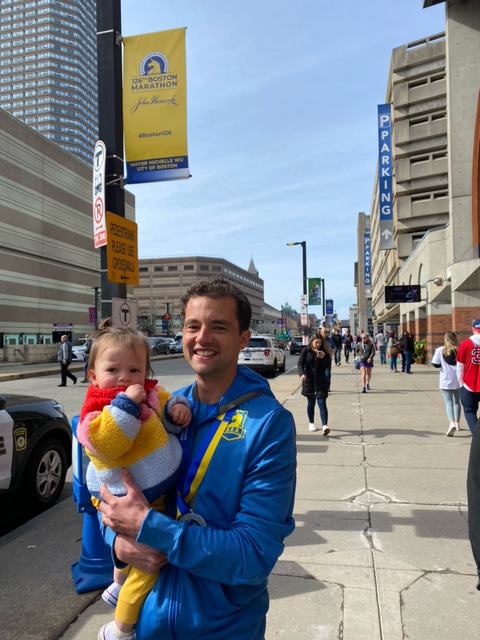
For six years the jacket hung in the back of my closet. It came with me from a subletted room in San Diego, to a condo shared with my sister in Gainesville, to my childhood home in Port Orange, to two apartments in Asheville, to our new home in a little town near Hendersonville, to, finally, a carry-on bag in Boston.

It’s a nice jacket: adidas, blue and yellow, lightweight. I paid $100 for it. It’d keep you warm on a cold run, or serve as something comfy and casual to wear anywhere. There have been countless times that it would have come in handy. I really liked this jacket.

For six years I refused to wear it.


I dropped out of the 2016 Boston Marathon. Around mile 15, after a decent start, I started wheezing: scratchy, clipped, labored breathing. I hadn’t had an asthma attack in years, but I convinced myself that this was one, or about to become one. I walked off the course, in tears, to the red medical tent, where nurses checked my vitals and gave me a phone to call whoever I needed to call to tell them my marathon was over. I then boarded a bus to the finish line in the city, next to other broken dreamers, riding on the highway past the iconic course where we were supposed to be running. I was embarrassed, and so, so sad.

When I got to the finish line, where thousands of other runners were experiencing perhaps the greatest running moment of their lives, a place of uncontainable joy and triumph, I sat alone on stone steps and cried. I called my parents.

“I —” my voice cracked. I could barely speak. “I—I had to drop out.”

They, and everyone else, were beyond understanding. You had to listen to your body, they said. It was the right call, they told me. Your body betrayed you, they assured me.

For a while, I believed them, and in moments when you’re physically vulnerable it’s natural to make decisions based on self-preservation. But I think what really happened was perhaps simpler, and harder to accept: I was scared.

At mile 15, my pace had fallen off, my legs were getting heavy, and I was in pain. I was scared of posting a slow time, of shuffling 11 more miles, of hurting for another 90 minutes. I panicked and walked off the course of the most famous footrace in the world.

For six years, memories of that decision, that unfinished race, haunted me. The jacket—a Boston Athletic Association logo-emblazoned hoodie I bought at the pre-race expo—became the physical manifestation of those demons. It was a symbol of my failure. Every time I caught a glance of it in the back of my closet, I was reminded of that day.

I made a pact with myself soon after that race: I would not put on the jacket until I crossed the finish line of the Boston Marathon.


In that time I, like most rudderless millennials in their early 20s, moved and grew and otherwise experienced life. In 2016 I was confused and directionless: After a mere eight months in my first real job, the one I spent at least four years, several internships, and many thousands of dollars preparing for, I decided I didn’t want to pursue it as a career. A month after I (kind of) ran Boston, I moved from a room in San Diego to a condo on the opposite side of the country to live with my sister and study to become a teacher. I was 23 and lost.

That inexperience, that lack of perspective, was reflected in the race. As soon as things went south that day, as soon as I became uncomfortable, I broke. I thought my (sure-to-be-slow) time was the most important thing that day; I thought I was bigger than Boston. I failed to realize that I was in the middle of the oldest, most famous, most glorious, marathon in the world. I didn’t think about the hundreds of thousands of men and women—the Salazars and Rodgerses and Switzers, of course, but also the everyday warriors who were running for something bigger than themselves, for love or loss or hope—who had spilled their (literal) blood, sweat, and tears on the undulating pavement below. I didn’t think about the men, 241 years earlier almost to the day, who had officially started a revolution near the course in Lexington and Concord, fighting and often dying for a country that didn’t yet exist. I didn’t know that the course was initially inspired by the ever-famous ride of Paul Revere to alert his countrymen that war was imminent. I didn’t think about how lucky I was to have the ability to run, to move as we were divinely designed, bipedal locomotion on a grand scale. I was simply upset that I was going to run 15 minutes slower than I hoped.

I vowed that my next time at Boston would be different.

In those intervening years, I found a calling, fell in love, moved again, got married, bought a house, lived through a pandemic, and, most significantly and life-alteringly, became a father to a persistent, strong, beautiful baby girl. This all made me tougher, instilled in me a valuable perspective about life and its waves. A bad race at Boston would suck; but what would suck even more is not having a job to pay the mortgage. Like most people, I was (am) a much stronger person than I was a year after graduating college.

The jacket transformed with me, evolving from a garment of shame to a training tool. Near the end of a 20-mile run a couple years ago, training for a Boston qualifier, I was struggling to keep the agreed-upon pace of 6:20 a mile to close the run. My best friend and training partner Jordan turned to me and snarled, “Think of Boston! Think of your jacket!” I caught up with him with a 6:17, and qualified for Boston a few weeks later with a 2:52 marathon, a new PR.

Before I left the house for another 20-miler last month, I was pissed. It was 6 a.m. and I forgot the time changed early that morning, so we lost an hour of sleep. I, like most runners, didn’t want to go run for two-plus hours while most of the world was sleeping. I opened my closet and peeked in the back: the silver lines on the jacket’s shoulder sleeves gleamed in the dark. Jordan and I met and ran one of our best long runs of the training cycle. I knew then that I could be only weeks away from wearing it for the first time.


Throughout training, I tried not to make the race bigger than it was: It was simply a marathon, 26 miles and 385 yards, just like the ones I’d run before. But I knew that was a lie. Despite growing up and recognizing that there are more important things than my marathon time, I knew that this time Boston represented something more. I knew that it was a shot at redemption, something elusive and rare: Many others never get one, and I wanted to cherish mine. I knew that it, like all races but even more significantly for Boston, was a chance to show my family, my friends, my wife, my 13-month-old daughter, myself that all of the sacrifices they and I made—the hours spent away running, the nightly old-man stretches, the neurotic, often annoying discussions of various anatomical maladies—had value. I knew that it was a way to show my fifth-grade students, who had sent me off with a gift basket and inspirational letters, that all of our talks about perseverance and priorities and life were not empty. I knew that it was an opportunity to show my daughter (or at least tell her when she’s old enough to understand) that sometimes the best thing to do when life kicks your ass is to lace up your trainers and head out the door for another 10-miler in the mountains. “If you fall from the horse,” as my favorite soccer coach put it, “the best thing you can do is go immediately back on it.” I wanted to show her that you should always get back on the horse.

So, yes, Boston was more than a race; it was Something Big; I knew I wouldn’t be the same after. I carried this weight throughout training and to the starting line, where, with the sound of the starter’s pistol, it was lifted, finally, into the brisk Massachusetts air—and I could simply run.

And for the first seven miles, clipping off 6:20 miles next to Jordan, surrounded by thousands of other runners and spectators, under the sun and a cloudless sky, it was perhaps the greatest running experience of my life. My legs felt light and smooth, my heart and lungs working together efficiently and effortlessly, and I thought, Could this be the day?

But it was a marathon, of course, and Boston is particularly relentless, unsparing with its combination of uphills and downhills, punishing those who start off too aggressively. By miles 9 and 10, the initial relief running provided had worn off, and the uncomplicated calculus of the marathon set in: I still had 16 miles to go. And then the wheels came off. My legs became suddenly heavy; each step required far more effort than before. An ill-timed knee/calf/hamstring injury, which had caused me to taper more aggressively than I wanted during the final weeks of training, flared: My right leg became tight and even heavier and began hurting with each step. I hit halfway in 1:24, perfectly on pace for my goal of sub-2:50, but I knew that it wasn’t going to last.

I reached the point, at the edge of Newton, one of the several small towns the course runs through, where I dropped out in 2016 because I was significantly off pace and hurting. Six years later, I found myself in nearly the exact same situation—cinderblock legs, slow pace, double-digit miles still to go—running in nearly the same exact scene—a dense, rowdy crowd oblivious to my hurting, cheering in front of red-brick buildings—and I thought to myself, This is what life comes to, isn’t it? These choices, these moments…

And I did what I told myself I’d do in the low moments. I kept running.

Or, more accurately, I shuffled. The 6s marking the miles on my watch quickly became 7s, then 8s (and even one 9). I moved over to the right side of the road, like a slow car on the highway, as no fewer than 1,500 runners passed me. My aspirations for a fast time vaporized; the race simply became about surviving and enjoying.

I told myself that I simply had an 11- or 9- or 7-mile run ahead of me, something I’d done countless times before, and this one was on a historic course with thousands of other people running next to me and Boston College students on the side of the road screaming “I SEE YOU, 2765!” (my bib number). When I reached mile 21, I told myself I simply had to run one more Friday Five, a quintessential college run with the boys, envisioning those runs in Chapel Hill as I ran in real time close to Boston.

Throughout it all, I tried to soak in the experience as much as possible, to do everything I failed to do last time, to continue seeing the forest among the trees. Boston was a celebration of running, and of life, and I didn’t want to let my pride interfere again. I found my family at mile 20 and stopped to kiss my daughter. I pumped up the crowd. I high-fived little kids and middle-aged women. I laughed at clever signs and nodded in appreciation to the people holding them. I talked to my twitching legs as they were about to cramp. I fought the urge to walk by telling myself to just make it to the next mile marker; I did this for at least seven miles. I saw, by random chance, a girl I graduated college with cheering on the side of the course, whom I hadn’t seen in seven years, and thought about how the world can be so vast—with runners around me from every U.S. state and 99 other countries—and yet so small. I sang to myself, talked to myself, listened to myself. I felt unapologetically alive.

As I entered Boston, where the energy from the crowd was a living, breathing, tangible thing, where you can feel its love like a punch, I smiled for 30 straight minutes. I was there, practically: three miles, a 5K, to go. Until then, in the back of my mind lived the fear, as much as I didn’t want to admit it, that I wasn’t going to finish again. For the first time in six years, I knew for a fact that I was.

The last mile was a spiritual experience. Despite peak cramping, I felt like I was floating, living out a surreal dream. The disappointment of six years ago seemed to melt away with every slow step. I followed the curves of the road, the sounds of the crowd, and entered the famous final stretch: Right on Hereford, left on Boylston…

The last 100 meters were a cacophony of noise and emotion. I told myself to enjoy every painful step, to remember these moments because it doesn’t get better than this. I thought, probably correctly, that this was how it was supposed to happen, a long, grinding struggle to the finish line, because if everything had gone my way that day, if my body had allowed me to keep clipping off the pace I intended to run, if I had never hurt and things had never gotten truly hard, then it all would have been too easy, too clean, not representative of the six-year journey that brought me there. No, it was supposed to be like this: I was supposed to be tested, as a matter of fact supposed to be tested in the exact same spot where I walked off crying last time, because the marathon cuts you to your unvarnished core to see, once and for all, what you’re made of. I passed that test, found out what was inside me, and let myself feel something I don’t usually allow: proud. Yes, despite being 20 minutes slower than I hoped, I was proud of myself and fine to admit it. If I were less dehydrated, I likely would have started crying.

But mostly I just ran, because that’s what this was all about, right?, that’s all this has ever been about, running and everything it’s brought you and changed in you, running along the dirt roads of your childhood as the neighbors told you they’d see you on TV in the Olympics one day, running on suburban streets and overgrown trails, running with your best friends through campus and with your daughter through the park, running through heartbreak and loss and joy and the ceaseless waves of life, running those final steps toward the finish line but knowing, deep down, that you’ll never stop running because it’s part of you forever.

As I crossed the finish line, I threw my hands in the air and let out a violent fist pump. There was a jacket I needed to find and then I would be on my way.


Afterword: Part of me was hesitant to write this because I didn’t want to make myself out to be some type of hero; there are far more impressive things than running a 3:10 marathon (like running a 1:59 marathon) and far more important things than running. But one of the beautiful things about the sport, and particularly Boston, is that everyone—from Scott Fauble, the top American this year with a time of 2:08:52, to the woman who finished in 5-plus hours being interviewed by the local TV station we were watching later that day—has a story that led them to the race, and I think the world is a richer place when people share them. So please know I did not write this for the back-pats and congratulations; I wrote it because it was something that meant a lot to me, even more than I initially thought. Thank you for reading, and thank you, Boston.


Join our mailing list!

Subscribe to the Essays of Dad newsletter, a weekly email with parenting stories, background on essays, book recommendations, and more.

Processing…
Success! You're on the list.