Will I Ever Sleep Again?

Illustration by Samantha Harrington

Late in Carly’s pregnancy, we completed an online course titled “Will I ever sleep again?” After watching the first few videos, I used to joke that the answer to the entire course, which spanned a few hours over several videos, could be stated simply: No. (It was not that funny of a joke.)

The course taught us—and specifically, me—a lot of information that we didn’t know—how to swaddle properly, how wake windows ruled everything, how babies, when they’re fussy, love movement and noise because it imitates their mother’s womb—but it didn’t give a satisfying answer to its central question. Because it can’t. Because the answer, like that to most questions, is much more complicated—gray when we want black and white. Will I ever sleep again? Yes. But probably not as much as you want to, or used to. Also, it depends. There are going to be nights when you feel like you won’t. And there are going to be nights when you think your child is going to be a Nobel Laureate because they slept through till morning. Finally, and importantly, you probably don’t have as much control over it as you think you do. That answer is neither satisfying nor succinct. But it’s some version of the truth.

Sleep, perhaps more than anything else, is understandably a pressing concern in the minds of most new parents (including us). It dictates your mood, your outlook, your daily schedules and routines. Want to go for a run before work in the morning? Sounds great, until you and your wife are up with your screaming 6-month-old in the dark mid-morning hours. Ready for that road trip to Florida to visit family? Wonderful, just strap your baby in the car seat and hit the highway, just like you used to—but be prepared to stop every half-hour because she won’t stop crying. Time to unwind and enjoy a movie together? Grab a blanket and cozy up on the couch; just ignore the screams from above, your baby protesting sleep upstairs. 

Accordingly, new parents spend an unhealthy amount of money on methods that promise to help—or make!—their babies sleep through the night, a practice called sleep training. There are countless books on the topic, all of which can be read during parents’ ample free time, and a cursory Google search reveals several cutely and aspirationally named online programs—Tinyhood ($100), EATSLEEPDREAM ($150), taking cara babies ($249), Little Z’s ($99)—all promising tantalizing results: getting your baby to sleep through the night in two weeks or less. If you choose to enter this tempting world, soon you will be dropping into casual conversation phrases like the Ferber Method (sounds like a Netflix original), Graduated Extinction (band name?), and the most polarizing thing on the internet since that dress that was two colors at once: Cry It Out.

(Whatever your thoughts on Cry It Out, and I realize most people probably have none, at least its name says exactly what it is: You drop your baby in their crib, close the door behind you, and don’t open it until the morning. You let them cry it out. Eventually, the thinking goes, they will discover that you will not always be there to soothe or feed them back to sleep, so they’ll learn how to put themselves to sleep any time they wake up; they will then use these skills to sleep through the night. There are studies supporting the effectiveness of this technique, and many more pieces debating whether parents should try it. This is not one of them.)

Carly and I did not try Cry It Out. We paid, too much, for a course that advocated the Ferber Method/Graduated Extinction, a less extreme version than Cry It Out, and that was hard enough. Our daughter, Mayla, was determined to make sleep training as difficult as possible. The first night she cried, at varying levels of intensity, for about 45 minutes until relenting. We attempted to make and eat dinner as she howled her displeasure; it was like trying to read on the beach during a hurricane. And that was one of her best performances. 

The following nights were truly awful. It was, I remember telling Carly, one of the most difficult things that we endured as a couple. With the benefit of hindsight, I recognize that claim is hyperbolic, but for those minutes leading into hours when your 5-month-old screams, with short breaks only to refill her lungs with deep gulps, nothing else seemed to matter. We, of course, felt like horrible human beings; Carly, during those unrelenting cry sessions, couldn’t focus, couldn’t eat, couldn’t do, basically, anything. When Mayla finally succumbed to biology and fell asleep, I remember thinking that the absolute meanest thing someone could do in that moment was come to our house and wake her up. Steal the car, punch me in the face, but don’t wake up the baby! 

The science behind sleep training is sound, and for most babies it’s effective. But I think what most of these courses underestimate and (understandably) don’t advertise is that it really, really sucks to listen to your baby cry for that long. They present the facts but often fail to account for emotion, which is equally important and shapes the entire experience. Or as Toni Morrison wrote much more eloquently (not about sleep training): “…[T]he crucial distinction for me is not the difference between fact and fiction, but the distinction between fact and truth. Because facts can exist without human intelligence, but truth cannot.” The facts are sleep training works; the truth is that because we are humans and don’t like listening to our babies cry, sleep training is incredibly challenging.  

On night 11 of Mayla’s sleep training, three before the end of the magical two-week period that was supposed to see her become a perfect sleeper, she simply refused to go to sleep. As she lay in her crib, screaming her tiny lungs out for hours, Carly and I were understandably discouraged, perhaps even distraught; I remember actually falling to my knees in the kitchen, around 2 or 3 a.m., nearly in tears. We soon decided to pick her up out of the crib, thus ending our sleep training experiment.

Until a couple months later! Dismayed by Mayla’s lack of progress, we hired an independent sleep consultant. For a hefty fee we got an hour phone call and unlimited texts and emails for two weeks. It was marginally more successful. Near the end of the two weeks, one of my texts to the consultant read, “Really bad screaming. Some of the worst ever.” (I don’t remember if that was referring to Mayla or us.)

And then, a couple weeks later, Mayla somehow got good at sleeping. She stopped fighting so hard to fall asleep. She allowed herself to be soothed in her crib. She sometimes even lay down in her crib fully awake before falling asleep, the golden skill our sleep-training courses were designed to help her master. It seemed miraculous. 

Since then, she’s been a pretty good sleeper. She still has nights (the one before I finished writing this was one of them) when she wakes up randomly and won’t go back to sleep without Carly feeding her, but those are relatively rare. Most of the time we put her down in her crib between 8 and 9 p.m. and pick her up out of it around 8 the next morning. We feel lucky.

So how did she become a good sleeper? We don’t know, and maybe that’s the point. Her improvement eating was probably part of it, and maybe the sleep-training courses and consultations helped us establish principles that bore fruit later than expected. Or maybe had we done nothing the result would have been the exact same. Parents, like all humans, think they have autonomy over most events in their lives, when in fact a lot of it is simply random. Maybe sleep falls into that category, too. Sleep training is probably helpful, and studying babies, specifically their sleep, to learn more about them is essential. But equally important is to remember that babies are fickle creatures. Maybe Mayla became a good sleeper not because of anything we did but because of some natural process that took six months; we don’t know and never will. As Carly, after another battle with the blackout curtains to make Mayla’s room as dark as possible, this time literally duct taping them to the windows, told me recently, “I will never stop messing with those because I will never accept that I can’t control how well and long Mayla sleeps, that she’s just a baby and sometimes she just won’t sleep.” She said it with a self-aware smile. 

This was perhaps the most important lesson from all of those difficult nights: Some things, as hard as it is to accept, are simply beyond our control. And when your baby finally learns how to sleep—because they will—you will look back on those times with something close to a smile. Because one day, one night, your daughter will fall asleep in your arms, resting her head on your shoulder, and the only sounds will be the white noise from the sound machine and your soft singing as her breathing warms your chest: Find a beautiful love/look straight into their eyes/make sure they know they’re your morning light…

Will I ever sleep again? In that moment, the answer won’t matter.


Join our mailing list!

Subscribe to the Essays of Dad newsletter, a weekly email with parenting stories, background on essays, book recommendations, and more.
Processing…
Success! You're on the list.

Lessons from a Pandemic Pregnancy

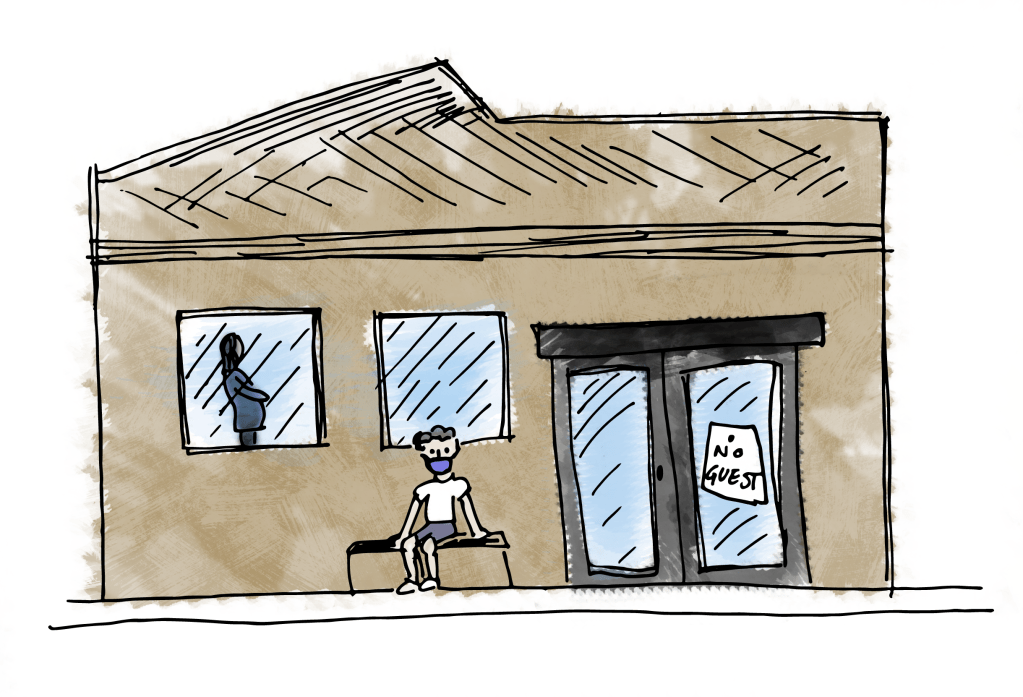
Illustration by Samantha Harrington

Every Thursday for about a month, I sat alone in my car, staring at the red-brown bricks of a birth center. My pregnant wife, Carly, was inside one of its rooms, being poked and prodded and tested to ensure she and our daughter were healthy and strong. To minimize risk during the worst stages of the pandemic, partners were not allowed in. Sometimes the appointments were quick, lasting no longer than 20 minutes; other times I sat alone for a couple hours.

During these solitary moments, I always noted my view from the car: those bricks, lots of plants, a thin gray tree. We’d been to the birth center so many times, and I’d sat by myself in the car so many times, staring at the same pieces of the world, that we saw winter transition to spring: By the end, the day before our daughter, Mayla, was born, the sad gray tree had started sprouting little white flowers. 

The symbolism—our baby coming into the world as flowers began to bloom after a long winter—was not lost on me. Carly and I, on long, cold walks around our neighborhood, would talk about how everything, soon, would be different: We would have a baby girl, and the days would be longer and warmer, and summer break was on the horizon, and we could visit family and friends, and the world, for so long dominated by a stubborn pandemic, would return to some type of normal (or so we thought). On the best days, we were filled with hope.

For the last three-plus months of the pregnancy, that’s all we had. Alarmed by stories of mothers-to-be facing more severe COVID cases, and with vaccines unavailable for us until the early spring, we were, more than most, locked down. We worked from home. We bought an annual subscription to Instacart and used it weekly. We ordered delivery, asking drivers to leave the food at the door; if we were feeling adventurous, we got takeout, our lone semi-weekly venture into the world. Those trips inside the restaurant terrified me, even as Carly stayed in the car. (One night, a week or so before the due date, I spent the better part of three hours worrying if I got COVID from a maskless woman chasing her daughter around a restaurant where I was waiting for food.) I used to half-jokingly tell my friend, also an expectant father, that if everyone in the world had a pregnant partner, the pandemic would recede in days. 

Carly, to her credit, rarely complained about the hand she was dealt. She had looked forward to pregnancy, and motherhood, for most of her adult years, and this pandemic pregnancy of course did not live up to her expectations; but she maintained, better than most, perspective: She knew that her, and our, problems were minor held up against the ones affecting hundreds of thousands across the country and world.

We, like everyone else, made sacrifices to keep our family safe. Carly had wanted a big baby shower; we had one on Zoom and another with three friends sitting in spaced-out chairs in our backyard. She wanted to go home to Florida for Christmas to spend time with family and show off her growing bump; we ended up, to minimize risk, staying by ourselves in North Carolina. She wanted to attend in-person childbirth classes, to meet other moms, to feel connected to a community; she was, for weeks and then months, basically alone.

That included all of her appointments: The first time I was allowed in the birth center was the day Mayla was born. In the car I cried only once, on week 41, when she had to go to a different building for a different test; maybe I missed my familiar bricks and tree. Remaining by myself in the parking lot was a small price to pay to protect nurses, doctors, and mothers, but I wanted desperately to be in the room with her, holding her hand and watching Mayla squirm on the little black-and-white screen. The first time I saw our daughter, at the 20-week ultrasound to confirm her heartbeat, was via FaceTime as I sat in the parking lot.

A lot of it, to use the formal phrase, really sucked. But the most important truth never changed: She and Mayla remained healthy for nine-plus months. And this spartan existence, with just the two of us spending together lazy days and slow nights, was perhaps the one of the best ways to culminate our pre-parenthood lives. We would work, at home, until mid-afternoon, go on a walk around the neighborhood as the sun slowly sank below the mountains, talking about the baby and plans and the world. When we got back home we’d stretch in the living room, listening to music and playing with the dogs, before making something warm for dinner and eating it while we watched “New Girl.” Then we’d clean up and get ready for bed, without rushing, and watch TV or just sit there, talking and marveling at Carly’s moving stomach, letting it sink in how wild, how wonderful it was that there was a baby, our baby, in it; and she would drift off to sleep, and I’d read with the lights out before joining her in dreaming.

Now, of course, when life has sped up and responsibilities have multiplied, we both miss those unhurried days. Now we work and coach and come home and work some more and eat dinner and pack our lunches for the next day and wash bottles and give Mayla a bath and then put her to bed and by the end of the day we’ve seen her, and each other, for two, maybe three hours. And then we do it all again the next day.

Our pandemic pregnancy was stressful and isolating and restrictive. But it was also, toward the end, peaceful, maybe even necessary. We were forced, by circumstance, to return to basics, to prioritize what was essential and forget all else. We were forced to confront a truth that deep down we knew but the rush of life had complicated: that simplicity—family, and food, and books, a warm sun and laughter—is all we really ever need. Everything else is periphery. There is always time to do what matters.

So every time I see a pregnant woman now, keeping a baby alive in the throes of a pandemic, I say a little prayer of protection, and hope that she can find peace amid all of the chaos. I appreciate her, and her partner, sitting alone in the parking lot, staring at bricks, on a deeper level than I ever thought I would.


Join our mailing list!

Subscribe to the Essays of Dad newsletter, a weekly email with parenting stories, background on essays, book recommendations, and more.
Processing…
Success! You're on the list.

Her Eyes

Illustration by Samantha Harrington

Let’s start with the surprise: her eyes are wide and blue, the color of the ocean. Mine and my wife’s are thin and dark brown, the color of coffee without cream. They say her eyes can change color up until she’s a year old, and maybe they will. Most of our close family members’ are dark like ours. But until then her eyes, big and blue, will be two unexpected pools of color in our world.   

Her eyes don’t open immediately when she wakes up. In fact, it seems like sometimes they’re the last part of her body to know she’s awake. She yawns and stretches and grunts and sometimes even cries all the while her eyes stay closed. Only when she opens them fully do we know that she is ready.

Her eyes are then alerted by her stomach that she’s hungry. Often this happens immediately, seconds after they open, and food has to be made available no matter what her mother is doing. If too much time passes, she will squeeze her eyes tight, like she’s looking for something inside her face, as her mouth opens to scream. 

As she eats, her eyes are focused on the task at hand, only taken occasionally by a passerby in the house (her dad) or the weight of sleep. They have no time, no patience, for distractions; eating time is for eating, and everything else will have to wait. Later, often as you are holding her, her eyes will suddenly widen and turn grave, the universal sign for I gotta take a poop. Sure enough, she will let it all out, making no effort to conceal the noise, her eyes serious the whole time. 

Once she has eaten, digested, and excreted, her eyes are light, full of life. If you say something she likes—“Are you having fun with Sophie Giraffe?” “Do you love your mama?”—they will squint in delight as her chin falls to her chest and her shoulders rise and her lips curl in a smile. It is a picture of cuteness, of pure glee. If you say something she doesn’t like—“Are you ready for a nap?” “Wanna take a bath?”—they will sink and stare as her lips twist into the cleanest and clearest of frowns. It is a picture of pure disdain.

You will then have to pick her up, which is the time her eyes love the most. From your arms, they search, constantly. They look at lights and other eyes and signs hanging on the wall and ceiling fans. (Oh how they love ceiling fans.) They often look curiously at her parents’ wedding photos behind the couch, scrutinizing them as if to say, Wait, I know those people… For the first couple months of life, they love contrasts, the black-and-white books of shapes you give to her during the ever-important Tummy Time, literally seeing the world in black and white. A month or two later, they will follow you, or your finger, or whatever you’re holding, as you move from one spot to another, an important developmental milestone, you learn, called tracking. 

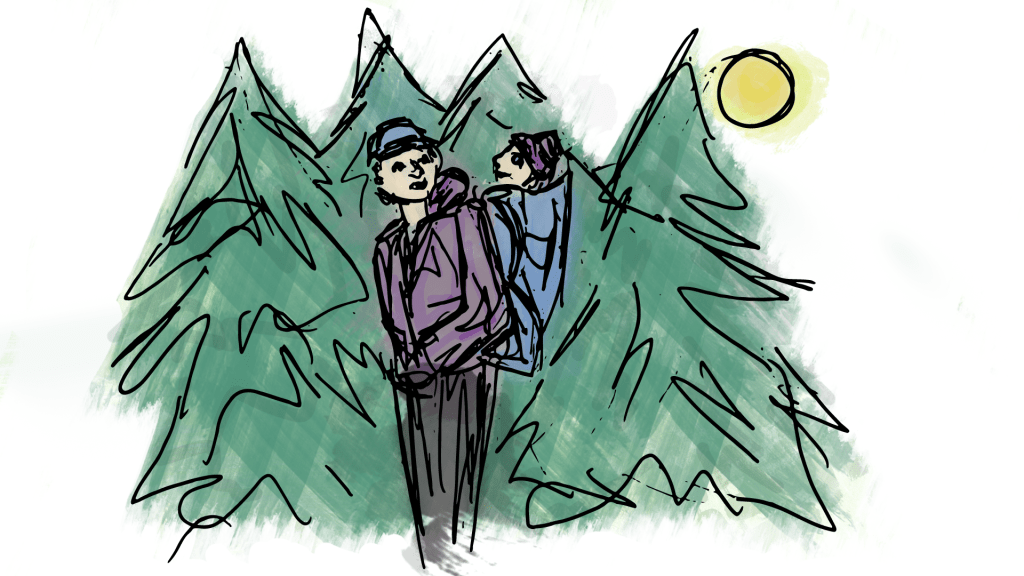
And that’s only inside. Take her outside and her eyes will have, to use the scientific terminology, an absolute field day. (Only after, of course, she theatrically squints and turns her head away from the sun, like a teenage gamer walking outside for the first time in weeks.) Once they are adjusted to the brightness, or shielded by a bucket hat, they get to work. They take in the trees and the mountains and the squirrels and the birds and the rocks and the leaves and the giant empty blue space up above and the green green green all around. Sometimes they dance across her plane of vision, darting from one thing to the next without rest; other times, they stare, endlessly, at some inanimate object, like a chair or a blade of grass. On hikes through the forest, they look straight up, through the canopy of trees, and when you are overcome by curiosity you will do the same and wonder why you don’t do it more often, for the sight is magnificent: streams of blue and light popping through small pockets between the trees. You smile as you realize that your 3-month-old has taught you to look for the beauty in hidden places.

One day her eyes will fill with tears, and it will be sudden and sad. Until then her cries were dry and therefore lacked a certain magnitude; the tears change all of that. They will hop, slowly, down her cheeks when she’s upset and you will think of the lyrics of a song called “The Girl”: When you cry a piece of my heart dies/knowing that I may have been the cause. Often, you will have been the cause: You will have had the audacity to try to get her to take a nap, or put her in the car seat. Her eyes will narrow and blink as you rock her in your arms and she releases full-throated screams, but they will refuse to close until biologically necessary. When they finally do shut, they will look so peaceful you will forget the battle you waged to get her to sleep. From the baby monitor or from the side of her crib, sometimes you will just watch her sleep, and your worries, for those precious minutes, will melt away.

With the exception of her hair, a chaos of dark brown perched wildly atop her head, her eyes, big and blue, are her most defining feature. They search and find and cry and sleep and track and close—and, you will learn, comfort.

One day you will be so worried about keeping her safe during a pandemic that you will be in the bedroom, fighting off tears. From Mom’s arms, her eyes will turn to yours and look at them curiously, as if to wonder, What’s wrong with Dad? They will stare at you for several seconds, paying attention to nothing else around them because they realize that right then you need the full extent of their love. As they continue to stare, you will think of the lyrics to another song, the one that inspired her name—And all I have to do to rise/is look into your eyes—and take her from Mom’s arms. Her eyes, big and blue, will stare up at yours. And they will, not for the last time, help you rise.


Join our mailing list!

Subscribe to the Essays of Dad newsletter, a weekly email with parenting stories, background on essays, book recommendations, and more.
Processing…
Success! You're on the list.

The First Month

Illustration by Samantha Harrington

Maybe, in a few years, we will forget all of this. Maybe, when life speeds up and obligations multiply and priorities shift, we, my wife and I, will forget the small things that made this first month of parenthood the greatest, and fastest, of our lives.

Maybe we will forget eating Jimmy John’s subs in bed at the birth center, fulfilling my wife’s nine-month vision for cold cuts after the restrictions of pregnancy eating had finally, gloriously, been lifted. Maybe we will forget the drive home a few hours later, in the dark of night, as I clutched the steering wheel harder than I ever had and Carly, the new mom, sat in the back seat with the newest member of our family, a sleeping seven-hour-old baby girl named Mayla, speaking to her softly. Maybe we will forget first carrying her blanket into the house so the dogs could familiarize themselves with her scent before she, an intruder, entered the space they’d devoted their lives to protecting. Maybe we will forget that first night, a haze of FaceTiming and unpacking and, finally, sleeping.

Maybe I will forget scooping her from her bassinet as she awoke in the middle of that first night, softly placing her on my chest as I read Lord of the Rings on Kindle. Maybe Carly will forget having to wake up every two to three hours, every night, indefinitely, to feed our growing daughter by lamplight. Maybe I will forget the fruitlessness I felt for not being able to feed her myself and occupying the far less important role of Mid-Feeding Diaper Changer to ensure she’s alert for the second half of her 3 a.m. snack. Maybe we will forget the sporadic, hopeful naps the following afternoons—sleeping, as everyone advises, when your newborn sleeps. Maybe we will forget frantically waking up at 2 a.m. to make sure that she was in the bassinet next to us, that we didn’t doze off with her in our arms in bed. Maybe we will forget, once that panic had passed, touching her sinking and rising chest to make sure she was breathing.

Maybe we will forget the countless appointments, checkups, and weigh-ins with different doctors and specialists, each of them offering a version of the most important truth: Both mom and baby are healthy and strong. Maybe we will forget putting Mayla on the porch to soak up some Vitamin D and reduce her moderately high levels of bilirubin. Maybe we will forget what the heck bilirubin is. Maybe we will forget the gratitude we felt for her first-time grandparents and aunts and uncles, who arrived from out of state to take care of the people taking care of the baby. Maybe we will forget the sheer joy they felt once they held their grandchild or niece for the first time, all of their worries melted away almost instantly.

Maybe we will forget the diapers soiled by yellow, seedy poop, a development that would have been concerning had the doctors not told you it was normal. Maybe we will forget our daughter’s propensity for peeing only when we had removed her diaper before putting on a new one, soiling the changing pad liner more times than we’d ever expected. Maybe we will forget the looks of grim determination or grave concern as she felt, or forced, a bowel movement. Maybe we will forget her first blowout, which somehow resulted in poop coming out the front of her diaper, staining, for good, the clean white shirt she’d been wearing.

Maybe we will forget staring at her, for minutes straight, watching her watch the world, her eyes a window into her days-old mind, trying to decipher what she’s thinking and learning and feeling. Maybe we will forget the furrowed brows and pursed lips and open mouths, or the sudden, instinctual punches and kicks. Maybe we will forget the grunts and moans and squeaks and yawns, the new, adorable soundtrack to our lives. Maybe we will forget her round cheeks and thick hair, her chunky legs and searching eyes. Maybe we will forget her sneezes, full-body contractions that seem to surprise her no matter how many times they come (six in a row one night). Maybe I will forget reading to her in the gray chair in the nursery, feeling her warm milky breath on my chest as she slept or stared out of the window, paying little attention to my reading of dozens of words that rhyme with llama.

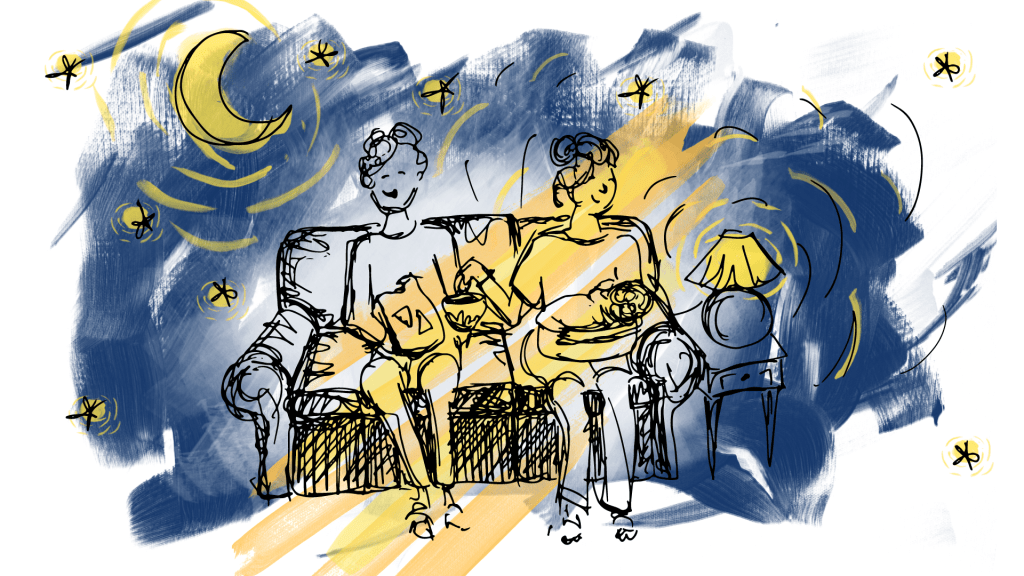
Maybe we will forget the crying, and the challenges of breastfeeding, and the stress and short fuses caused by lack of sleep. Maybe we will forget failing to adhere to any type of schedule because newborns are fickle and need to eat when they need to eat. Maybe I will forget feeding Carly appetizers on the couch as she feeds Mayla, holding a bowl of salsa steady so she can carefully dip tortilla chips into it, a hilarious food chain. Maybe we will forget our realization that they weren’t lying when they said parenting was hard.

Maybe we will forget all of this. Maybe this first month will be nothing more than a fleeting, blurry memory, a series of half-remembered moments that we will embellish with time. Maybe we will look back on them and feel completely different than we do right now.

Or maybe not. Maybe there are some moments that you will remember forever.

Maybe, one night, your daughter will have trouble feeding and your wife will be understandably frustrated, her clothes wet with excess milk. Maybe, as she is upstairs showering and you are in charge of heating up burritos for dinner, your daughter will start crying. Maybe you will pick her up and put on music; as the lyrics came through the speaker, maybe you will look into her wide blue eyes. Maybe they will stare past yours, over your right shoulder, into the middle distance. Maybe it will seem like she is watching her entire future unfold, right there in the kitchen, and she lay in your arms, a curious, half-smiling expression painting her face. And, maybe, in that moment, it will just be the two of you, and nothing else will matter, and it will feel like time slows as your eyes become warm and wet and she continues to stare past you, and then she will look at you, and right then you will feel something you’d never experienced in your life, a surge of pure love, and you will know then that she is the most important thing to ever happen to you.

No, you will not forget that.


Join our mailing list!

Subscribe to the Essays of Dad newsletter, a weekly email with parenting stories, background on essays, book recommendations, and more.

Processing…
Success! You're on the list.

On the Power of Women

Illustration by Samantha Harrington

Somehow, they sold you short. For months, years if you’re around the right people often enough, they told you this would be “the greatest day of your life” and “there’s no other feeling like it in the world” and “cherish every second because it’s over like that.” They tried, with the vocabulary available to them, to describe something that was beyond words, beyond communication, beyond, even, comprehension.

They did not tell you, in the moment your daughter, Mayla Ruth, entered the world, as you watched the midwife unwrap the umbilical cord from her gray neck and she took her first gulp of oxygen, that your own chest would fill with a light you’d never felt before as around you time slowed and surroundings blurred. They did not tell you, as she was placed, softly and immediately, on your wife’s chest, that your head would, instinctively, fall there as well, the first moments of your new family captured not in a picture but solely in your memory, where they will live forever. They did not tell you, as your wife exclaimed, “I did it!” through relieved, joyous, clipped breaths, that you would be crying more than your newborn daughter, the tears falling under your cloth mask. They did not tell you, when they described her, that words like “beautiful” and “gorgeous” and “precious” were somehow not powerful enough; angelic, maybe even divine, would come closer. They did not, could not, tell you any of this, and perhaps that was for the best, because this was, after all, something, like watching the Northern Lights or viewing the Earth from space, that could only be felt.

The intensity of those feelings, of that love, for your daughter were matched only by the same ones for your wife, and the gratitude you felt for the people who delivered your baby: the nurses and midwives at the women-run birth center who guided you through the most intense, and greatest, day of your lives. All of them reminded you, on International Women’s Day no less, of the irrepressible, imperishable power of women.


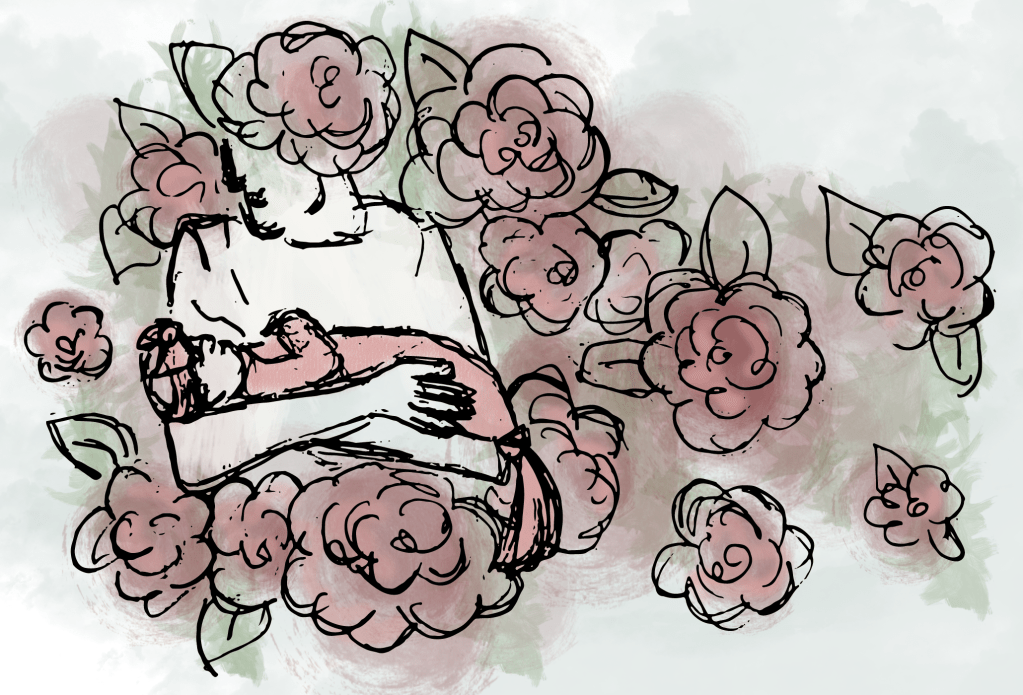
You learn a truth soon after you find out you are going to be a father: A pregnant woman is a superhero. She carries, for nine months or more, a human inside of her, one that causes her indigestion and nausea and no small amount of pain. For the first few months, she can eat only watermelon and popsicles (maybe, too, a watermelon-flavored popsicle) lest she throw up, her body rejecting foods like it never has before. If she’s lucky enough to keep down the food, it might stay in there for far longer than is normal, or healthy: The only trips she makes to the bathroom are to empty her bladder, again and again and again, like an old man in a Flomax commercial, interrupting sleep, which she wants, and needs, desperately.

The next three months, the second trimester, are supposedly the easiest, because all she has to deal with then is the small fact that a living being is growing inside of her, constantly, expanding her stomach like a slowly inflating balloon. Perhaps, too, she’ll have some “practice” contractions, and her fingers and ankles and feet will swell, rendering quotidian tasks like taking off a wedding band or putting on shoes a true challenge.

Then it gets real. Her belly, by the third trimester, is at the point where strangers ask, “When’s your due date?” Maybe she’ll describe it to you as carrying, in her stomach, a basketball, only the type that constantly kicks and moves and squirms inside of her. On walks around the neighborhood, the basketball will press down on her bladder, requiring her to find, immediately, a bathroom, or simply make her extremely uncomfortable. Preparations for the big day will be made: bags packed, nurseries decorated, floors cleaned and vacuumed over and over. She will waddle around the house, attempting to make everything perfect for her baby’s imminent arrival, a practice, your how-to-be-a-dad books tell you, called “nesting.”

If, for some reason, she is pregnant during a pandemic, she will go through all of this relatively alone, staying home for Christmas, celebrating baby showers on Zoom, talking to her doctors and watching ultrasounds by herself as you are forced to sit in the parking lot. She will not see family, or friends, for weeks, and by the end of it, months. She will ask you, on a random Wednesday, to take her on a ride to see the mountains under the sun and the cloudless sky, to breathe fresh air away from the house. She will cry, sometimes, but she will carry on with a quiet strength that you can only admire.

After all of this, she will describe it as a “pretty easy pregnancy.”

Maybe her preparation, weeks and months in advance, will be worth it soon, and she’ll have her baby on the due date, or perhaps even earlier. Or maybe she will have to wait a bit longer: a few days, or a week, or two. This time, you will learn, moves excruciatingly slow. In these cases—in the midst of countless doctor’s appointments to check the baby’s health and hers, of trips to the chiropractor to maneuver the baby into a better position, of uncomfortable exams and no-stress tests—she will experience a strange cocktail of emotions, a mix of disappointment that the baby is not yet here and disappointment with herself for feeling disappointed, and growing anxiety about labor, and anticipation, and true excitement that it could happen at any moment.

And then, one day, it will.


Or, more accurately, for biological reasons that she will have already explained to you, one night. Maybe the contractions will start around 11 p.m., just as she was ready to lay her head on her pillow to get some necessary sleep; she will attempt to sleep through them at the start, but she will soon learn that that is impossible, like trying to take a walk during a tornado. Instead she will open up her app to time contractions on her phone, and press the green button when they start and red button when they end. At the start, she’ll be able to talk through them, and as you are shuttling in and out of the garage to load up the car you will find her standing in the kitchen, wondering where to place a new sticker on her water bottle. You will smile.

The time between the contractions will get smaller, and their intensity will increase, until she calls the midwife, who will suggest taking a bath to see if they calm. They will not, and after the bath she will lay down, and suddenly she will jump up, sprint to the bathroom, flip open the toilet, and discard her dinner. The contractions, you will learn, have become so intense that in certain positions they make her throw up. “Maybe we should call her back,” she will suggest, and in less than an hour you will be on your way to the birth center as she huffs, from a small sheet of toilet paper, peppermint oil to manage the nausea.

By the time you arrive she will have been in labor for six hours, and the pain will only increase. For the next six hours, you will watch, hopelessly, as she struggles through active labor, her stomach contracting every couple minutes and rendering her speechless. She will sit on a giant exercise ball, her head bent over a pile of towels, and actually, for a few priceless minutes, doze off between contractions; she will try lying down, and again she will throw up from the pain; she will labor in a giant inflatable tub filled with water.

Throughout it all, the midwives and nurses will shuttle in and out of your room, checking on her and measuring the baby’s heartbeat. They will encourage her, suggest different positions to relieve the pain, and patiently answer your questions: “Does that mean it’s OK?” “All good?” “Are we still moving forward?” They will tell you what to do; you will gratefully listen.

You will change the music and massage her shoulders and tell her you love her, but mostly you will sit, in awe, of the strength she shows in the toughest hours of her life and the unassuming grace and professionalism of the other women helping her through them. She will not be able to speak to you, and this is perhaps the toughest part, because up to that point any major challenge you encountered together you discussed together. You will feel, more than any other time in your life, truly, utterly useless, as you watch the person you love most go through something close to an out-of-body experience as you sit next to her, painfully aware of your physical limitations and the injustice of biology.

She will not, contrary to what you remembered from your birth courses, experience any breaks, any letups from contractions. She will say, accurately, in one of her few full sentences in hours, “I feel like this is constant.” Despite this, she will not take any medicine to manage the pain, her mind set on the natural birth she’d planned for months.

And then, suddenly, miraculously, she will be 10 centimeters dilated and her water will break. You remember from your birth course that she has gone through the worst part, the dreaded “transition,” and from here it’s an hour, maybe two, of pushing the baby out. You feel, finally, that there is light at the end of the tunnel, and for the baby that is literal. Your heart starts to beat faster; you know she is close.

Three hours later, she will still be pushing. The worst part, it turned out, was far from over. At this point she will be exhausted, physically of course—over 15 hours without food, 27-plus without sleep—but also emotionally, with little left to give; she will feel nothing but pain; she will forget the reason for all of this. She will not have said a full sentence, or opened her eyes, for nearly 240 minutes. No position—sitting, laying, squatting—will ease her pain. She will, hands on her knees, barely able to hold up her head, tell you, “I’m scared.” At this point you will wonder, as you look out of a crack through the window at a plane leaving a white wake in the light-blue sky, “Is anything worth this?”

The answer will come less than 15 minutes later.


You will later reflect on the experience and conclude that it was the most impressive thing you have ever, and will ever, watched another human being do: 16 hours of unmedicated labor off of zero sleep and fueled only by fruit juice. You will know then, more than ever before, that your wife is the strongest person you know. You will force back an incredulous smile when she describes the labor as “pretty smooth”; you will know, too, that she is right: Every day, women endure labors with greater challenges and complications than hers, and you will feel even more grateful that she and your daughter are healthy and strong. You will be reminded that women are capable of what you thought was impossible.

They are capable of pushing out, through primal screams, a seven-pound human from inside of them. They are capable of forgetting all of the pain—the nine months of sacrifices and hours of searing contractions—almost instantly as they hold their baby in their arms. They are capable of calmly guiding other women through the most intense experience of their lives, and of soothing the nerves, assuaging the fears, of their partners. They are capable of the extraordinary.

And that, perhaps, is the most important lesson you will ever teach your daughter.


Join our mailing list!

Subscribe to the Essays of Dad newsletter, a weekly email with parenting stories, background on essays, book recommendations, and more.

Processing…
Success! You're on the list.