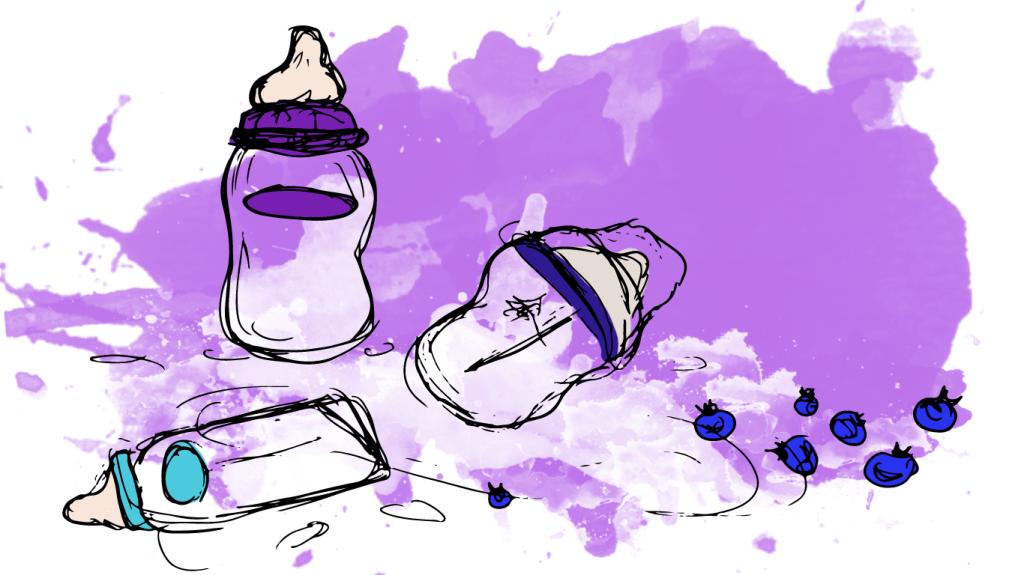
My Complicated Nostalgia for Baby Bottles

Bottles were at the center of our long, challenging journey to feed our daughter. Why do I miss them?

Illustration by Samantha Harrington

Every night for months, just before we put our daughter, Mayla, to bed, Carly fed her from a bottle. Reclining in the crook of Carly’s elbow, Mayla’s wide blue eyes would stare up into her mother’s with a look of determination and contentment as she drained the milk or formula from within. The whole process would take no more than three minutes. They were among the best of my day.

Watching Mayla drink from her bottle produced a cocktail of complicated emotions. For months, the most prominent one was relief: Mayla, for the first five months of her life, simply couldn’t drink from one, her lips and tongue and brain unable to harmonize into the sucking pattern that came naturally for most other babies. She was 100 percent dependent on Carly for food and, therefore, survival. So when she finally started taking a bottle, in what seemed like a miracle, her every sip reminded me of the long, challenging journey there.  

Near the end of her bottle feeding days, though, I began to feel something deeper. Silently sitting and watching the most powerful woman I know feed the most important thing to ever happen to us, the white noise from the sound machine slowly growing in intensity and the lamp gradually dimming, I felt peace, a firm sense that, after years of trying to figure out post-college life, I was exactly where I was supposed to be: living those moments, as Barack Obama wrote in A Promised Land, “when the world slows down, your strivings get pushed to the back of your mind, and all that matters if that you are present, fully, to witness the miracle of your child growing up.”

And soon, I knew, those moments would be gone, replaced by new ones, because, yes, Mayla was growing up. She was going to graduate from the bottle any day, to straw cups, and in my mind that marked her progression to becoming a toddler. Her bottle, for so long a source of frustration, had become one of the final things tethering her to babyhood. And that, more than anything else so far in our journey, made clear one of the fundamental truths of parenting: Youth, as one of my favorite writers put it, doesn’t bother to say goodbye.


Around her sixth week of life, we discovered that Mayla had a tongue and lip tie. In biological terms, it meant that the frenulum under her tongue and upper lip were both too tight and too restricted to allow proper tongue and lip movement; these movements are necessary for sucking, swallowing, and, later, speech. In applicable terms, it meant that she had lots of trouble eating. 

Not only was she inefficient—breastfeeding sessions, which typically last 10 to 20 minutes, would often take Mayla 45—she was not getting enough milk: At her three-month check-up at the pediatrician, she had dropped from the mid-20th percentile to the 6th for weight. Usually when a baby has trouble breastfeeding you can supplement with a bottle; Mayla was not usually. Bottles hung limply from her lips, which didn’t know how to extract the milk. Her only way of eating was laboring for hours every day to get less than what she needed.  

Constantly being hungry and never being able to eat enough, of course, affected her mood and sleep, which affected her parents’ mood and sleep. She was, thankfully, developing properly in every other way, but as her parents it was hard to think you were doing a good job when your firstborn was going to bed hungry.

Mayla’s inability to eat well and take a bottle bore consequences daily. Carly could not leave her, ever, because Mayla, psychologically and often literally, was attached to her: Mom was the only way to get food. (I often told—and tell—Carly that she legitimately, for more than five months, kept another human alive, was her sole source of nutrition. At the time it perhaps seemed unremarkable; it was simply what she had to do, and she’d do it again without hesitation. But the quiet, consistent strength it required was something close to heroic.) We couldn’t go anywhere because Mayla would simply scream in the car, or at our destination, because she was hungry; or if we did make it somewhere, she’d have to eat for another 45 minutes. Our days mostly consisted of hanging out around the couch, waiting for Mayla to finish eating or begin again soon.     

We tried everything to get her to take a bottle, which would, we knew, significantly improve our life. The first step was to get the tongue and lip tie fixed, through a not-inexpensive procedure called a frenectomy, but that, surprisingly and unfortunately, did little to improve her feeding skills. The pediatric dentist who performed the frenectomy gave us exercises for her mouth and tongue designed to help her (re)learn how to suck, and we did them daily, religiously. Still, no improvement. 

We talked to our pediatrician. We talked to several lactation consultants. We talked to a pediatric nutrition team at the hospital. We tried no fewer than a dozen different bottles. We drove an hour to an orofacial myologist, who poked and prodded around her mouth. We drove 40 minutes to a craniofacial myologist, who gave her what seemed to be an extremely light massage. We took Mayla to a chiropractor (for real), who gave her what had to be the gentlest neck adjustment in history. Very little of this was covered by insurance—we spent a few thousand dollars trying to help our daughter learn how to take a bottle—and very little of it brought about improvements in her eating.

We were discouraged, and desperate. I remember thinking, What if she just never takes a bottle? I knew that some babies, of course, were exclusively breastfed, but that was not our plan. Carly needed a break; the current system was wholly unsustainable and typically unjust. I could leave the house to run, or go out of town for a friend’s bachelor party, or simply cook dinner or take a 10-minute shower. Carly couldn’t do any of those things, had to miss the final month of school and her best friend’s bachelorette party because she couldn’t be away from Mayla. 

Intensifying matters was the fact that Carly, an elementary school speech therapist, was due back at work at the end of the summer; if Mayla couldn’t take a bottle by then, she wouldn’t be able to return to work, and we would have had to find a way to make up that lost salary. I was already working two part-time jobs in addition to teaching, and I began looking into more. As the weeks passed in July, and then August, our anxiety grew. We had a deadline by which Mayla, lest there be even more significant changes in our lives, had to take a bottle. 

What was alarming, both then and now, was the complete lack of accessible guidance on how to proceed if your baby won’t take a bottle (and the time and money spent if you ever found it). We were—I was—lucky that Carly, who possesses a deep knowledge of infant feeding and orofacial anatomy, knew where to look and what to research. Even then, though, at times the advice we received from highly educated professionals was either conflicting or simply reduced to: Have you tried this bottle?

In the end, I have no idea what saved us. Perhaps the bottle Mayla eventually liked—a Lansinoh with a purple cap—was the difference-maker, or maybe something suddenly clicked between her brain, lips, and tongue that allowed her to finally develop the sucking reflex we had spent several months and thousands of dollars trying to achieve. All I knew was that it was one of the greatest feelings of my life.

“OMG,” Carly texted me on August 10 at 12:05 p.m. I was at work.  “SHE JUST TOOK A WHOLE OUNCE FROM THE BOTTLE.”

“I’m going to cry,” I wrote back.


The first time I bottle fed my daughter was later that day; she was five months old. Carly took a video of it, and as I watch it now I’m struck with how pure my joy is: I smiled for the entirety of the 35-second feeding session (from 45 minutes to 35 seconds…). I gave her encouragement and watched with pride as she guzzled the milk. “That’s amazing,” I concluded once the bottle was empty. And it was: I could finally feed our baby, and Carly, throughout the upcoming weeks and months, could finally become something close to a normal human again. 

The last time I bottle fed her was…I honestly don’t remember. It became such a quotidian experience that it stopped being memorable (despite my proclamations in the months prior that I would never take it for granted) and soon became obsolete. Mayla drinks milk and water from straw cups now, and eats solid food: blueberries and oatmeal and broccoli and salmon. She is a thriving toddler with no shortage of curiosity, energy, and emotion, the best part of my day every day. 

Every now and again, though, especially before she goes to bed, I’m hit with a pang of nostalgia about her bottle feeding days. She was so small, dependent: She just looked like a baby when she drank from a bottle. Now she can tell us, with sign language or the few words she knows, when and what she wants to eat, and walk over to her high chair to show us where she’d like to eat it. Now, instead of feeding her a bottle from the reclining chair before bed, we attempt to read her Goodnight Moon for the 800th time as she tries to squirm free to turn the lamp on and off unceasingly. Now, I relearn every day, she is not a baby anymore.

So there they lay, the bottles, there they lay in a neat pile in a clear tub that sits in our attic, relics of a past I didn’t think I would ever miss. 


Join our mailing list!

Subscribe to the Essays of Dad newsletter, a weekly email with parenting stories, background on essays, book recommendations, and more.
Processing…
Success! You're on the list.

A Warm (Re)Introduction

Logo by Daniel Wilco

Editor’s note: This is the introduction to our first newsletter, which will feature background on essays, parenting stories, book recommendations, and more, in your inbox every Thursday. You can subscribe to the newsletter at the bottom of this page!

Almost a year ago, I launched a website called Essays of Dad, a place where I hope(d) to explore fatherhood—its joys and triumphs and challenges and everything in between—through writing. I designed the site and wrote an introduction! I created a Facebook page and Instagram account! I outlined a schedule of essays to publish! I enlisted the help of my incredibly talented friends Samantha and Daniel to, respectively, draw illustrations and create logos! Essays of Dad was ready to become something! 

And then…and then life, as it often does, intervened. I attended weddings. I watched our daughter, Mayla, crawl, then walk, then talk. I lost sleep. I endured the most challenging year of teaching of my career. I missed spending time with Mayla after school to work two part-time jobs. I, relatedly, questioned my career choice and interviewed for others. I trained for and ran the Boston Marathon. I, like everyone else, attempted to navigate the endless changes of life during a pandemic. Essays of Dad, sadly and perhaps necessarily, fell down the list of priorities.    

My plan to publish an essay every week lasted for…two weeks. I wrote a piece in September and the next didn’t come until January; then I took another writing hiatus until April. The site never became—or came close to becoming—what I hoped and thought it could. Essays of Dad never got its chance.

Now, I’m hoping to give it that chance with consistent writing: weekly essays and newsletters and #content. Things, personally and professionally, have become infinitely more clear in recent months: I realized, through no small amount of trials and disappointments and searchings of soul, that teaching, like fatherhood, is a calling, something I’m supposed to do (there will soon be an essay on that and how it relates to raising a child). 

And with that realization came another: I need to write. I will not be satisfied—and worse, will always regret—if I simply fantasize about my grand plans of writing (essays! articles! books!) but never act on them. I need to write, especially, about being a father, the most important role I will ever occupy, about the questions and experiences and challenges I and all dads attempt to tackle daily. Last year I thought that Essays of Dad needed me; what I’ve learned since is that I need Essays of Dad.  

So. Here we are. The first newsletter of what I hope is many. Thank you for subscribing, for reading, for believing. I hope you enjoy.


To receive the rest of this newsletter on Thursday, enter your email here!

Processing…
Success! You're on the list.

Boston, Finally.

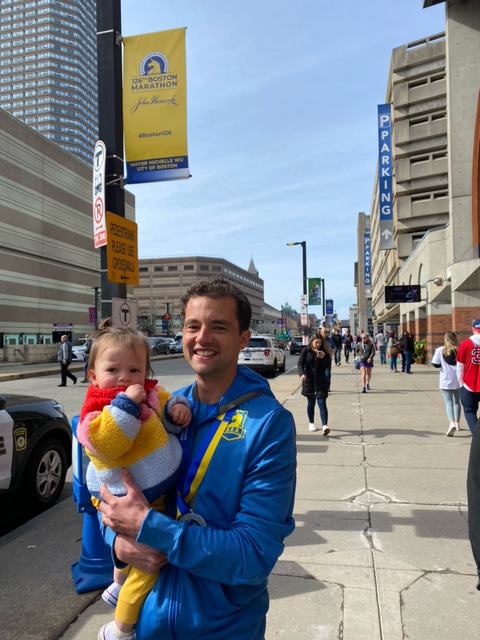
For six years the jacket hung in the back of my closet. It came with me from a subletted room in San Diego, to a condo shared with my sister in Gainesville, to my childhood home in Port Orange, to two apartments in Asheville, to our new home in a little town near Hendersonville, to, finally, a carry-on bag in Boston.

It’s a nice jacket: adidas, blue and yellow, lightweight. I paid $100 for it. It’d keep you warm on a cold run, or serve as something comfy and casual to wear anywhere. There have been countless times that it would have come in handy. I really liked this jacket.

For six years I refused to wear it.


I dropped out of the 2016 Boston Marathon. Around mile 15, after a decent start, I started wheezing: scratchy, clipped, labored breathing. I hadn’t had an asthma attack in years, but I convinced myself that this was one, or about to become one. I walked off the course, in tears, to the red medical tent, where nurses checked my vitals and gave me a phone to call whoever I needed to call to tell them my marathon was over. I then boarded a bus to the finish line in the city, next to other broken dreamers, riding on the highway past the iconic course where we were supposed to be running. I was embarrassed, and so, so sad.

When I got to the finish line, where thousands of other runners were experiencing perhaps the greatest running moment of their lives, a place of uncontainable joy and triumph, I sat alone on stone steps and cried. I called my parents.

“I —” my voice cracked. I could barely speak. “I—I had to drop out.”

They, and everyone else, were beyond understanding. You had to listen to your body, they said. It was the right call, they told me. Your body betrayed you, they assured me.

For a while, I believed them, and in moments when you’re physically vulnerable it’s natural to make decisions based on self-preservation. But I think what really happened was perhaps simpler, and harder to accept: I was scared.

At mile 15, my pace had fallen off, my legs were getting heavy, and I was in pain. I was scared of posting a slow time, of shuffling 11 more miles, of hurting for another 90 minutes. I panicked and walked off the course of the most famous footrace in the world.

For six years, memories of that decision, that unfinished race, haunted me. The jacket—a Boston Athletic Association logo-emblazoned hoodie I bought at the pre-race expo—became the physical manifestation of those demons. It was a symbol of my failure. Every time I caught a glance of it in the back of my closet, I was reminded of that day.

I made a pact with myself soon after that race: I would not put on the jacket until I crossed the finish line of the Boston Marathon.


In that time I, like most rudderless millennials in their early 20s, moved and grew and otherwise experienced life. In 2016 I was confused and directionless: After a mere eight months in my first real job, the one I spent at least four years, several internships, and many thousands of dollars preparing for, I decided I didn’t want to pursue it as a career. A month after I (kind of) ran Boston, I moved from a room in San Diego to a condo on the opposite side of the country to live with my sister and study to become a teacher. I was 23 and lost.

That inexperience, that lack of perspective, was reflected in the race. As soon as things went south that day, as soon as I became uncomfortable, I broke. I thought my (sure-to-be-slow) time was the most important thing that day; I thought I was bigger than Boston. I failed to realize that I was in the middle of the oldest, most famous, most glorious, marathon in the world. I didn’t think about the hundreds of thousands of men and women—the Salazars and Rodgerses and Switzers, of course, but also the everyday warriors who were running for something bigger than themselves, for love or loss or hope—who had spilled their (literal) blood, sweat, and tears on the undulating pavement below. I didn’t think about the men, 241 years earlier almost to the day, who had officially started a revolution near the course in Lexington and Concord, fighting and often dying for a country that didn’t yet exist. I didn’t know that the course was initially inspired by the ever-famous ride of Paul Revere to alert his countrymen that war was imminent. I didn’t think about how lucky I was to have the ability to run, to move as we were divinely designed, bipedal locomotion on a grand scale. I was simply upset that I was going to run 15 minutes slower than I hoped.

I vowed that my next time at Boston would be different.

In those intervening years, I found a calling, fell in love, moved again, got married, bought a house, lived through a pandemic, and, most significantly and life-alteringly, became a father to a persistent, strong, beautiful baby girl. This all made me tougher, instilled in me a valuable perspective about life and its waves. A bad race at Boston would suck; but what would suck even more is not having a job to pay the mortgage. Like most people, I was (am) a much stronger person than I was a year after graduating college.

The jacket transformed with me, evolving from a garment of shame to a training tool. Near the end of a 20-mile run a couple years ago, training for a Boston qualifier, I was struggling to keep the agreed-upon pace of 6:20 a mile to close the run. My best friend and training partner Jordan turned to me and snarled, “Think of Boston! Think of your jacket!” I caught up with him with a 6:17, and qualified for Boston a few weeks later with a 2:52 marathon, a new PR.

Before I left the house for another 20-miler last month, I was pissed. It was 6 a.m. and I forgot the time changed early that morning, so we lost an hour of sleep. I, like most runners, didn’t want to go run for two-plus hours while most of the world was sleeping. I opened my closet and peeked in the back: the silver lines on the jacket’s shoulder sleeves gleamed in the dark. Jordan and I met and ran one of our best long runs of the training cycle. I knew then that I could be only weeks away from wearing it for the first time.


Throughout training, I tried not to make the race bigger than it was: It was simply a marathon, 26 miles and 385 yards, just like the ones I’d run before. But I knew that was a lie. Despite growing up and recognizing that there are more important things than my marathon time, I knew that this time Boston represented something more. I knew that it was a shot at redemption, something elusive and rare: Many others never get one, and I wanted to cherish mine. I knew that it, like all races but even more significantly for Boston, was a chance to show my family, my friends, my wife, my 13-month-old daughter, myself that all of the sacrifices they and I made—the hours spent away running, the nightly old-man stretches, the neurotic, often annoying discussions of various anatomical maladies—had value. I knew that it was a way to show my fifth-grade students, who had sent me off with a gift basket and inspirational letters, that all of our talks about perseverance and priorities and life were not empty. I knew that it was an opportunity to show my daughter (or at least tell her when she’s old enough to understand) that sometimes the best thing to do when life kicks your ass is to lace up your trainers and head out the door for another 10-miler in the mountains. “If you fall from the horse,” as my favorite soccer coach put it, “the best thing you can do is go immediately back on it.” I wanted to show her that you should always get back on the horse.

So, yes, Boston was more than a race; it was Something Big; I knew I wouldn’t be the same after. I carried this weight throughout training and to the starting line, where, with the sound of the starter’s pistol, it was lifted, finally, into the brisk Massachusetts air—and I could simply run.

And for the first seven miles, clipping off 6:20 miles next to Jordan, surrounded by thousands of other runners and spectators, under the sun and a cloudless sky, it was perhaps the greatest running experience of my life. My legs felt light and smooth, my heart and lungs working together efficiently and effortlessly, and I thought, Could this be the day?

But it was a marathon, of course, and Boston is particularly relentless, unsparing with its combination of uphills and downhills, punishing those who start off too aggressively. By miles 9 and 10, the initial relief running provided had worn off, and the uncomplicated calculus of the marathon set in: I still had 16 miles to go. And then the wheels came off. My legs became suddenly heavy; each step required far more effort than before. An ill-timed knee/calf/hamstring injury, which had caused me to taper more aggressively than I wanted during the final weeks of training, flared: My right leg became tight and even heavier and began hurting with each step. I hit halfway in 1:24, perfectly on pace for my goal of sub-2:50, but I knew that it wasn’t going to last.

I reached the point, at the edge of Newton, one of the several small towns the course runs through, where I dropped out in 2016 because I was significantly off pace and hurting. Six years later, I found myself in nearly the exact same situation—cinderblock legs, slow pace, double-digit miles still to go—running in nearly the same exact scene—a dense, rowdy crowd oblivious to my hurting, cheering in front of red-brick buildings—and I thought to myself, This is what life comes to, isn’t it? These choices, these moments…

And I did what I told myself I’d do in the low moments. I kept running.

Or, more accurately, I shuffled. The 6s marking the miles on my watch quickly became 7s, then 8s (and even one 9). I moved over to the right side of the road, like a slow car on the highway, as no fewer than 1,500 runners passed me. My aspirations for a fast time vaporized; the race simply became about surviving and enjoying.

I told myself that I simply had an 11- or 9- or 7-mile run ahead of me, something I’d done countless times before, and this one was on a historic course with thousands of other people running next to me and Boston College students on the side of the road screaming “I SEE YOU, 2765!” (my bib number). When I reached mile 21, I told myself I simply had to run one more Friday Five, a quintessential college run with the boys, envisioning those runs in Chapel Hill as I ran in real time close to Boston.

Throughout it all, I tried to soak in the experience as much as possible, to do everything I failed to do last time, to continue seeing the forest among the trees. Boston was a celebration of running, and of life, and I didn’t want to let my pride interfere again. I found my family at mile 20 and stopped to kiss my daughter. I pumped up the crowd. I high-fived little kids and middle-aged women. I laughed at clever signs and nodded in appreciation to the people holding them. I talked to my twitching legs as they were about to cramp. I fought the urge to walk by telling myself to just make it to the next mile marker; I did this for at least seven miles. I saw, by random chance, a girl I graduated college with cheering on the side of the course, whom I hadn’t seen in seven years, and thought about how the world can be so vast—with runners around me from every U.S. state and 99 other countries—and yet so small. I sang to myself, talked to myself, listened to myself. I felt unapologetically alive.

As I entered Boston, where the energy from the crowd was a living, breathing, tangible thing, where you can feel its love like a punch, I smiled for 30 straight minutes. I was there, practically: three miles, a 5K, to go. Until then, in the back of my mind lived the fear, as much as I didn’t want to admit it, that I wasn’t going to finish again. For the first time in six years, I knew for a fact that I was.

The last mile was a spiritual experience. Despite peak cramping, I felt like I was floating, living out a surreal dream. The disappointment of six years ago seemed to melt away with every slow step. I followed the curves of the road, the sounds of the crowd, and entered the famous final stretch: Right on Hereford, left on Boylston…

The last 100 meters were a cacophony of noise and emotion. I told myself to enjoy every painful step, to remember these moments because it doesn’t get better than this. I thought, probably correctly, that this was how it was supposed to happen, a long, grinding struggle to the finish line, because if everything had gone my way that day, if my body had allowed me to keep clipping off the pace I intended to run, if I had never hurt and things had never gotten truly hard, then it all would have been too easy, too clean, not representative of the six-year journey that brought me there. No, it was supposed to be like this: I was supposed to be tested, as a matter of fact supposed to be tested in the exact same spot where I walked off crying last time, because the marathon cuts you to your unvarnished core to see, once and for all, what you’re made of. I passed that test, found out what was inside me, and let myself feel something I don’t usually allow: proud. Yes, despite being 20 minutes slower than I hoped, I was proud of myself and fine to admit it. If I were less dehydrated, I likely would have started crying.

But mostly I just ran, because that’s what this was all about, right?, that’s all this has ever been about, running and everything it’s brought you and changed in you, running along the dirt roads of your childhood as the neighbors told you they’d see you on TV in the Olympics one day, running on suburban streets and overgrown trails, running with your best friends through campus and with your daughter through the park, running through heartbreak and loss and joy and the ceaseless waves of life, running those final steps toward the finish line but knowing, deep down, that you’ll never stop running because it’s part of you forever.

As I crossed the finish line, I threw my hands in the air and let out a violent fist pump. There was a jacket I needed to find and then I would be on my way.


Afterword: Part of me was hesitant to write this because I didn’t want to make myself out to be some type of hero; there are far more impressive things than running a 3:10 marathon (like running a 1:59 marathon) and far more important things than running. But one of the beautiful things about the sport, and particularly Boston, is that everyone—from Scott Fauble, the top American this year with a time of 2:08:52, to the woman who finished in 5-plus hours being interviewed by the local TV station we were watching later that day—has a story that led them to the race, and I think the world is a richer place when people share them. So please know I did not write this for the back-pats and congratulations; I wrote it because it was something that meant a lot to me, even more than I initially thought. Thank you for reading, and thank you, Boston.


Join our mailing list!

Subscribe to the Essays of Dad newsletter, a weekly email with parenting stories, background on essays, book recommendations, and more.

Processing…
Success! You're on the list.

Will I Ever Sleep Again?

Illustration by Samantha Harrington

Late in Carly’s pregnancy, we completed an online course titled “Will I ever sleep again?” After watching the first few videos, I used to joke that the answer to the entire course, which spanned a few hours over several videos, could be stated simply: No. (It was not that funny of a joke.)

The course taught us—and specifically, me—a lot of information that we didn’t know—how to swaddle properly, how wake windows ruled everything, how babies, when they’re fussy, love movement and noise because it imitates their mother’s womb—but it didn’t give a satisfying answer to its central question. Because it can’t. Because the answer, like that to most questions, is much more complicated—gray when we want black and white. Will I ever sleep again? Yes. But probably not as much as you want to, or used to. Also, it depends. There are going to be nights when you feel like you won’t. And there are going to be nights when you think your child is going to be a Nobel Laureate because they slept through till morning. Finally, and importantly, you probably don’t have as much control over it as you think you do. That answer is neither satisfying nor succinct. But it’s some version of the truth.

Sleep, perhaps more than anything else, is understandably a pressing concern in the minds of most new parents (including us). It dictates your mood, your outlook, your daily schedules and routines. Want to go for a run before work in the morning? Sounds great, until you and your wife are up with your screaming 6-month-old in the dark mid-morning hours. Ready for that road trip to Florida to visit family? Wonderful, just strap your baby in the car seat and hit the highway, just like you used to—but be prepared to stop every half-hour because she won’t stop crying. Time to unwind and enjoy a movie together? Grab a blanket and cozy up on the couch; just ignore the screams from above, your baby protesting sleep upstairs. 

Accordingly, new parents spend an unhealthy amount of money on methods that promise to help—or make!—their babies sleep through the night, a practice called sleep training. There are countless books on the topic, all of which can be read during parents’ ample free time, and a cursory Google search reveals several cutely and aspirationally named online programs—Tinyhood ($100), EATSLEEPDREAM ($150), taking cara babies ($249), Little Z’s ($99)—all promising tantalizing results: getting your baby to sleep through the night in two weeks or less. If you choose to enter this tempting world, soon you will be dropping into casual conversation phrases like the Ferber Method (sounds like a Netflix original), Graduated Extinction (band name?), and the most polarizing thing on the internet since that dress that was two colors at once: Cry It Out.

(Whatever your thoughts on Cry It Out, and I realize most people probably have none, at least its name says exactly what it is: You drop your baby in their crib, close the door behind you, and don’t open it until the morning. You let them cry it out. Eventually, the thinking goes, they will discover that you will not always be there to soothe or feed them back to sleep, so they’ll learn how to put themselves to sleep any time they wake up; they will then use these skills to sleep through the night. There are studies supporting the effectiveness of this technique, and many more pieces debating whether parents should try it. This is not one of them.)

Carly and I did not try Cry It Out. We paid, too much, for a course that advocated the Ferber Method/Graduated Extinction, a less extreme version than Cry It Out, and that was hard enough. Our daughter, Mayla, was determined to make sleep training as difficult as possible. The first night she cried, at varying levels of intensity, for about 45 minutes until relenting. We attempted to make and eat dinner as she howled her displeasure; it was like trying to read on the beach during a hurricane. And that was one of her best performances. 

The following nights were truly awful. It was, I remember telling Carly, one of the most difficult things that we endured as a couple. With the benefit of hindsight, I recognize that claim is hyperbolic, but for those minutes leading into hours when your 5-month-old screams, with short breaks only to refill her lungs with deep gulps, nothing else seemed to matter. We, of course, felt like horrible human beings; Carly, during those unrelenting cry sessions, couldn’t focus, couldn’t eat, couldn’t do, basically, anything. When Mayla finally succumbed to biology and fell asleep, I remember thinking that the absolute meanest thing someone could do in that moment was come to our house and wake her up. Steal the car, punch me in the face, but don’t wake up the baby! 

The science behind sleep training is sound, and for most babies it’s effective. But I think what most of these courses underestimate and (understandably) don’t advertise is that it really, really sucks to listen to your baby cry for that long. They present the facts but often fail to account for emotion, which is equally important and shapes the entire experience. Or as Toni Morrison wrote much more eloquently (not about sleep training): “…[T]he crucial distinction for me is not the difference between fact and fiction, but the distinction between fact and truth. Because facts can exist without human intelligence, but truth cannot.” The facts are sleep training works; the truth is that because we are humans and don’t like listening to our babies cry, sleep training is incredibly challenging.  

On night 11 of Mayla’s sleep training, three before the end of the magical two-week period that was supposed to see her become a perfect sleeper, she simply refused to go to sleep. As she lay in her crib, screaming her tiny lungs out for hours, Carly and I were understandably discouraged, perhaps even distraught; I remember actually falling to my knees in the kitchen, around 2 or 3 a.m., nearly in tears. We soon decided to pick her up out of the crib, thus ending our sleep training experiment.

Until a couple months later! Dismayed by Mayla’s lack of progress, we hired an independent sleep consultant. For a hefty fee we got an hour phone call and unlimited texts and emails for two weeks. It was marginally more successful. Near the end of the two weeks, one of my texts to the consultant read, “Really bad screaming. Some of the worst ever.” (I don’t remember if that was referring to Mayla or us.)

And then, a couple weeks later, Mayla somehow got good at sleeping. She stopped fighting so hard to fall asleep. She allowed herself to be soothed in her crib. She sometimes even lay down in her crib fully awake before falling asleep, the golden skill our sleep-training courses were designed to help her master. It seemed miraculous. 

Since then, she’s been a pretty good sleeper. She still has nights (the one before I finished writing this was one of them) when she wakes up randomly and won’t go back to sleep without Carly feeding her, but those are relatively rare. Most of the time we put her down in her crib between 8 and 9 p.m. and pick her up out of it around 8 the next morning. We feel lucky.

So how did she become a good sleeper? We don’t know, and maybe that’s the point. Her improvement eating was probably part of it, and maybe the sleep-training courses and consultations helped us establish principles that bore fruit later than expected. Or maybe had we done nothing the result would have been the exact same. Parents, like all humans, think they have autonomy over most events in their lives, when in fact a lot of it is simply random. Maybe sleep falls into that category, too. Sleep training is probably helpful, and studying babies, specifically their sleep, to learn more about them is essential. But equally important is to remember that babies are fickle creatures. Maybe Mayla became a good sleeper not because of anything we did but because of some natural process that took six months; we don’t know and never will. As Carly, after another battle with the blackout curtains to make Mayla’s room as dark as possible, this time literally duct taping them to the windows, told me recently, “I will never stop messing with those because I will never accept that I can’t control how well and long Mayla sleeps, that she’s just a baby and sometimes she just won’t sleep.” She said it with a self-aware smile. 

This was perhaps the most important lesson from all of those difficult nights: Some things, as hard as it is to accept, are simply beyond our control. And when your baby finally learns how to sleep—because they will—you will look back on those times with something close to a smile. Because one day, one night, your daughter will fall asleep in your arms, resting her head on your shoulder, and the only sounds will be the white noise from the sound machine and your soft singing as her breathing warms your chest: Find a beautiful love/look straight into their eyes/make sure they know they’re your morning light…

Will I ever sleep again? In that moment, the answer won’t matter.


Join our mailing list!

Subscribe to the Essays of Dad newsletter, a weekly email with parenting stories, background on essays, book recommendations, and more.
Processing…
Success! You're on the list.

Lessons from a Pandemic Pregnancy

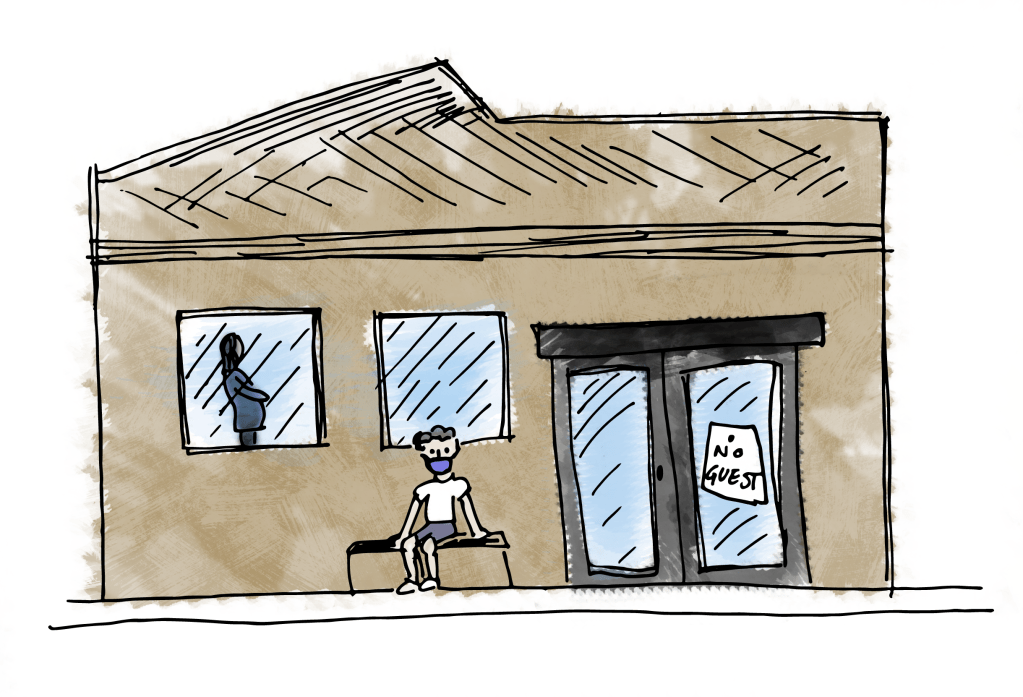
Illustration by Samantha Harrington

Every Thursday for about a month, I sat alone in my car, staring at the red-brown bricks of a birth center. My pregnant wife, Carly, was inside one of its rooms, being poked and prodded and tested to ensure she and our daughter were healthy and strong. To minimize risk during the worst stages of the pandemic, partners were not allowed in. Sometimes the appointments were quick, lasting no longer than 20 minutes; other times I sat alone for a couple hours.

During these solitary moments, I always noted my view from the car: those bricks, lots of plants, a thin gray tree. We’d been to the birth center so many times, and I’d sat by myself in the car so many times, staring at the same pieces of the world, that we saw winter transition to spring: By the end, the day before our daughter, Mayla, was born, the sad gray tree had started sprouting little white flowers. 

The symbolism—our baby coming into the world as flowers began to bloom after a long winter—was not lost on me. Carly and I, on long, cold walks around our neighborhood, would talk about how everything, soon, would be different: We would have a baby girl, and the days would be longer and warmer, and summer break was on the horizon, and we could visit family and friends, and the world, for so long dominated by a stubborn pandemic, would return to some type of normal (or so we thought). On the best days, we were filled with hope.

For the last three-plus months of the pregnancy, that’s all we had. Alarmed by stories of mothers-to-be facing more severe COVID cases, and with vaccines unavailable for us until the early spring, we were, more than most, locked down. We worked from home. We bought an annual subscription to Instacart and used it weekly. We ordered delivery, asking drivers to leave the food at the door; if we were feeling adventurous, we got takeout, our lone semi-weekly venture into the world. Those trips inside the restaurant terrified me, even as Carly stayed in the car. (One night, a week or so before the due date, I spent the better part of three hours worrying if I got COVID from a maskless woman chasing her daughter around a restaurant where I was waiting for food.) I used to half-jokingly tell my friend, also an expectant father, that if everyone in the world had a pregnant partner, the pandemic would recede in days. 

Carly, to her credit, rarely complained about the hand she was dealt. She had looked forward to pregnancy, and motherhood, for most of her adult years, and this pandemic pregnancy of course did not live up to her expectations; but she maintained, better than most, perspective: She knew that her, and our, problems were minor held up against the ones affecting hundreds of thousands across the country and world.

We, like everyone else, made sacrifices to keep our family safe. Carly had wanted a big baby shower; we had one on Zoom and another with three friends sitting in spaced-out chairs in our backyard. She wanted to go home to Florida for Christmas to spend time with family and show off her growing bump; we ended up, to minimize risk, staying by ourselves in North Carolina. She wanted to attend in-person childbirth classes, to meet other moms, to feel connected to a community; she was, for weeks and then months, basically alone.

That included all of her appointments: The first time I was allowed in the birth center was the day Mayla was born. In the car I cried only once, on week 41, when she had to go to a different building for a different test; maybe I missed my familiar bricks and tree. Remaining by myself in the parking lot was a small price to pay to protect nurses, doctors, and mothers, but I wanted desperately to be in the room with her, holding her hand and watching Mayla squirm on the little black-and-white screen. The first time I saw our daughter, at the 20-week ultrasound to confirm her heartbeat, was via FaceTime as I sat in the parking lot.

A lot of it, to use the formal phrase, really sucked. But the most important truth never changed: She and Mayla remained healthy for nine-plus months. And this spartan existence, with just the two of us spending together lazy days and slow nights, was perhaps the one of the best ways to culminate our pre-parenthood lives. We would work, at home, until mid-afternoon, go on a walk around the neighborhood as the sun slowly sank below the mountains, talking about the baby and plans and the world. When we got back home we’d stretch in the living room, listening to music and playing with the dogs, before making something warm for dinner and eating it while we watched “New Girl.” Then we’d clean up and get ready for bed, without rushing, and watch TV or just sit there, talking and marveling at Carly’s moving stomach, letting it sink in how wild, how wonderful it was that there was a baby, our baby, in it; and she would drift off to sleep, and I’d read with the lights out before joining her in dreaming.

Now, of course, when life has sped up and responsibilities have multiplied, we both miss those unhurried days. Now we work and coach and come home and work some more and eat dinner and pack our lunches for the next day and wash bottles and give Mayla a bath and then put her to bed and by the end of the day we’ve seen her, and each other, for two, maybe three hours. And then we do it all again the next day.

Our pandemic pregnancy was stressful and isolating and restrictive. But it was also, toward the end, peaceful, maybe even necessary. We were forced, by circumstance, to return to basics, to prioritize what was essential and forget all else. We were forced to confront a truth that deep down we knew but the rush of life had complicated: that simplicity—family, and food, and books, a warm sun and laughter—is all we really ever need. Everything else is periphery. There is always time to do what matters.

So every time I see a pregnant woman now, keeping a baby alive in the throes of a pandemic, I say a little prayer of protection, and hope that she can find peace amid all of the chaos. I appreciate her, and her partner, sitting alone in the parking lot, staring at bricks, on a deeper level than I ever thought I would.


Join our mailing list!

Subscribe to the Essays of Dad newsletter, a weekly email with parenting stories, background on essays, book recommendations, and more.
Processing…
Success! You're on the list.

Her Eyes

Illustration by Samantha Harrington

Let’s start with the surprise: her eyes are wide and blue, the color of the ocean. Mine and my wife’s are thin and dark brown, the color of coffee without cream. They say her eyes can change color up until she’s a year old, and maybe they will. Most of our close family members’ are dark like ours. But until then her eyes, big and blue, will be two unexpected pools of color in our world.   

Her eyes don’t open immediately when she wakes up. In fact, it seems like sometimes they’re the last part of her body to know she’s awake. She yawns and stretches and grunts and sometimes even cries all the while her eyes stay closed. Only when she opens them fully do we know that she is ready.

Her eyes are then alerted by her stomach that she’s hungry. Often this happens immediately, seconds after they open, and food has to be made available no matter what her mother is doing. If too much time passes, she will squeeze her eyes tight, like she’s looking for something inside her face, as her mouth opens to scream. 

As she eats, her eyes are focused on the task at hand, only taken occasionally by a passerby in the house (her dad) or the weight of sleep. They have no time, no patience, for distractions; eating time is for eating, and everything else will have to wait. Later, often as you are holding her, her eyes will suddenly widen and turn grave, the universal sign for I gotta take a poop. Sure enough, she will let it all out, making no effort to conceal the noise, her eyes serious the whole time. 

Once she has eaten, digested, and excreted, her eyes are light, full of life. If you say something she likes—“Are you having fun with Sophie Giraffe?” “Do you love your mama?”—they will squint in delight as her chin falls to her chest and her shoulders rise and her lips curl in a smile. It is a picture of cuteness, of pure glee. If you say something she doesn’t like—“Are you ready for a nap?” “Wanna take a bath?”—they will sink and stare as her lips twist into the cleanest and clearest of frowns. It is a picture of pure disdain.

You will then have to pick her up, which is the time her eyes love the most. From your arms, they search, constantly. They look at lights and other eyes and signs hanging on the wall and ceiling fans. (Oh how they love ceiling fans.) They often look curiously at her parents’ wedding photos behind the couch, scrutinizing them as if to say, Wait, I know those people… For the first couple months of life, they love contrasts, the black-and-white books of shapes you give to her during the ever-important Tummy Time, literally seeing the world in black and white. A month or two later, they will follow you, or your finger, or whatever you’re holding, as you move from one spot to another, an important developmental milestone, you learn, called tracking. 

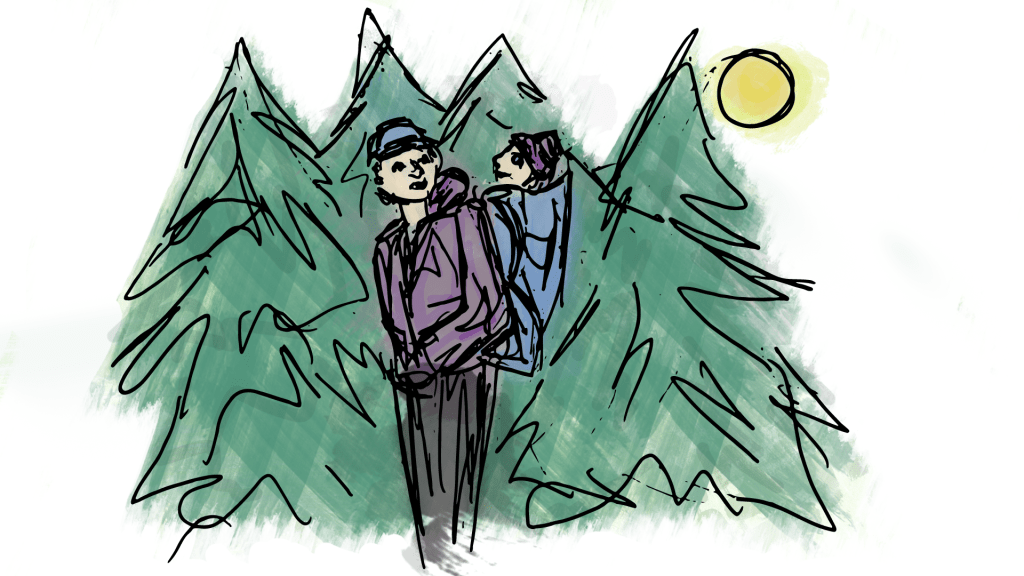
And that’s only inside. Take her outside and her eyes will have, to use the scientific terminology, an absolute field day. (Only after, of course, she theatrically squints and turns her head away from the sun, like a teenage gamer walking outside for the first time in weeks.) Once they are adjusted to the brightness, or shielded by a bucket hat, they get to work. They take in the trees and the mountains and the squirrels and the birds and the rocks and the leaves and the giant empty blue space up above and the green green green all around. Sometimes they dance across her plane of vision, darting from one thing to the next without rest; other times, they stare, endlessly, at some inanimate object, like a chair or a blade of grass. On hikes through the forest, they look straight up, through the canopy of trees, and when you are overcome by curiosity you will do the same and wonder why you don’t do it more often, for the sight is magnificent: streams of blue and light popping through small pockets between the trees. You smile as you realize that your 3-month-old has taught you to look for the beauty in hidden places.

One day her eyes will fill with tears, and it will be sudden and sad. Until then her cries were dry and therefore lacked a certain magnitude; the tears change all of that. They will hop, slowly, down her cheeks when she’s upset and you will think of the lyrics of a song called “The Girl”: When you cry a piece of my heart dies/knowing that I may have been the cause. Often, you will have been the cause: You will have had the audacity to try to get her to take a nap, or put her in the car seat. Her eyes will narrow and blink as you rock her in your arms and she releases full-throated screams, but they will refuse to close until biologically necessary. When they finally do shut, they will look so peaceful you will forget the battle you waged to get her to sleep. From the baby monitor or from the side of her crib, sometimes you will just watch her sleep, and your worries, for those precious minutes, will melt away.

With the exception of her hair, a chaos of dark brown perched wildly atop her head, her eyes, big and blue, are her most defining feature. They search and find and cry and sleep and track and close—and, you will learn, comfort.

One day you will be so worried about keeping her safe during a pandemic that you will be in the bedroom, fighting off tears. From Mom’s arms, her eyes will turn to yours and look at them curiously, as if to wonder, What’s wrong with Dad? They will stare at you for several seconds, paying attention to nothing else around them because they realize that right then you need the full extent of their love. As they continue to stare, you will think of the lyrics to another song, the one that inspired her name—And all I have to do to rise/is look into your eyes—and take her from Mom’s arms. Her eyes, big and blue, will stare up at yours. And they will, not for the last time, help you rise.


Join our mailing list!

Subscribe to the Essays of Dad newsletter, a weekly email with parenting stories, background on essays, book recommendations, and more.
Processing…
Success! You're on the list.

The First Month

Illustration by Samantha Harrington

Maybe, in a few years, we will forget all of this. Maybe, when life speeds up and obligations multiply and priorities shift, we, my wife and I, will forget the small things that made this first month of parenthood the greatest, and fastest, of our lives.

Maybe we will forget eating Jimmy John’s subs in bed at the birth center, fulfilling my wife’s nine-month vision for cold cuts after the restrictions of pregnancy eating had finally, gloriously, been lifted. Maybe we will forget the drive home a few hours later, in the dark of night, as I clutched the steering wheel harder than I ever had and Carly, the new mom, sat in the back seat with the newest member of our family, a sleeping seven-hour-old baby girl named Mayla, speaking to her softly. Maybe we will forget first carrying her blanket into the house so the dogs could familiarize themselves with her scent before she, an intruder, entered the space they’d devoted their lives to protecting. Maybe we will forget that first night, a haze of FaceTiming and unpacking and, finally, sleeping.

Maybe I will forget scooping her from her bassinet as she awoke in the middle of that first night, softly placing her on my chest as I read Lord of the Rings on Kindle. Maybe Carly will forget having to wake up every two to three hours, every night, indefinitely, to feed our growing daughter by lamplight. Maybe I will forget the fruitlessness I felt for not being able to feed her myself and occupying the far less important role of Mid-Feeding Diaper Changer to ensure she’s alert for the second half of her 3 a.m. snack. Maybe we will forget the sporadic, hopeful naps the following afternoons—sleeping, as everyone advises, when your newborn sleeps. Maybe we will forget frantically waking up at 2 a.m. to make sure that she was in the bassinet next to us, that we didn’t doze off with her in our arms in bed. Maybe we will forget, once that panic had passed, touching her sinking and rising chest to make sure she was breathing.

Maybe we will forget the countless appointments, checkups, and weigh-ins with different doctors and specialists, each of them offering a version of the most important truth: Both mom and baby are healthy and strong. Maybe we will forget putting Mayla on the porch to soak up some Vitamin D and reduce her moderately high levels of bilirubin. Maybe we will forget what the heck bilirubin is. Maybe we will forget the gratitude we felt for her first-time grandparents and aunts and uncles, who arrived from out of state to take care of the people taking care of the baby. Maybe we will forget the sheer joy they felt once they held their grandchild or niece for the first time, all of their worries melted away almost instantly.

Maybe we will forget the diapers soiled by yellow, seedy poop, a development that would have been concerning had the doctors not told you it was normal. Maybe we will forget our daughter’s propensity for peeing only when we had removed her diaper before putting on a new one, soiling the changing pad liner more times than we’d ever expected. Maybe we will forget the looks of grim determination or grave concern as she felt, or forced, a bowel movement. Maybe we will forget her first blowout, which somehow resulted in poop coming out the front of her diaper, staining, for good, the clean white shirt she’d been wearing.

Maybe we will forget staring at her, for minutes straight, watching her watch the world, her eyes a window into her days-old mind, trying to decipher what she’s thinking and learning and feeling. Maybe we will forget the furrowed brows and pursed lips and open mouths, or the sudden, instinctual punches and kicks. Maybe we will forget the grunts and moans and squeaks and yawns, the new, adorable soundtrack to our lives. Maybe we will forget her round cheeks and thick hair, her chunky legs and searching eyes. Maybe we will forget her sneezes, full-body contractions that seem to surprise her no matter how many times they come (six in a row one night). Maybe I will forget reading to her in the gray chair in the nursery, feeling her warm milky breath on my chest as she slept or stared out of the window, paying little attention to my reading of dozens of words that rhyme with llama.

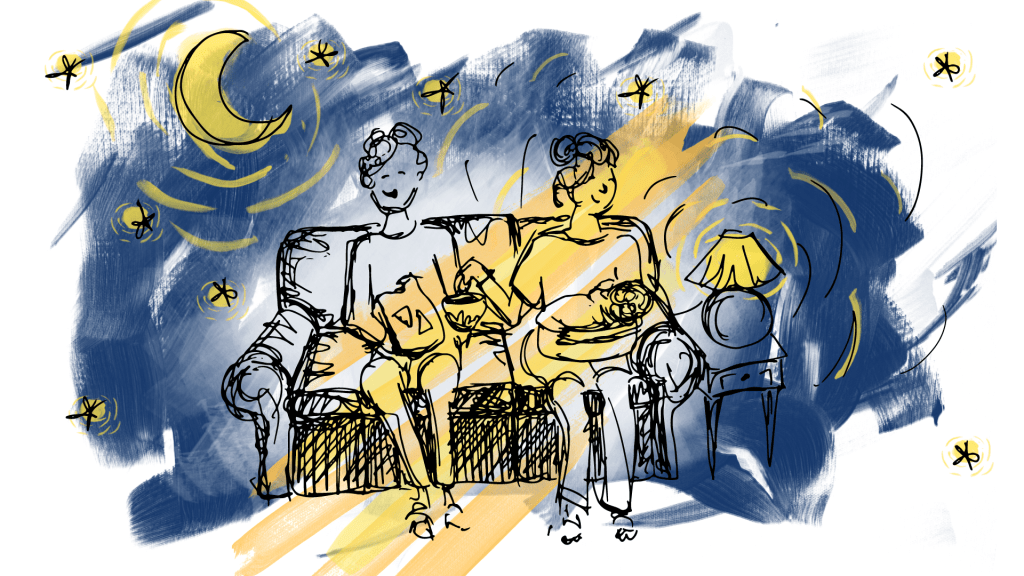
Maybe we will forget the crying, and the challenges of breastfeeding, and the stress and short fuses caused by lack of sleep. Maybe we will forget failing to adhere to any type of schedule because newborns are fickle and need to eat when they need to eat. Maybe I will forget feeding Carly appetizers on the couch as she feeds Mayla, holding a bowl of salsa steady so she can carefully dip tortilla chips into it, a hilarious food chain. Maybe we will forget our realization that they weren’t lying when they said parenting was hard.

Maybe we will forget all of this. Maybe this first month will be nothing more than a fleeting, blurry memory, a series of half-remembered moments that we will embellish with time. Maybe we will look back on them and feel completely different than we do right now.

Or maybe not. Maybe there are some moments that you will remember forever.

Maybe, one night, your daughter will have trouble feeding and your wife will be understandably frustrated, her clothes wet with excess milk. Maybe, as she is upstairs showering and you are in charge of heating up burritos for dinner, your daughter will start crying. Maybe you will pick her up and put on music; as the lyrics came through the speaker, maybe you will look into her wide blue eyes. Maybe they will stare past yours, over your right shoulder, into the middle distance. Maybe it will seem like she is watching her entire future unfold, right there in the kitchen, and she lay in your arms, a curious, half-smiling expression painting her face. And, maybe, in that moment, it will just be the two of you, and nothing else will matter, and it will feel like time slows as your eyes become warm and wet and she continues to stare past you, and then she will look at you, and right then you will feel something you’d never experienced in your life, a surge of pure love, and you will know then that she is the most important thing to ever happen to you.

No, you will not forget that.


Join our mailing list!

Subscribe to the Essays of Dad newsletter, a weekly email with parenting stories, background on essays, book recommendations, and more.
Processing…
Success! You're on the list.

On the Power of Women

Illustration by Samantha Harrington

Somehow, they sold you short. For months, years if you’re around the right people often enough, they told you this would be “the greatest day of your life” and “there’s no other feeling like it in the world” and “cherish every second because it’s over like that.” They tried, with the vocabulary available to them, to describe something that was beyond words, beyond communication, beyond, even, comprehension.

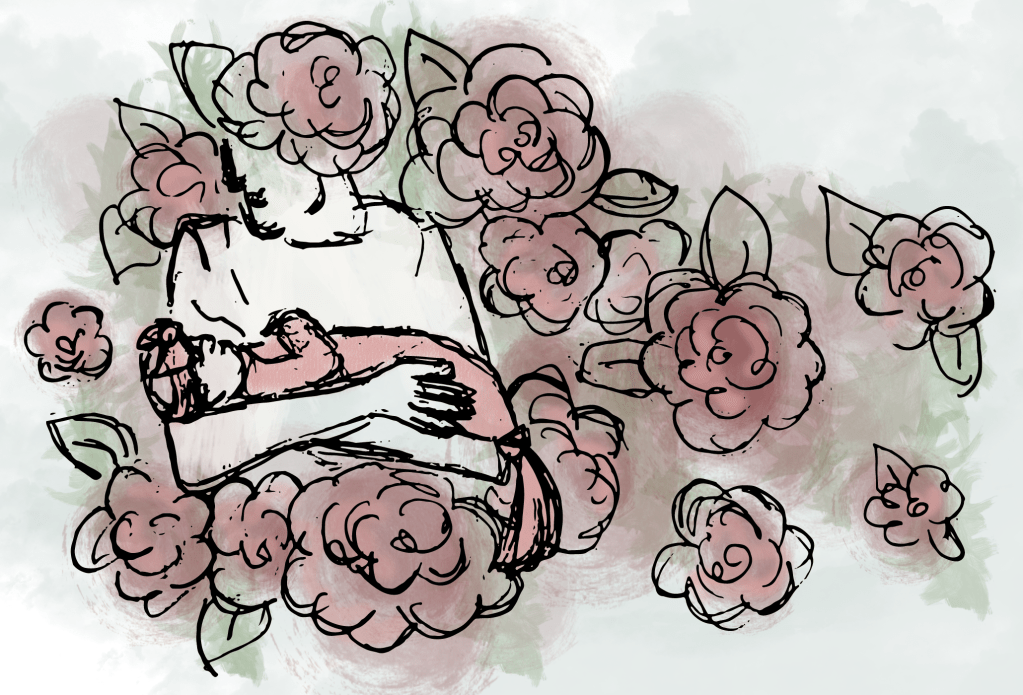
They did not tell you, in the moment your daughter, Mayla Ruth, entered the world, as you watched the midwife unwrap the umbilical cord from her gray neck and she took her first gulp of oxygen, that your own chest would fill with a light you’d never felt before as around you time slowed and surroundings blurred. They did not tell you, as she was placed, softly and immediately, on your wife’s chest, that your head would, instinctively, fall there as well, the first moments of your new family captured not in a picture but solely in your memory, where they will live forever. They did not tell you, as your wife exclaimed, “I did it!” through relieved, joyous, clipped breaths, that you would be crying more than your newborn daughter, the tears falling under your cloth mask. They did not tell you, when they described her, that words like “beautiful” and “gorgeous” and “precious” were somehow not powerful enough; angelic, maybe even divine, would come closer. They did not, could not, tell you any of this, and perhaps that was for the best, because this was, after all, something, like watching the Northern Lights or viewing the Earth from space, that could only be felt.

The intensity of those feelings, of that love, for your daughter were matched only by the same ones for your wife, and the gratitude you felt for the people who delivered your baby: the nurses and midwives at the women-run birth center who guided you through the most intense, and greatest, day of your lives. All of them reminded you, on International Women’s Day no less, of the irrepressible, imperishable power of women.


You learn a truth soon after you find out you are going to be a father: A pregnant woman is a superhero. She carries, for nine months or more, a human inside of her, one that causes her indigestion and nausea and no small amount of pain. For the first few months, she can eat only watermelon and popsicles (maybe, too, a watermelon-flavored popsicle) lest she throw up, her body rejecting foods like it never has before. If she’s lucky enough to keep down the food, it might stay in there for far longer than is normal, or healthy: The only trips she makes to the bathroom are to empty her bladder, again and again and again, like an old man in a Flomax commercial, interrupting sleep, which she wants, and needs, desperately.

The next three months, the second trimester, are supposedly the easiest, because all she has to deal with then is the small fact that a living being is growing inside of her, constantly, expanding her stomach like a slowly inflating balloon. Perhaps, too, she’ll have some “practice” contractions, and her fingers and ankles and feet will swell, rendering quotidian tasks like taking off a wedding band or putting on shoes a true challenge.

Then it gets real. Her belly, by the third trimester, is at the point where strangers ask, “When’s your due date?” Maybe she’ll describe it to you as carrying, in her stomach, a basketball, only the type that constantly kicks and moves and squirms inside of her. On walks around the neighborhood, the basketball will press down on her bladder, requiring her to find, immediately, a bathroom, or simply make her extremely uncomfortable. Preparations for the big day will be made: bags packed, nurseries decorated, floors cleaned and vacuumed over and over. She will waddle around the house, attempting to make everything perfect for her baby’s imminent arrival, a practice, your how-to-be-a-dad books tell you, called “nesting.”

If, for some reason, she is pregnant during a pandemic, she will go through all of this relatively alone, staying home for Christmas, celebrating baby showers on Zoom, talking to her doctors and watching ultrasounds by herself as you are forced to sit in the parking lot. She will not see family, or friends, for weeks, and by the end of it, months. She will ask you, on a random Wednesday, to take her on a ride to see the mountains under the sun and the cloudless sky, to breathe fresh air away from the house. She will cry, sometimes, but she will carry on with a quiet strength that you can only admire.

After all of this, she will describe it as a “pretty easy pregnancy.”

Maybe her preparation, weeks and months in advance, will be worth it soon, and she’ll have her baby on the due date, or perhaps even earlier. Or maybe she will have to wait a bit longer: a few days, or a week, or two. This time, you will learn, moves excruciatingly slow. In these cases—in the midst of countless doctor’s appointments to check the baby’s health and hers, of trips to the chiropractor to maneuver the baby into a better position, of uncomfortable exams and no-stress tests—she will experience a strange cocktail of emotions, a mix of disappointment that the baby is not yet here and disappointment with herself for feeling disappointed, and growing anxiety about labor, and anticipation, and true excitement that it could happen at any moment.

And then, one day, it will.


Or, more accurately, for biological reasons that she will have already explained to you, one night. Maybe the contractions will start around 11 p.m., just as she was ready to lay her head on her pillow to get some necessary sleep; she will attempt to sleep through them at the start, but she will soon learn that that is impossible, like trying to take a walk during a tornado. Instead she will open up her app to time contractions on her phone, and press the green button when they start and red button when they end. At the start, she’ll be able to talk through them, and as you are shuttling in and out of the garage to load up the car you will find her standing in the kitchen, wondering where to place a new sticker on her water bottle. You will smile.

The time between the contractions will get smaller, and their intensity will increase, until she calls the midwife, who will suggest taking a bath to see if they calm. They will not, and after the bath she will lay down, and suddenly she will jump up, sprint to the bathroom, flip open the toilet, and discard her dinner. The contractions, you will learn, have become so intense that in certain positions they make her throw up. “Maybe we should call her back,” she will suggest, and in less than an hour you will be on your way to the birth center as she huffs, from a small sheet of toilet paper, peppermint oil to manage the nausea.

By the time you arrive she will have been in labor for six hours, and the pain will only increase. For the next six hours, you will watch, hopelessly, as she struggles through active labor, her stomach contracting every couple minutes and rendering her speechless. She will sit on a giant exercise ball, her head bent over a pile of towels, and actually, for a few priceless minutes, doze off between contractions; she will try lying down, and again she will throw up from the pain; she will labor in a giant inflatable tub filled with water.

Throughout it all, the midwives and nurses will shuttle in and out of your room, checking on her and measuring the baby’s heartbeat. They will encourage her, suggest different positions to relieve the pain, and patiently answer your questions: “Does that mean it’s OK?” “All good?” “Are we still moving forward?” They will tell you what to do; you will gratefully listen.

You will change the music and massage her shoulders and tell her you love her, but mostly you will sit, in awe, of the strength she shows in the toughest hours of her life and the unassuming grace and professionalism of the other women helping her through them. She will not be able to speak to you, and this is perhaps the toughest part, because up to that point any major challenge you encountered together you discussed together. You will feel, more than any other time in your life, truly, utterly useless, as you watch the person you love most go through something close to an out-of-body experience as you sit next to her, painfully aware of your physical limitations and the injustice of biology.

She will not, contrary to what you remembered from your birth courses, experience any breaks, any letups from contractions. She will say, accurately, in one of her few full sentences in hours, “I feel like this is constant.” Despite this, she will not take any medicine to manage the pain, her mind set on the natural birth she’d planned for months.

And then, suddenly, miraculously, she will be 10 centimeters dilated and her water will break. You remember from your birth course that she has gone through the worst part, the dreaded “transition,” and from here it’s an hour, maybe two, of pushing the baby out. You feel, finally, that there is light at the end of the tunnel, and for the baby that is literal. Your heart starts to beat faster; you know she is close.

Three hours later, she will still be pushing. The worst part, it turned out, was far from over. At this point she will be exhausted, physically of course—over 15 hours without food, 27-plus without sleep—but also emotionally, with little left to give; she will feel nothing but pain; she will forget the reason for all of this. She will not have said a full sentence, or opened her eyes, for nearly 240 minutes. No position—sitting, laying, squatting—will ease her pain. She will, hands on her knees, barely able to hold up her head, tell you, “I’m scared.” At this point you will wonder, as you look out of a crack through the window at a plane leaving a white wake in the light-blue sky, “Is anything worth this?”

The answer will come less than 15 minutes later.


You will later reflect on the experience and conclude that it was the most impressive thing you have ever, and will ever, watched another human being do: 16 hours of unmedicated labor off of zero sleep and fueled only by fruit juice. You will know then, more than ever before, that your wife is the strongest person you know. You will force back an incredulous smile when she describes the labor as “pretty smooth”; you will know, too, that she is right: Every day, women endure labors with greater challenges and complications than hers, and you will feel even more grateful that she and your daughter are healthy and strong. You will be reminded that women are capable of what you thought was impossible.

They are capable of pushing out, through primal screams, a seven-pound human from inside of them. They are capable of forgetting all of the pain—the nine months of sacrifices and hours of searing contractions—almost instantly as they hold their baby in their arms. They are capable of calmly guiding other women through the most intense experience of their lives, and of soothing the nerves, assuaging the fears, of their partners. They are capable of the extraordinary.

And that, perhaps, is the most important lesson you will ever teach your daughter.


Join our mailing list!

Subscribe to the Essays of Dad newsletter, a weekly email with parenting stories, background on essays, book recommendations, and more.

Processing…
Success! You're on the list.

An Introduction

Logo by Daniel Wilco

On June 18, 2020, our world changed forever. As I was adding chunks of frozen mango to a blender to make a smoothie, my wife, Carly, came downstairs, holding a little white-and-blue device that looked like a thermometer. She was smiling warily, walking cautiously, as if one wrong step might propel her from a dream she didn’t believe she was having but didn’t want to end. As she approached she held up the thin piece of plastic for me to read:

“Pregnant.”

The rush of emotions was contradictory and revelatory: a cocktail of relief and surprise, excitement and fear, unbridled glee and concealed disbelief. That day had started like any other of my first 27-plus years of life, with the comfort of knowing that my primary responsibility was taking care of myself; the next morning when I looked in the mirror, the same face that 24 hours earlier had looked so young stared back at me in awe, making plain a newly indisputable truth: I was going to be a father. 

To be clear, this baby was relatively planned, if a bit early. Carly and I were going to start trying later in the year, so any feelings of shock were tempered by the fact that it happened only a couple of months earlier than the best-case scenario. (When we broke the news to my parents later in the summer, my dad—whose immediate reaction was to yell, “Oh shit!”—asked if it was planned. “A happy surprise,” I told him.)

But still: I thought I had more time! I wasn’t ready to be a dad, a sentiment echoed by Chris Rock’s character in the movie What to Expect When You’re Expecting, which we watched the night we found out: “There’s no such thing as ready. You just jump on a moving train and you try not to die.” We had just outlined a pre-babymoon plan, featuring lots of time eating sushi and riding rollercoasters. We were going to prepare financially. We were going to take a beach trip. We were going to, and this is straight from the list, find Carly a dentist, get established with primary care doctors, take a road trip to Vermont with the dogs, organize the house, and, my favorite, “read books.” We were going to enjoy the last few months of our family of two. (In the back of our minds we both knew that many of the items on the list would be unattainable because of the pandemic that was ripping through the country.)   

Of course, babies don’t come immediately, but there was now a firm deadline by which we had to accomplish all of the things we wanted to accomplish by the time we became parents. We didn’t, of course, both because of the scale of our mission and because aside from the agonizingly slow last few weeks, the time flew by. 

On March 8, 2021, at 2:46 p.m., I became a father. I still don’t think I recognize the full magnitude of what it means; I don’t know if I ever will. But I’m hoping this site can help.


I used to write for a living, mostly about sports, interning at The New York Times and Boston Globe before moving out west to work at another paper after college. When I realized I wasn’t suited for the isolation of sportswriting, I did what so many other rudderless millennials do: I changed careers. In a couple of weeks I’ll enter my fifth year of teaching fifth grade in public schools, a job that is equal parts exhausting and rewarding, not unlike, I’m learning, being a parent.

I bore you with this brief biography to help myself understand my connection between writing and fatherhood. Soon after our daughter was born, I realized that every day, everything, seemed so big, so important, so significant that I needed a place to ask and answer my questions, to contextualize our challenges, to help demonstrate a love that I’d never felt before.

I hope Essays of Dad can be, or become, that place. I hope it will be a space for thoughtful writing about fatherhood, a collection of stories and essays and observations that together paint a true picture of parenting, with its contradictions and messiness and uncontainable joys. Judging from cursory Google searches, there doesn’t seem to be a site like it, which both surprised and encouraged me. I hope Essays of Dad will remain unique. 

Thank you for being here. I hope to publish an essay—accompanied by an illustration from my incredibly talented friend Sam—every week, and send out a weekly newsletter with background on essays, stories about parenting a toddler, book recommendations, and more (you can subscribe below).

Thank you, again, for reading.

Robbie Harms
August 2021


Join our mailing list!

Subscribe to the Essays of Dad newsletter, a weekly email with parenting stories, background on essays, book recommendations, and more.

Processing…
Success! You're on the list.