“Have you figured out what you’re running from yet?”
The question came from a man in the dark. It was a weeknight, a few years ago, and I was stretching by my car after doing some school parking-lot loops to get in a couple extra miles after a late meeting. The question was sudden, disarming. It came from one of our school’s custodians, who had come out to his car to retrieve something during his solo night shift.
I laughed noncommittally. “Umm.” I paused, thought. “I don’t know.”
“The correct answer is heart disease and type II diabetes,” he said, smiling.
I laughed. “I guess I’ve never really thought about it,” I said. “I guess I’m just running from…” I paused. “Yesterday’s self? To get faster, I mean.”
He stopped about halfway between our cars.
“You know, I was reading Craig Ferguson’s—he’s a Scottish comedian, one of my favorites—I was reading his biography. It’s called Riding the Elephant. And in it he talks about how he’s always been a runner. You ever heard of it?”
I shook my head.
“Well, it’s about all of the challenges he’s been through—addiction, heartbreak, pain, fatherhood—and something really stuck with me. And I thought of you when I read it, because I see you running, every day.”
He paused. I looked into his eyes.
“He said that he used to run from all the hurt. Until he met his wife. That was when he finally found something to run toward.”
I let the words seep into the night. Something to run toward.
He retreated back to his car and said goodnight, leaving me alone to think in the darkness. I had been a runner for almost a decade at that point and had never considered one of its simplest questions.
What was I running toward?
Two Saturdays ago I woke up at 3:30 a.m. to run 30 miles through the mountains. About two weeks earlier I had turned 30, and it had become something of a rite of passage among my runner friends to cover 30 miles in honor of this milestone birthday. My motivation was relatively simple: I wanted to prove to myself that even though I was getting older, I could still run something long. My plan was to run from the base of Mount Pisgah to the Folk Art Center, a section of the Mountains to Sea trail that I had covered in pieces before but never all at once. My wife, Carly, and two girls would meet me at the end. This would be, if all went well, the farthest I’d ever run, in terms of both distance and time.
And so there I was, driving up the Blue Ridge Parkway in the early morning hours with my best friend Jordan, climbing out of the car when we arrived in the parking lot of the Mount Pisgah trailhead. It was cold when we got out, the sun still hours from rising and the wind and elevation much stronger than down below. Wondering if we’d underdressed, we filled our bottles, organized our nutrition—an avalanche of sugary powders and gummies—and strapped on our running packs and headlamps. And then we entered the dark trail.
The first section, down a brutal stretch of trail officially known as 151 but more endearingly referred to as “the elevator shaft,” was choppy and technical, but we nearly immediately entered that sacred running space, where ideas and conversation bounce and flow as unpredictably as our footsteps. It was just after 5 a.m. in the mountains and we were loving it.
For the next two or so hours we talked about running and fatherhood and public education, saw one bear and two people, ran into the sunrise, and marveled at the green mountains surrounding us. Around mile 12, Jordan stopped at his car at his pre-planned departure spot, and we said goodbye. I continued down the trail on my own.
Almost immediately I popped in Carly’s Airpods and so soon Arcade Fire and Mumford & Sons accompanied me as I glided through the mountains, enjoying their curves and undulations I’d run so many times before even as my quads began to sear on the downhills.
And then a song came on that I listened to during my brief, post-college stay in San Diego, one of those times when life punches you in the mouth but you come out stronger, and then it hit me: I was running this not to simply to prove that I could, not merely to delay or defy the endless march of time, but for something deeper, more important: This 30-mile run represented my 30 years on Earth, those thousands of beautiful and difficult and ultimately purposeful days that had shaped me. I’d started the run with Jordan, my best friend since birth, covering miles together as we’d done countless times as teenagers through the heat of Florida. And now I was by myself, as I was after college, running forward, unaware of what awaited. I knew then that everything—the good, the bad, the in-between—had led me to that specific moment, sprinting down a mountain and pumping my arms to the music blaring through my headphones. It felt big.
A few miles later I ran into the parking lot where my friend Charlie was waiting with pickles and Gatorade. I ate a little, drank a ton, and ambled back to the trails, where 13 more miles beckoned.
Around mile 19, on one of the easiest sections of the trail and one I’d run dozens of times before, the physical and mental reality began to set in: double-digit miles to go on heavy legs and a tired brain. As it often does in low moments, doubt, about the rest of the run and its value, began to slowly creep in.
But Charlie, as he and so many other friends had done for me throughout runs and more broadly life, powered us through the rough patch, with humor and conversation and, most importantly, by simply being there. We continued that simple, most elemental task of putting one foot in front of the other, and the miles began to clip off a little more easily, nine to go then seven then five, and soon we were two miles out from the finish, laughing and waxing philosophical and tearing into a pack of peanut M&Ms and at one point taking a wrong turn that led us to the right place.
With a mile to go, we shoveled down some more M&Ms and opened our stride. Here it was, here it always is, the last mile, that holy place of pain and joy and heart, where you find out important things and you’re no longer running but floating, drifting by the world passing at a different speed and feeling only your chest working hard and blood coursing to your arms and legs.
I was running fast, faster than I had all day, because I finally knew the answer to my custodian’s late-night question all those years ago.
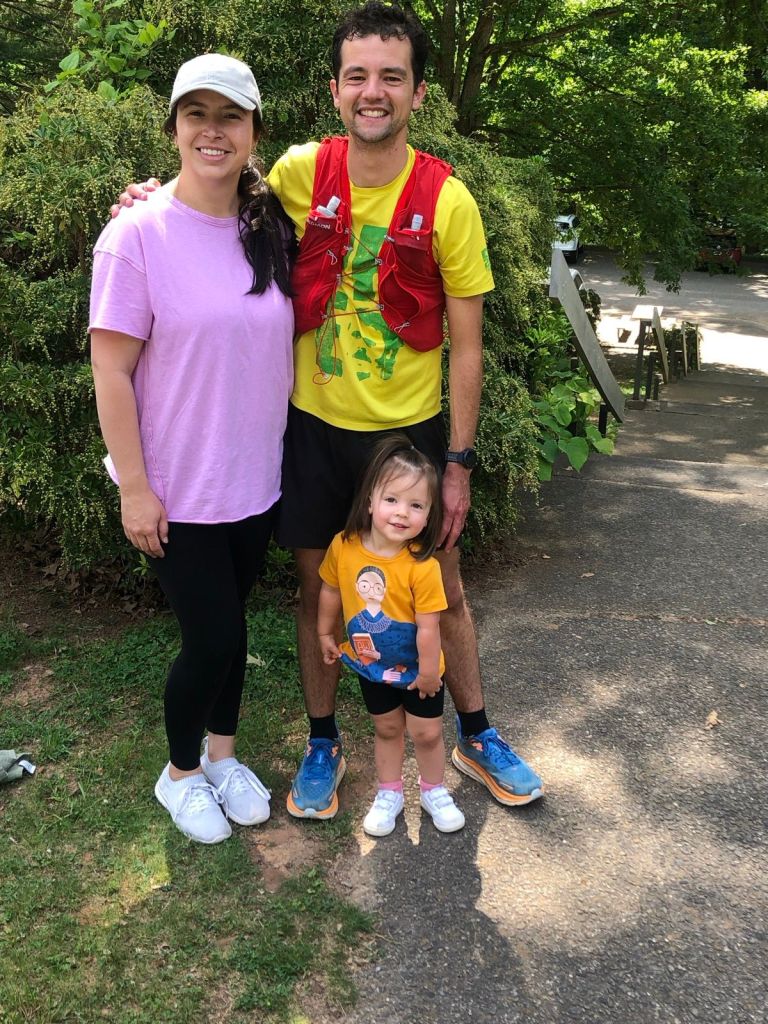
I reached the parking lot. And then I walked over to my wife and two girls.
Turns out I’ve been running toward them all along.
 Essays of Dad