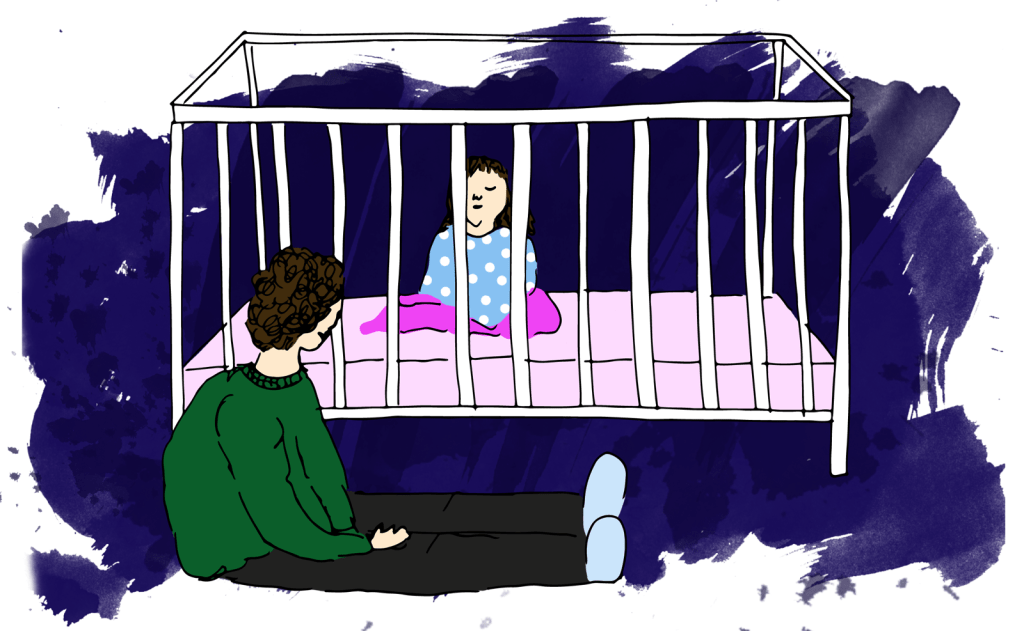
You stare into the dark and hear a squeaky voice.
“Mama?”
“No,” you say, “it’s Dada.”
“Mama?” your 2-year-old daughter repeats. She’s sitting up in her crib.
“Mama can come up if she needs to, but why don’t we try to fall asleep,” you propose, “and if you can’t, I’ll go get Mama.”
Silence. You take that as confirmation that it wasn’t a horrible suggestion and an invitation to start a conversation. She’s been having trouble going to bed recently, been having trouble with a lot of things since her little sister arrived three weeks ago. So there you are, kneeling at the edge of her crib, reasoning about sleep with your toddler. Your eyes are failing to adjust to the darkness. All you see is black.
“Hey, Mayla,” you ask, head leaning on the hard wooden crib posts, “are you feeling sad?”
“Deh.” Yeah.
“Why are you feeling sad?”
“Dow-stahs. Mama.”
“You’re feeling sad because you want to go downstairs to see Mama?”
“Deh.”
“I gotcha. I’m sorry you’re feeling sad. But right now we can’t go downstairs to see Mama because it’s time to sleep.”
“No, no, no!” She starts to get upset.
“What type of ice cream did you get Mama earlier?”
“Sta-ba.”
“Strawberry?”
“Deh.”
“Did you get Dada some ice cream, too?”
“Deh.”
“That was so nice. What do you want to do tomorrow?”
“Red büks.” She inflects on the word books, making it clear that they are what she wants to read, not something else.
“Read books? That sounds like fun. What else do you want to do?”
“Go ow-si.”
“Yes! It’s finally supposed to be warm tomorrow. Do you want to draw with chalk outside?”
“Deh.”
“And go on the swing?”
“Deh.”
She then says a long sentence that you don’t fully understand. That happens a lot these days, as her language has continued to develop and she says things that to her make perfect sense but to us have very little meaning. And your wife isn’t here to translate.
“Hey,” you say, “did we follow Daniel Tiger’s bedtime routine tonight?”
“Baf tam bhush teeth ps on stor n song ff to bed!” she recites. Bath time, brush teeth, PJs on, story and song, and off to bed!
“Yeah! We took a bath, brushed our teeth, put on our PJs, read a story, sang a song. And now it’s time to…go to bed!”
She repeats the song.
“Hey, Mayla,” you say, sensing it’s now the right moment, “remember at dinner when we talked about how sleep is so important to help us grow and feel happy?”
“Deh.”
“And remember last night when you were feeling sad when you went to bed, and when you woke up this morning you were feeling happy?”
“Deh. Oou hap-pa.” I happy.
“Well, I think the same thing might happen right now if you try to go to sleep. And if you want to do all of those fun things tomorrow, you want to feel rested and happy.”
Silence.
“Why don’t you try to lay down and see if you can fall asleep?”
Shifting. Slight creaking. Your eyes have still not adjusted, so you reach your hand into the crib. She is laying down.
“Do you want Dada to rub your back and sing a song while you try to fall asleep?”
“Deh.”
“What song do you want Dada to sing?”
“Tinkl tinkl li stah.”
“Twinkle, Twinkle, Little Star?”
“Deh.”
You begin singing and gently rubbing her back. She lay still and silent. You repeat the song several more times. Still silent.
You still can’t see anything, so you text your wife to check the baby monitor to see if her eyes are closed. They are not. You keep singing.
You move your hand from her back and find her hand. You hold it and run your fingers on her palm. Twinkle, twinkle, little star…
For the past few weeks she’s seemed giant, both physically and developmentally, compared to her 3-week-old little sister. She can run and talk and eat and play and help with chores around the house. But in that moment, holding her tiny hand, you remember that she is still small, still your little girl. And that will never change.
Your wife texts back. “Eyes are closed.”
You gingerly get up, still humming the song, and quietly exit the room. You need to go to bed, too. You have to be ready to go outside with your daughter tomorrow.
 Essays of Dad