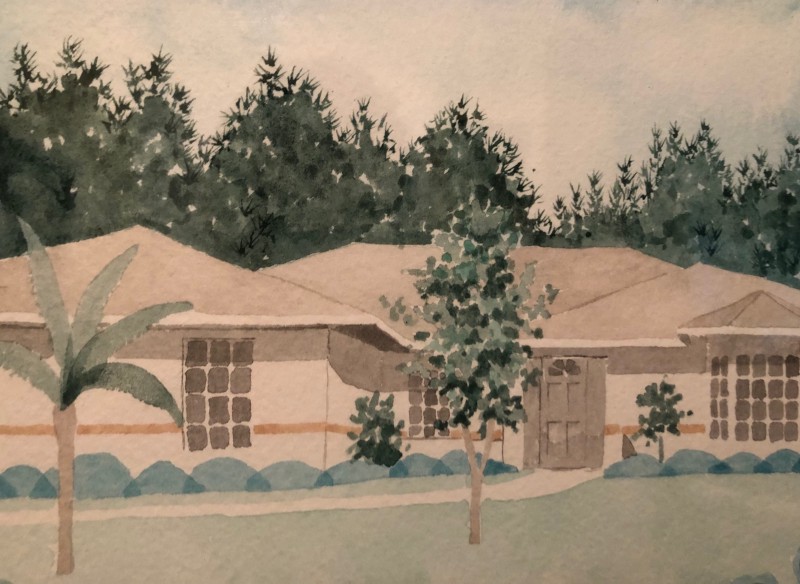
“You’re not gonna wear a shirt?” my dad asks me from the garage. He’s wearing a thin shirt blotched by giant circles of sweat. “Mosquitoes are bad today.”
I’m standing between my parents’ cars in their driveway, attempting to connect my GPS watch by holding my left wrist above my head, pleading with the heavens. I smile and nod.
“Well, you didn’t listen to me when you were 16,” he tells me, walking inside. “You’re not gonna listen to me when you’re 28.”
He’s right. My shirtlessness was never in question on this run: It’s the second day of August in central Florida, the time of year when, as a friend once told me, “the air is so thick you can chew it.” I start off down the crushed stone driveway, shaking out the stiffness from my legs as I cross the cracked concrete bridge leading into the rest of the neighborhood.
I’m home—or am I?—for a week, working at a camp that helps high school students apply to college. That’s how I described this solo trip to anyone who asked—“I’m going home to Florida”—but now I’m hesitant. Is my parents’ house, where I spent 16-plus years, where I picked blackberries in the spring with my mom and watched “Jeopardy!” on school nights with my dad and battled friends in marathon basketball games—is this home? My wife and our daughter stayed back at our house in North Carolina, where pictures of our growing family dot the walls, a 15-minute drive from friends and work and the apartment we lived in when we moved there three years ago. In the coming days, I will tell my wife, “I can’t wait to come home.” Is it possible—is it allowed—to have two homes, or is home, by its very definition, a singular place?
Maybe I’m just being sentimental; people tell me I’m too sentimental. Maybe I’m calling my parents’ house in rural Daytona, a one-story stucco with a weathered palm tree in the front yard and the stump of a towering sycamore in the back—maybe I’m calling it home because I know this could be the final time I’m here, and assuredly the final time I’m here alone. They’re going to sell this house soon, they tell me, because without my sister or me living here, they don’t need these two-and-a-half acres and 2,000 square feet and the upkeep it all entails. They want something smaller, simpler to begin their retired lives together.
Maybe I’m calling it home because I know, in some fiber deep in my chest, that I am back, for the last time, in my childhood.
My parents’ house stands a few miles south of Daytona Beach, in an area referred to as “unincorporated county land.” That’s a good word, unincorporated, to describe their community, a swath of land teeming with deer and dirt and Ford F-150s. The road leading to their house, a misshapen oval named after the fourth wife of the man who owned all the land, has never been paved, which is why after it rains you will often see Mr. Knox from two houses down riding a tractor to smooth out the sizable divots in the crushed gravel.
That’s where I’m running, mosquitoes be damned, on this gray and humid Monday, beginning the barely four-and-a-half mile route that we used to call five even. Without my wife, without (most of) the responsibilities of fatherhood, staying in my sister’s old bedroom, trying to finish the run before dinner, I feel 10 years younger, like I’m in high school, putting off studying for a bio test the next day and T9 texting friends from my flip phone. I can hear the echoes of my childhood in my dads’ words before the run (“You didn’t listen to me when you were 16…) and see it all around me as I run: There’s Harry’s farm, with a couple dozen chickens running around in the yard, a 500-pound pig lying in the hay, goats munching on grass contentedly. There’s Mr. Kondos, trying to corral his fierce German shepherd and yapping little terrier on another frenetic walk. There’s Lily, the neighborhood deer, who’s so unafraid of humans now that she essentially lives in Harry’s yard, a wild addition to his domesticated animal haven.
But even if the neighborhood had remained comfortingly static, I had changed, of course I had, because that’s what people do in the 10 years since high school: They change and they grow and they try to navigate adulthood and maybe parenthood and, if they’re alive at the right time, a pandemic that won’t go away. They learn that health insurance is a complicated mess, that all you need to watch TV is a baby boomer’s cable login, that every single one of their stored passwords is somehow compromised.
I’m running in, running through, my childhood as an adult, with all of the experience and baggage and contradiction it brings, running past the house I used to think was haunted, down to another one on the corner where Fife, their dog, used to bark and chase me along the edge of his yard until I was far enough away. I’m running across the busy road to the other neighborhood, taking a right onto the paved road, passing the same white mailbox that marks two miles and dozens of No Trespassing signs (“The fastest way to meet the Lord is praying. The second fastest is trespassing”), reaching the turnaround just past my old soccer teammate Garrett’s house.
I’m running the same route I’d run hundreds of times before, and its overwhelming sameness strikes me. It’s me that’s changed: Everything is shaped, or sharpened, by my adult experiences and perspectives and skepticism.
The first way this distinction strikes me is when I read, from my annoyingly precise GPS watch, that the white mailbox is actually only 1.88 miles, not two. I later wonder if it’s ironic or wholly appropriate that one of the most remote areas in the county has the highest number of No Trespassing signs per capita, and if it’s strange or refreshing that my parents, two lifelong Democratic educators, chose to live in a conservative stronghold where their shirtless, skinny son ran for miles while other kids rode four wheelers through the mud. When I pass Garrett’s house, I think about how he is married with a kid, and how that’s almost beyond comprehension, because it was just yesterday that his grandma was driving us to soccer practice, stopping at McDonald’s for double cheeseburgers on the way home—and then I catch myself: Holy crap. I’m married with a kid.
It’s a strange place, your childhood. When you’re in it, all you think about is leaving; when you’re back, all you think about is how you can never live it again, not like you did before. It exists independent of you, unmalleable and unaffected by your new interpretations of it. You can come back, of course, to revisit its memories, appreciate its simplicity, but it remains unchanged, forever. So you’re left running through it alone, in a growing rain, back to the place that you used to call home.
Join our mailing list!
Subscribe to the Essays of Dad newsletter, a weekly email with parenting stories, background on essays, book recommendations, and more.
 Essays of Dad