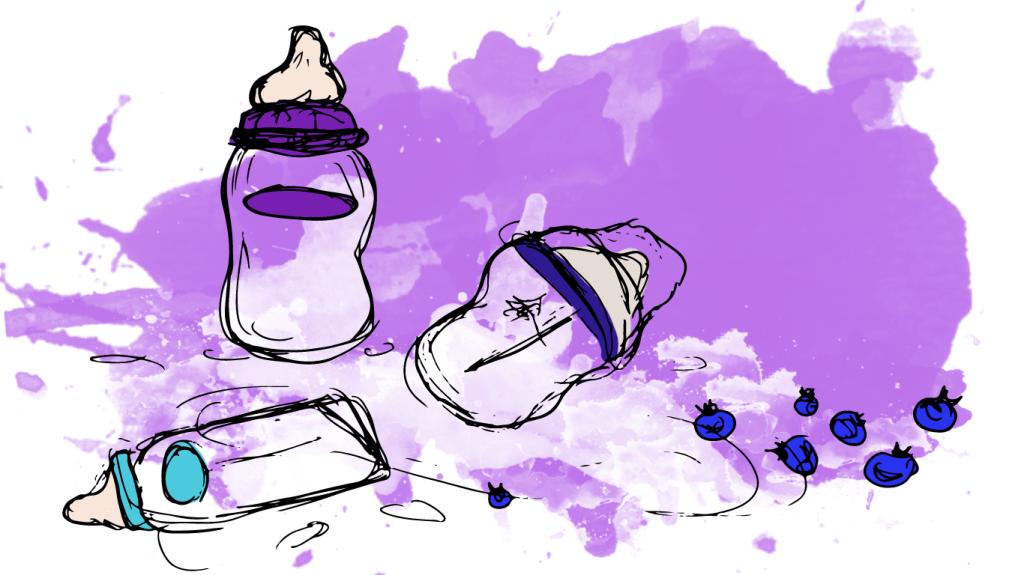
Every night for months, just before we put our daughter, Mayla, to bed, Carly fed her from a bottle. Reclining in the crook of Carly’s elbow, Mayla’s wide blue eyes would stare up into her mother’s with a look of determination and contentment as she drained the milk or formula from within. The whole process would take no more than three minutes. They were among the best of my day.
Watching Mayla drink from her bottle produced a cocktail of complicated emotions. For months, the most prominent one was relief: Mayla, for the first five months of her life, simply couldn’t drink from one, her lips and tongue and brain unable to harmonize into the sucking pattern that came naturally for most other babies. She was 100 percent dependent on Carly for food and, therefore, survival. So when she finally started taking a bottle, in what seemed like a miracle, her every sip reminded me of the long, challenging journey there.
Near the end of her bottle feeding days, though, I began to feel something deeper. Silently sitting and watching the most powerful woman I know feed the most important thing to ever happen to us, the white noise from the sound machine slowly growing in intensity and the lamp gradually dimming, I felt peace, a firm sense that, after years of trying to figure out post-college life, I was exactly where I was supposed to be: living those moments, as Barack Obama wrote in A Promised Land, “when the world slows down, your strivings get pushed to the back of your mind, and all that matters if that you are present, fully, to witness the miracle of your child growing up.”
And soon, I knew, those moments would be gone, replaced by new ones, because, yes, Mayla was growing up. She was going to graduate from the bottle any day, to straw cups, and in my mind that marked her progression to becoming a toddler. Her bottle, for so long a source of frustration, had become one of the final things tethering her to babyhood. And that, more than anything else so far in our journey, made clear one of the fundamental truths of parenting: Youth, as one of my favorite writers put it, doesn’t bother to say goodbye.
Around her sixth week of life, we discovered that Mayla had a tongue and lip tie. In biological terms, it meant that the frenulum under her tongue and upper lip were both too tight and too restricted to allow proper tongue and lip movement; these movements are necessary for sucking, swallowing, and, later, speech. In applicable terms, it meant that she had lots of trouble eating.
Not only was she inefficient—breastfeeding sessions, which typically last 10 to 20 minutes, would often take Mayla 45—she was not getting enough milk: At her three-month check-up at the pediatrician, she had dropped from the mid-20th percentile to the 6th for weight. Usually when a baby has trouble breastfeeding you can supplement with a bottle; Mayla was not usually. Bottles hung limply from her lips, which didn’t know how to extract the milk. Her only way of eating was laboring for hours every day to get less than what she needed.
Constantly being hungry and never being able to eat enough, of course, affected her mood and sleep, which affected her parents’ mood and sleep. She was, thankfully, developing properly in every other way, but as her parents it was hard to think you were doing a good job when your firstborn was going to bed hungry.
Mayla’s inability to eat well and take a bottle bore consequences daily. Carly could not leave her, ever, because Mayla, psychologically and often literally, was attached to her: Mom was the only way to get food. (I often told—and tell—Carly that she legitimately, for more than five months, kept another human alive, was her sole source of nutrition. At the time it perhaps seemed unremarkable; it was simply what she had to do, and she’d do it again without hesitation. But the quiet, consistent strength it required was something close to heroic.) We couldn’t go anywhere because Mayla would simply scream in the car, or at our destination, because she was hungry; or if we did make it somewhere, she’d have to eat for another 45 minutes. Our days mostly consisted of hanging out around the couch, waiting for Mayla to finish eating or begin again soon.
We tried everything to get her to take a bottle, which would, we knew, significantly improve our life. The first step was to get the tongue and lip tie fixed, through a not-inexpensive procedure called a frenectomy, but that, surprisingly and unfortunately, did little to improve her feeding skills. The pediatric dentist who performed the frenectomy gave us exercises for her mouth and tongue designed to help her (re)learn how to suck, and we did them daily, religiously. Still, no improvement.
We talked to our pediatrician. We talked to several lactation consultants. We talked to a pediatric nutrition team at the hospital. We tried no fewer than a dozen different bottles. We drove an hour to an orofacial myologist, who poked and prodded around her mouth. We drove 40 minutes to a craniofacial myologist, who gave her what seemed to be an extremely light massage. We took Mayla to a chiropractor (for real), who gave her what had to be the gentlest neck adjustment in history. Very little of this was covered by insurance—we spent a few thousand dollars trying to help our daughter learn how to take a bottle—and very little of it brought about improvements in her eating.
We were discouraged, and desperate. I remember thinking, What if she just never takes a bottle? I knew that some babies, of course, were exclusively breastfed, but that was not our plan. Carly needed a break; the current system was wholly unsustainable and typically unjust. I could leave the house to run, or go out of town for a friend’s bachelor party, or simply cook dinner or take a 10-minute shower. Carly couldn’t do any of those things, had to miss the final month of school and her best friend’s bachelorette party because she couldn’t be away from Mayla.
Intensifying matters was the fact that Carly, an elementary school speech therapist, was due back at work at the end of the summer; if Mayla couldn’t take a bottle by then, she wouldn’t be able to return to work, and we would have had to find a way to make up that lost salary. I was already working two part-time jobs in addition to teaching, and I began looking into more. As the weeks passed in July, and then August, our anxiety grew. We had a deadline by which Mayla, lest there be even more significant changes in our lives, had to take a bottle.
What was alarming, both then and now, was the complete lack of accessible guidance on how to proceed if your baby won’t take a bottle (and the time and money spent if you ever found it). We were—I was—lucky that Carly, who possesses a deep knowledge of infant feeding and orofacial anatomy, knew where to look and what to research. Even then, though, at times the advice we received from highly educated professionals was either conflicting or simply reduced to: Have you tried this bottle?
In the end, I have no idea what saved us. Perhaps the bottle Mayla eventually liked—a Lansinoh with a purple cap—was the difference-maker, or maybe something suddenly clicked between her brain, lips, and tongue that allowed her to finally develop the sucking reflex we had spent several months and thousands of dollars trying to achieve. All I knew was that it was one of the greatest feelings of my life.
“OMG,” Carly texted me on August 10 at 12:05 p.m. I was at work. “SHE JUST TOOK A WHOLE OUNCE FROM THE BOTTLE.”
“I’m going to cry,” I wrote back.
The first time I bottle fed my daughter was later that day; she was five months old. Carly took a video of it, and as I watch it now I’m struck with how pure my joy is: I smiled for the entirety of the 35-second feeding session (from 45 minutes to 35 seconds…). I gave her encouragement and watched with pride as she guzzled the milk. “That’s amazing,” I concluded once the bottle was empty. And it was: I could finally feed our baby, and Carly, throughout the upcoming weeks and months, could finally become something close to a normal human again.
The last time I bottle fed her was…I honestly don’t remember. It became such a quotidian experience that it stopped being memorable (despite my proclamations in the months prior that I would never take it for granted) and soon became obsolete. Mayla drinks milk and water from straw cups now, and eats solid food: blueberries and oatmeal and broccoli and salmon. She is a thriving toddler with no shortage of curiosity, energy, and emotion, the best part of my day every day.
Every now and again, though, especially before she goes to bed, I’m hit with a pang of nostalgia about her bottle feeding days. She was so small, dependent: She just looked like a baby when she drank from a bottle. Now she can tell us, with sign language or the few words she knows, when and what she wants to eat, and walk over to her high chair to show us where she’d like to eat it. Now, instead of feeding her a bottle from the reclining chair before bed, we attempt to read her Goodnight Moon for the 800th time as she tries to squirm free to turn the lamp on and off unceasingly. Now, I relearn every day, she is not a baby anymore.
So there they lay, the bottles, there they lay in a neat pile in a clear tub that sits in our attic, relics of a past I didn’t think I would ever miss.
Join our mailing list!
Subscribe to the Essays of Dad newsletter, a weekly email with parenting stories, background on essays, book recommendations, and more.
 Essays of Dad
4 thoughts on “My Complicated Nostalgia for Baby Bottles”