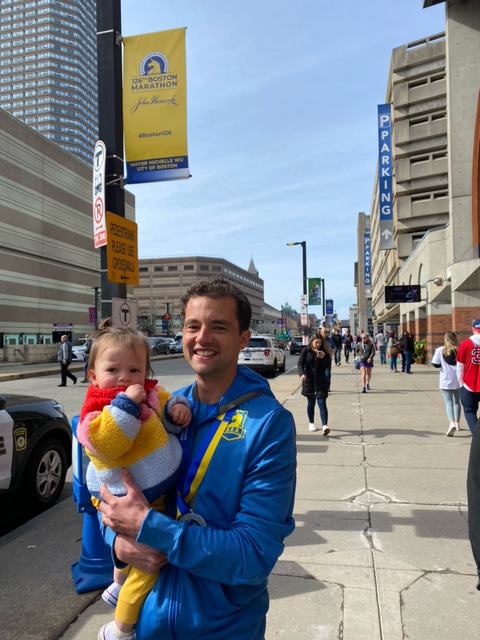
For six years the jacket hung in the back of my closet. It came with me from a subletted room in San Diego, to a condo shared with my sister in Gainesville, to my childhood home in Port Orange, to two apartments in Asheville, to our new home in a little town near Hendersonville, to, finally, a carry-on bag in Boston.
It’s a nice jacket: adidas, blue and yellow, lightweight. I paid $100 for it. It’d keep you warm on a cold run, or serve as something comfy and casual to wear anywhere. There have been countless times that it would have come in handy. I really liked this jacket.
For six years I refused to wear it.
I dropped out of the 2016 Boston Marathon. Around mile 15, after a decent start, I started wheezing: scratchy, clipped, labored breathing. I hadn’t had an asthma attack in years, but I convinced myself that this was one, or about to become one. I walked off the course, in tears, to the red medical tent, where nurses checked my vitals and gave me a phone to call whoever I needed to call to tell them my marathon was over. I then boarded a bus to the finish line in the city, next to other broken dreamers, riding on the highway past the iconic course where we were supposed to be running. I was embarrassed, and so, so sad.
When I got to the finish line, where thousands of other runners were experiencing perhaps the greatest running moment of their lives, a place of uncontainable joy and triumph, I sat alone on stone steps and cried. I called my parents.
“I —” my voice cracked. I could barely speak. “I—I had to drop out.”
They, and everyone else, were beyond understanding. You had to listen to your body, they said. It was the right call, they told me. Your body betrayed you, they assured me.
For a while, I believed them, and in moments when you’re physically vulnerable it’s natural to make decisions based on self-preservation. But I think what really happened was perhaps simpler, and harder to accept: I was scared.
At mile 15, my pace had fallen off, my legs were getting heavy, and I was in pain. I was scared of posting a slow time, of shuffling 11 more miles, of hurting for another 90 minutes. I panicked and walked off the course of the most famous footrace in the world.
For six years, memories of that decision, that unfinished race, haunted me. The jacket—a Boston Athletic Association logo-emblazoned hoodie I bought at the pre-race expo—became the physical manifestation of those demons. It was a symbol of my failure. Every time I caught a glance of it in the back of my closet, I was reminded of that day.
I made a pact with myself soon after that race: I would not put on the jacket until I crossed the finish line of the Boston Marathon.
In that time I, like most rudderless millennials in their early 20s, moved and grew and otherwise experienced life. In 2016 I was confused and directionless: After a mere eight months in my first real job, the one I spent at least four years, several internships, and many thousands of dollars preparing for, I decided I didn’t want to pursue it as a career. A month after I (kind of) ran Boston, I moved from a room in San Diego to a condo on the opposite side of the country to live with my sister and study to become a teacher. I was 23 and lost.
That inexperience, that lack of perspective, was reflected in the race. As soon as things went south that day, as soon as I became uncomfortable, I broke. I thought my (sure-to-be-slow) time was the most important thing that day; I thought I was bigger than Boston. I failed to realize that I was in the middle of the oldest, most famous, most glorious, marathon in the world. I didn’t think about the hundreds of thousands of men and women—the Salazars and Rodgerses and Switzers, of course, but also the everyday warriors who were running for something bigger than themselves, for love or loss or hope—who had spilled their (literal) blood, sweat, and tears on the undulating pavement below. I didn’t think about the men, 241 years earlier almost to the day, who had officially started a revolution near the course in Lexington and Concord, fighting and often dying for a country that didn’t yet exist. I didn’t know that the course was initially inspired by the ever-famous ride of Paul Revere to alert his countrymen that war was imminent. I didn’t think about how lucky I was to have the ability to run, to move as we were divinely designed, bipedal locomotion on a grand scale. I was simply upset that I was going to run 15 minutes slower than I hoped.
I vowed that my next time at Boston would be different.
In those intervening years, I found a calling, fell in love, moved again, got married, bought a house, lived through a pandemic, and, most significantly and life-alteringly, became a father to a persistent, strong, beautiful baby girl. This all made me tougher, instilled in me a valuable perspective about life and its waves. A bad race at Boston would suck; but what would suck even more is not having a job to pay the mortgage. Like most people, I was (am) a much stronger person than I was a year after graduating college.
The jacket transformed with me, evolving from a garment of shame to a training tool. Near the end of a 20-mile run a couple years ago, training for a Boston qualifier, I was struggling to keep the agreed-upon pace of 6:20 a mile to close the run. My best friend and training partner Jordan turned to me and snarled, “Think of Boston! Think of your jacket!” I caught up with him with a 6:17, and qualified for Boston a few weeks later with a 2:52 marathon, a new PR.
Before I left the house for another 20-miler last month, I was pissed. It was 6 a.m. and I forgot the time changed early that morning, so we lost an hour of sleep. I, like most runners, didn’t want to go run for two-plus hours while most of the world was sleeping. I opened my closet and peeked in the back: the silver lines on the jacket’s shoulder sleeves gleamed in the dark. Jordan and I met and ran one of our best long runs of the training cycle. I knew then that I could be only weeks away from wearing it for the first time.
Throughout training, I tried not to make the race bigger than it was: It was simply a marathon, 26 miles and 385 yards, just like the ones I’d run before. But I knew that was a lie. Despite growing up and recognizing that there are more important things than my marathon time, I knew that this time Boston represented something more. I knew that it was a shot at redemption, something elusive and rare: Many others never get one, and I wanted to cherish mine. I knew that it, like all races but even more significantly for Boston, was a chance to show my family, my friends, my wife, my 13-month-old daughter, myself that all of the sacrifices they and I made—the hours spent away running, the nightly old-man stretches, the neurotic, often annoying discussions of various anatomical maladies—had value. I knew that it was a way to show my fifth-grade students, who had sent me off with a gift basket and inspirational letters, that all of our talks about perseverance and priorities and life were not empty. I knew that it was an opportunity to show my daughter (or at least tell her when she’s old enough to understand) that sometimes the best thing to do when life kicks your ass is to lace up your trainers and head out the door for another 10-miler in the mountains. “If you fall from the horse,” as my favorite soccer coach put it, “the best thing you can do is go immediately back on it.” I wanted to show her that you should always get back on the horse.
So, yes, Boston was more than a race; it was Something Big; I knew I wouldn’t be the same after. I carried this weight throughout training and to the starting line, where, with the sound of the starter’s pistol, it was lifted, finally, into the brisk Massachusetts air—and I could simply run.
And for the first seven miles, clipping off 6:20 miles next to Jordan, surrounded by thousands of other runners and spectators, under the sun and a cloudless sky, it was perhaps the greatest running experience of my life. My legs felt light and smooth, my heart and lungs working together efficiently and effortlessly, and I thought, Could this be the day?
But it was a marathon, of course, and Boston is particularly relentless, unsparing with its combination of uphills and downhills, punishing those who start off too aggressively. By miles 9 and 10, the initial relief running provided had worn off, and the uncomplicated calculus of the marathon set in: I still had 16 miles to go. And then the wheels came off. My legs became suddenly heavy; each step required far more effort than before. An ill-timed knee/calf/hamstring injury, which had caused me to taper more aggressively than I wanted during the final weeks of training, flared: My right leg became tight and even heavier and began hurting with each step. I hit halfway in 1:24, perfectly on pace for my goal of sub-2:50, but I knew that it wasn’t going to last.
I reached the point, at the edge of Newton, one of the several small towns the course runs through, where I dropped out in 2016 because I was significantly off pace and hurting. Six years later, I found myself in nearly the exact same situation—cinderblock legs, slow pace, double-digit miles still to go—running in nearly the same exact scene—a dense, rowdy crowd oblivious to my hurting, cheering in front of red-brick buildings—and I thought to myself, This is what life comes to, isn’t it? These choices, these moments…
And I did what I told myself I’d do in the low moments. I kept running.
Or, more accurately, I shuffled. The 6s marking the miles on my watch quickly became 7s, then 8s (and even one 9). I moved over to the right side of the road, like a slow car on the highway, as no fewer than 1,500 runners passed me. My aspirations for a fast time vaporized; the race simply became about surviving and enjoying.
I told myself that I simply had an 11- or 9- or 7-mile run ahead of me, something I’d done countless times before, and this one was on a historic course with thousands of other people running next to me and Boston College students on the side of the road screaming “I SEE YOU, 2765!” (my bib number). When I reached mile 21, I told myself I simply had to run one more Friday Five, a quintessential college run with the boys, envisioning those runs in Chapel Hill as I ran in real time close to Boston.
Throughout it all, I tried to soak in the experience as much as possible, to do everything I failed to do last time, to continue seeing the forest among the trees. Boston was a celebration of running, and of life, and I didn’t want to let my pride interfere again. I found my family at mile 20 and stopped to kiss my daughter. I pumped up the crowd. I high-fived little kids and middle-aged women. I laughed at clever signs and nodded in appreciation to the people holding them. I talked to my twitching legs as they were about to cramp. I fought the urge to walk by telling myself to just make it to the next mile marker; I did this for at least seven miles. I saw, by random chance, a girl I graduated college with cheering on the side of the course, whom I hadn’t seen in seven years, and thought about how the world can be so vast—with runners around me from every U.S. state and 99 other countries—and yet so small. I sang to myself, talked to myself, listened to myself. I felt unapologetically alive.
As I entered Boston, where the energy from the crowd was a living, breathing, tangible thing, where you can feel its love like a punch, I smiled for 30 straight minutes. I was there, practically: three miles, a 5K, to go. Until then, in the back of my mind lived the fear, as much as I didn’t want to admit it, that I wasn’t going to finish again. For the first time in six years, I knew for a fact that I was.
The last mile was a spiritual experience. Despite peak cramping, I felt like I was floating, living out a surreal dream. The disappointment of six years ago seemed to melt away with every slow step. I followed the curves of the road, the sounds of the crowd, and entered the famous final stretch: Right on Hereford, left on Boylston…
The last 100 meters were a cacophony of noise and emotion. I told myself to enjoy every painful step, to remember these moments because it doesn’t get better than this. I thought, probably correctly, that this was how it was supposed to happen, a long, grinding struggle to the finish line, because if everything had gone my way that day, if my body had allowed me to keep clipping off the pace I intended to run, if I had never hurt and things had never gotten truly hard, then it all would have been too easy, too clean, not representative of the six-year journey that brought me there. No, it was supposed to be like this: I was supposed to be tested, as a matter of fact supposed to be tested in the exact same spot where I walked off crying last time, because the marathon cuts you to your unvarnished core to see, once and for all, what you’re made of. I passed that test, found out what was inside me, and let myself feel something I don’t usually allow: proud. Yes, despite being 20 minutes slower than I hoped, I was proud of myself and fine to admit it. If I were less dehydrated, I likely would have started crying.
But mostly I just ran, because that’s what this was all about, right?, that’s all this has ever been about, running and everything it’s brought you and changed in you, running along the dirt roads of your childhood as the neighbors told you they’d see you on TV in the Olympics one day, running on suburban streets and overgrown trails, running with your best friends through campus and with your daughter through the park, running through heartbreak and loss and joy and the ceaseless waves of life, running those final steps toward the finish line but knowing, deep down, that you’ll never stop running because it’s part of you forever.
As I crossed the finish line, I threw my hands in the air and let out a violent fist pump. There was a jacket I needed to find and then I would be on my way.
Afterword: Part of me was hesitant to write this because I didn’t want to make myself out to be some type of hero; there are far more impressive things than running a 3:10 marathon (like running a 1:59 marathon) and far more important things than running. But one of the beautiful things about the sport, and particularly Boston, is that everyone—from Scott Fauble, the top American this year with a time of 2:08:52, to the woman who finished in 5-plus hours being interviewed by the local TV station we were watching later that day—has a story that led them to the race, and I think the world is a richer place when people share them. So please know I did not write this for the back-pats and congratulations; I wrote it because it was something that meant a lot to me, even more than I initially thought. Thank you for reading, and thank you, Boston.
Join our mailing list!
Subscribe to the Essays of Dad newsletter, a weekly email with parenting stories, background on essays, book recommendations, and more.
 Essays of Dad
2 thoughts on “Boston, Finally.”